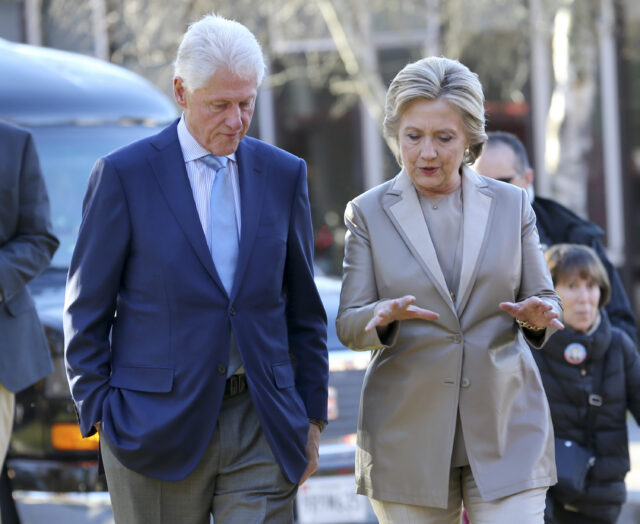
WASHINGTON — In a move that has ignited a firestorm on Capitol Hill, former President Bill Clinton and former Secretary of State Hillary Clinton have officially informed the House Oversight Committee that they will not comply with subpoenas to testify regarding their past ties to disgraced financier Jeffrey Epstein. The refusal, delivered via a blistering letter from their legal team, has prompted Committee Chairman James Comer (R-Ky.) to announce that he will initiate contempt of Congress proceedings as early as next week.
The escalation marks a significant chapter in the long-running investigation into the late sex offender’s high-profile social circle. While Bill Clinton’s friendship with Epstein in the late 1990s and early 2000s has been widely documented, both Clintons have consistently denied any knowledge of Epstein’s criminal activities. However, the committee’s renewed focus follows the recent release of thousands of pages of Justice Department files that included photos and flight logs connecting the former president to Epstein’s orbit.
The Legal Stand-off
In an eight-page letter addressed to Chairman Comer, attorneys for the Clintons characterized the subpoenas as “invalid and legally unenforceable.” They argued that the demand for closed-door depositions lacked a “valid legislative purpose” and represented an “unprecedented infringement on the separation of powers.”
“President and Secretary Clinton have already provided the limited information they possess about Jeffrey Epstein and Ghislaine Maxwell to the Committee,” the letter stated, referring to draft declarations previously submitted. The Clintons’ legal team further accused the committee of “politicizing a tragedy” and claimed the subpoenas were “nothing more than a ploy to attempt to embarrass” the former first couple.

Hillary Clinton’s spokesperson, Nick Merrill, took to social media to call the move “overtly political,” pointing out that several other former high-ranking government officials were subpoenaed but later excused from testifying after providing written statements. “The attempt to call the Clintons is a distraction and obfuscation campaign,” Merrill stated.
Bipartisan Pressure and Contempt Threats
Despite the Clintons’ protests, Chairman Comer emphasized that the subpoenas were issued with bipartisan support within the committee. Speaking to reporters on Tuesday after Bill Clinton failed to appear for his scheduled deposition, Comer remained firm.
“No one is accusing Bill Clinton of any wrongdoing. We just have questions,” Comer said. “Anyone would admit they spent a lot of time together. We have communicated with the Clintons’ legal team for months, offering them opportunities to choose a date, and they continue to delay.”
If the committee moves forward with a contempt vote next week, it would advance to the full House of Representatives. If passed there, the matter would be referred to the Department of Justice for potential criminal prosecution—a process that carries a maximum penalty of one year in prison and a fine of $100,000.
Context of the Investigation
The investigation is part of a broader effort by the House Oversight Committee to review the government’s handling of the Epstein case, including his 2019 death in federal custody. The probe has intensified as the Justice Department continues to release millions of pages of documents under the “Epstein Files Transparency Act,” a bipartisan law passed late last year.
The Clintons’ refusal comes at a time of heightened political tension. In their joint statement, the Clintons took aim at the Republican agenda, suggesting the committee was working harder to pass contempt charges than to discover the facts about the government’s role in the Epstein case. They noted that only two major figures—former Labor Secretary Alexander Acosta and former Attorney General William Barr—had been interviewed, while seven other former officials were allegedly “dismissed” from the same requirements.
Conversely, some Democrats on the committee have expressed a desire for cooperation. Sara Guerrero, a spokesperson for committee Democrats, noted that “cooperating with Congress is important” and urged both sides to continue working toward a resolution to obtain relevant information.
What Lies Ahead
The looming legal battle raises complex constitutional questions about the limits of congressional power to compel testimony from former presidents. While multiple former presidents have testified voluntarily before Congress in the past, the courts have rarely had to rule on a forced appearance.
As the deadline for Hillary Clinton’s scheduled testimony on Wednesday passes without her appearance, the focus shifts to the committee’s markup session next week. Whether the Department of Justice—currently under a different administration—would actually prosecute a former president for contempt remains a subject of intense legal debate.
For now, the standoff ensures that the shadow of the Epstein investigation will continue to loom over the political landscape well into 2026.
Sources
- The Guardian: Bill and Hillary Clinton refuse to testify in House Epstein investigation
- Associated Press (AP): Clintons refuse to testify in House Epstein probe as Republicans threaten contempt proceedings
- CBS News: Clintons refuse to testify in Epstein investigation as House Oversight GOP threatens to hold them in contempt
- House Committee on Oversight and Accountability: Chairman Comer: House Oversight Committee to Initiate Contempt of Congress Proceedings Against Former President Clinton
- People.com: Bill and Hillary Clinton Refuse to Testify in House’s Epstein Probe, Accepting They May Face Contempt Charges
- TIME: Clintons Refuse Subpoena in Epstein Inquiry
Disclaimer
The information contained in South Florida Reporter is for general information purposes only.
The South Florida Reporter assumes no responsibility for errors or omissions in the contents of the Service.
In no event shall the South Florida Reporter be liable for any special, direct, indirect, consequential, or incidental damages or any damages whatsoever, whether in an action of contract, negligence or other tort, arising out of or in connection with the use of the Service or the contents of the Service.
The Company reserves the right to make additions, deletions, or modifications to the contents of the Service at any time without prior notice.
The Company does not warrant that the Service is free of viruses or other harmful components