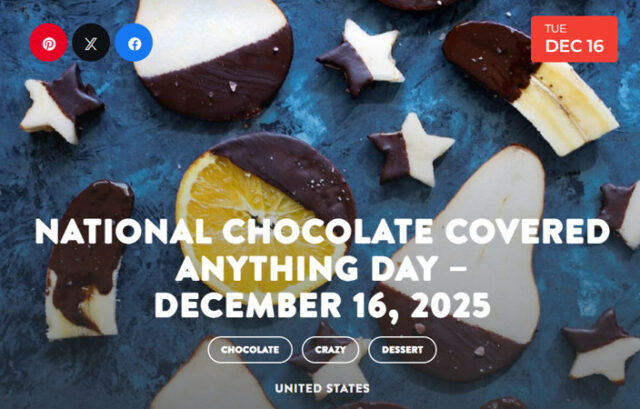
What do BBQ potato chips, strawberries, and ants have in common? On any ordinary day, not much. But on December 16, all three of these things —and thousands of others —could all be considered key ingredients in a creative culinary confection. Because on December 16, we’ll all be celebrating National Chocolate Covered Anything Day. This is the day you’ve been waiting for. All those times when you wondered, “What would this taste like dipped in chocolate?” can now officially be answered. Maybe you’re into the basics, like chocolate covered fruit or cookies, but you rarely take the time to dip these ingredients. Or, perhaps you’re a bit more adventurous and are looking to try out a new chocolate-encased dish. (French fries? Fish sticks?) Either way, December 16 is the perfect time to satisfy your craving for chocolate covered anything while getting into the holiday spirit.
- 1100 BC – Cacao has been cultivated for at least three millennia in Mexico, Central America, and Northern South America.
- 1502 – On the fourth visit of Christopher Columbus to the Americas, he presented cocoa beans to the Spanish Court.
- 17th Century – The first recorded “Death by Chocolate” case occurred in the 17th Century in Chiapas, Mexico. Upper-class Spaniards were addicted to chocolate and refused to adhere to a church dictated chocolate ban that forbade them from eating or drinking any food during the church services. As a result, the people of the town refused not only to listen to the ban but also chose to attend worship services in convents instead. The Bishop who passed the law was later found dead due to poison being mixed into his daily cup of chocolate.
- 1604 – The word chocolate was first recorded in English in 1604.
- 1647 – England’s first cup of chocolate was not brewed until 1647.
- 1700s – Long-stemmed sour ‘griotte’ cherries were layered with chocolate, with some of the local cherry brandy
- 1847 – Joseph Fry invented the first chocolate bar in Bristol, England
- 1929 – chocolate became Nestlé’s second biggest product.
- 1943 – Winston Churchill was in danger of a Nazi assassination by an exploding bar of chocolate.
- 1960 – Working in a small bakery, Lorraine Lorusso had the idea of dipping fresh strawberries in chocolate and selling them to customers.
- 1991 – According to Exclusive Chocolates, chocolate fountain machines were invented by Ben Brisman and popularized in 1991 by a Canadian company called Design & Realisation.
- 2007 – The Gourmet Chocolate Pizza Company began selling chocolate covered pizzas in the UK.
- 2012 – October 14 is annually observed as National Chocolate Covered Insects Day.
- 2013 – A study found that the smell of chocolate in a bookstore made customers 22% more likely to buy books of any genre and a whopping 40% more likely to buy cookbooks or romance novels.
- The word “chocolate” comes from the Aztec word, “Xocolatl”, which ironically means “bitter water”
- Americans eat an average of 22 pounds of candy each year or approximately 2.8 billion pounds annually which is split almost equally between chocolate and candy. Most Europeans consume far less than this.
- While the US produces the most chocolate and consumes the most pounds every year, the Swiss consume the most per capita, followed closely by the English.
- Chocolate manufacturers currently use 40% of the world’s almonds and 20% of the world’s peanuts.
- Brussels Airport is the world’s biggest chocolate seller, selling over 800 tons of chocolate a year.
- Chocolate is technically responsible for the microwave.
- Every Russian and American space voyage has included chocolate bars.
- Chocolate fountain machines are essential to covering anything and everything in chocolate.
- Chocolate covered strawberries are the first thing that comes to mind when you think of something covered in chocolate. And it’s not a surprise since it’s one of the tastiest and most requested desserts.
- Chocolate covered bacon: Many people enjoy the taste of bacon and chocolate.
- Try chocolate covered bell peppers, which the Huffington Post describes as “strangely delicious.”
- People spend more than 7 billion dollars a year on chocolate.
- Chocolate does not cause or aggravate acne, this is a myth.
- Dark chocolate is most popular among men.
- More than twice as many women as men eat and crave chocolate.
- The scientific name for the tree that chocolate comes from, Theobroma cacao, means “food of the gods.”
- 71% of American chocolate eaters prefer milk chocolate.
- While 75% of chocolate purchases are made by women all year long, during the days before Valentine’s Day, on Valentine’s Day 75% of the chocolate purchases are made by men.
- The average person will consume 10,000 chocolate bars in a lifetime.
- America consumes almost 50% of the world’s chocolate.
- The Aztecs once used cacao beans for currency.
- Hershey’s produces over 70 million chocolate Kisses every day
- Dark chocolate has been scientifically shown to be beneficial to human health. Milk chocolate, white chocolate, and other varieties are not.
- Women tend to prefer white chocolate, while men generally prefer bittersweet or dark chocolate.
- One chocolate chip can give a person enough energy to walk 150 feet. Need the energy to walk a mile? Consume just 35 chips.
- Hawaii is the only US state that grows cacao beans.
- In the original Psycho film, the blood in the famous shower scene was actually chocolate syrup.
- Chocolate is the only edible substance to melt around 93° F, just below body temperature causing it to melt easily on your tongue.
- More than twice as many women than men eat and crave chocolate.
Sources:
Mobile-Cuisine

Disclaimer
Artificial Intelligence Disclosure & Legal Disclaimer
AI Content Policy.
To provide our readers with timely and comprehensive coverage, South Florida Reporter uses artificial intelligence (AI) to assist in producing certain articles and visual content.
Articles: AI may be used to assist in research, structural drafting, or data analysis. All AI-assisted text is reviewed and edited by our team to ensure accuracy and adherence to our editorial standards.
Images: Any imagery generated or significantly altered by AI is clearly marked with a disclaimer or watermark to distinguish it from traditional photography or editorial illustrations.
General Disclaimer
The information contained in South Florida Reporter is for general information purposes only.
South Florida Reporter assumes no responsibility for errors or omissions in the contents of the Service. In no event shall South Florida Reporter be liable for any special, direct, indirect, consequential, or incidental damages or any damages whatsoever, whether in an action of contract, negligence or other tort, arising out of or in connection with the use of the Service or the contents of the Service.
The Company reserves the right to make additions, deletions, or modifications to the contents of the Service at any time without prior notice. The Company does not warrant that the Service is free of viruses or other harmful components.