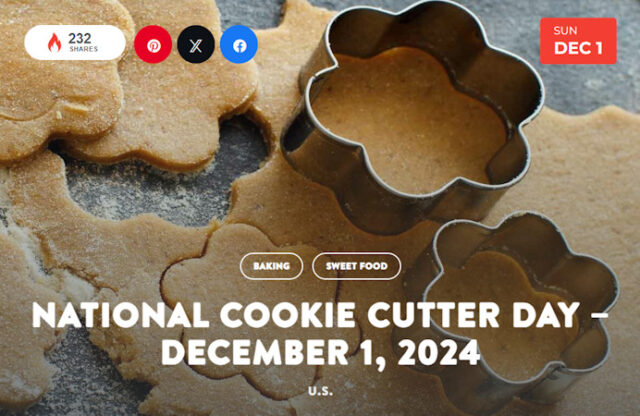
Becoming popular in the 16th century, when the gingerbread man made his way into the English court and then moved through to ordinary people, cookie cutters evolved into different shapes and sizes.
National Cookie Cutter Day comes around each year to remind people how valuable cookie cutters can be to their lives!
- 2000 BC – ceramic and wooden cookie cutters were used across Egypt
- 7th Century – Cookies are made in Persia as the country begins to harvest sugarcane.
- 16th Century – cookie cutters became popular, thanks to the popularity of the gingerbread pattern. Of course, the kings started this custom, and gingerbread cookies were frequently served at Queen Elizabeth I’s court.
- 1500s – Germans were baking small cakes into molds and designs, some of which were very intricate.
- 1800s – Cookie recipes are published in cookbooks. They are called ‘small cakes.’
- 1800s – Tin cookie cutters were readily available at any small shop.
- 1800s – Commercial machinery was developed in the United States and Europe, and manufacturers began creating and distributing cookie cutters
- 1875 – Alexander P. Ashbourne patented the first biscuit cutter in the United States
- 1902 – Animal Cracker launches its first commercial cookie.
- 1920s – The Girl Scouts begin selling cookies.
- 20th Century – Cookie cutters began being made from other materials, such as aluminum and plastic
- 2019 – Bobbi Barton established National Cookie Cutter Day in 2019 to recognize the value of cookie cutters in our lives.
- The National Cookie Cutter Historical Museum in Joplin, Missouri, houses an extensive collection of cookie cutters, preserving their history and showcasing their evolution.
- Antique and vintage cookie cutters can cost up to a few thousand dollars.
- Over two billion cookies are consumed every year.
- The chocolate chip cookie is the most popular in America.
- The average American eats 35,000 cookies in a lifetime.
- 3D printing technology enables personalized, intricate designs for cookie cutters.
- In Sweden, bakers use rosette irons to create delicate, lacy cookies called “struvor.”
- In India, “achappam” are flower-shaped cookies made using intricately designed irons, especially during festivals.
- Early cookie cutters featured religious symbols. As societies became more secular, designs expanded to include animals, vehicles, and pop culture icons, mirroring societal shifts and interests.
- In Greece, “kourabiedes” are almond cookies shaped using cutters, especially during Christmas.
- In Mexico, “buñuelos de viento” are fritters made with flower-shaped irons, highlighting the global culinary use of cookie cutters.
- Beyond baking, people use cookie cutters to craft ornaments, create unique candle molds, and even design custom stamps for arts and crafts, showcasing their versatility.
Sources:

Disclaimer
Artificial Intelligence Disclosure & Legal Disclaimer
AI Content Policy.
To provide our readers with timely and comprehensive coverage, South Florida Reporter uses artificial intelligence (AI) to assist in producing certain articles and visual content.
Articles: AI may be used to assist in research, structural drafting, or data analysis. All AI-assisted text is reviewed and edited by our team to ensure accuracy and adherence to our editorial standards.
Images: Any imagery generated or significantly altered by AI is clearly marked with a disclaimer or watermark to distinguish it from traditional photography or editorial illustrations.
General Disclaimer
The information contained in South Florida Reporter is for general information purposes only.
South Florida Reporter assumes no responsibility for errors or omissions in the contents of the Service. In no event shall South Florida Reporter be liable for any special, direct, indirect, consequential, or incidental damages or any damages whatsoever, whether in an action of contract, negligence or other tort, arising out of or in connection with the use of the Service or the contents of the Service.
The Company reserves the right to make additions, deletions, or modifications to the contents of the Service at any time without prior notice. The Company does not warrant that the Service is free of viruses or other harmful components.