The United States is entering a period of extreme meteorological volatility this week as three distinct weather stories collide. From the central plains to the Atlantic coast, a powerful weather pattern is set to deliver a “serious case of spring fever” alongside life-threatening severe weather and escalating flood risks. While parts of the central U.S. will welcome much-needed drought relief, the intensity of the incoming moisture—combined with unseasonable warmth in the Northeast—is creating a complex web of operational and safety hazards.
A Growing Flood Menace
The primary concern for meteorologists through the end of the week is the potential for significant flooding. A stalled frontal boundary is currently acting as a conveyor belt for moisture, stretching from the Mississippi Valley into the Ohio Valley. According to AccuWeather, “A stalled front will focus heavy rain from the Mississippi Valley into the Ohio Valley, spanning from parts of Missouri to West Virginia.”

Forecasters are keeping a close eye on rainfall totals, which are expected to average between 1 and 4 inches across the region. However, higher-intensity pockets could see much more. AccuWeather warns of a “Local StormMax™ of 7 inches” in the hardest-hit areas.
While the major arteries of the American river system, such as the Ohio and Mississippi, are currently sitting well below their historical average levels—meaning they have the capacity to absorb significant runoff—smaller systems are at high risk. Secondary rivers and small streams are expected to rise rapidly, particularly in areas where the terrain channels water quickly into narrow valleys.
The Weekend Expansion: Texas to the Ozarks
As we move into Friday and through Sunday, the flood risk is forecast to expand significantly southward and westward. The catalyst for this shift is a potent storm system emerging from the Southwest. Its interaction with moisture-rich air from the Gulf of Mexico will drench a corridor stretching from central Texas through the Ozark Mountains.
Widespread rainfall of 2 to 4 inches is the baseline forecast for the weekend, but localized totals could approach a staggering 12 inches. This poses a particular threat to the Texas Hill Country and the hilly terrain of the Ozarks. Saturated soils will no longer be able to absorb moisture, leading to rapid runoff.
The stakes are especially high for communities like Kerrville, Texas. Having previously been impacted by deadly flooding on July 4, 2025, the region remains hyper-vigilant. AccuWeather notes that “urban flooding, rapid small-stream rises, and transportation disruptions are likely in high-risk corridors,” emphasizing that the exact timing and peak impact will depend on the forward speed of the Southwest storm.
Severe Thunderstorms: The Threat of 80 MPH Winds
Parallel to the flooding threat is an escalating risk of severe weather. Starting Wednesday, the atmosphere over the central U.S. will become increasingly unstable. Residents from Texas to Indiana should prepare for multiple rounds of thunderstorms capable of producing large hail, damaging wind gusts, and tornadoes.
The initial round on Wednesday targets a broad swath from northeastern Texas into southern Illinois and Indiana. Meteorologists are particularly concerned about the potential for “damaging wind gusts, with an AccuWeather Local StormMax™ of 80 mph.”
By Thursday night, the “atmosphere will reload,” shifting the primary threat zone toward northwestern Texas and eastern Nebraska. While the tornado threat may be lower during this specific window, the risk of “damaging hail and wind” remains high enough for a “moderate risk” designation.
The most dangerous aspect of the weekend forecast may be the nocturnal nature of the storms. Repeated rounds of severe weather are expected to persist through Saturday night. As AccuWeather experts point out, “Repeated nighttime storms may heighten danger, especially if tornadoes develop after dark.” The combination of low visibility and high-speed winds creates a nightmare scenario for emergency management and local residents.
Record Warmth: A “Spring Fever” Surge
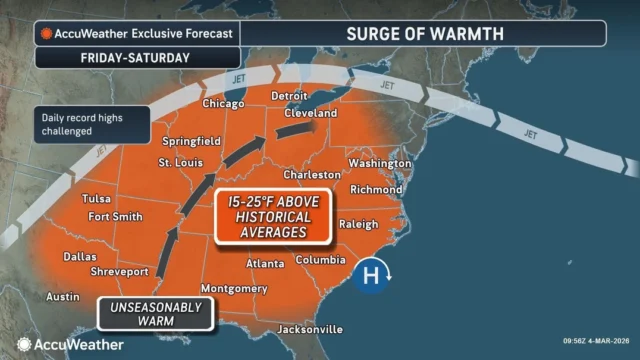
While the central U.S. battles wind and water, the Midwest and Northeast are preparing for a historic surge of warmth. Temperatures are forecast to climb 15 to 25 degrees above the historical average, marking the warmest conditions many cities have seen since last October.
“The pattern from late this week into the weekend will give tens of millions of people in parts of the Midwest and Northeast a serious case of spring fever,” says Matt Benz, AccuWeather Senior Meteorologist.
The numbers are startling for early March:
- Nashville: Forecast to hit 80°F by Friday for the first time this year.
- Atlanta: Expected to reach the low to mid-80s through Sunday, challenging long-standing daily records.
- Midwest: Widespread 60s and 70s are expected through Saturday.
In the Northeast, the warmup will be more gradual but still significant. New York City is expected to reach the mid-60s by Sunday—its warmest day since early November. However, this warmth comes with a hidden danger in the northern tier: melting snow and river ice. The sudden spike in temperature is raising “ice-jam flooding concerns” across parts of the Northeast, as frozen waterways begin to break up and move downstream.
Business and Operational Disruptions
The convergence of these weather events translates to significant real-world impacts. Beyond the immediate threat to life and property, the weather will likely cause:
- Transportation Delays: Flooded roadways and severe thunderstorms will impact major trucking routes and air travel hubs from Dallas to Chicago.
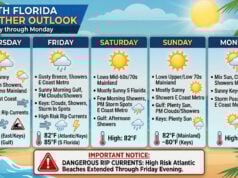
- Wildfire Risks: In Florida and parts of the Southeast, the pattern is notably different. A lack of rain combined with record warmth is building drought conditions, which AccuWeather warns will “elevate wildfire risk and the potential for widespread smoke,” affecting air quality and business continuity.
- Agricultural Uncertainty: While the rain provides much-needed relief to drought-stricken soils in the central U.S., the severity of the storms could damage infrastructure.
Looking Ahead
The window from Wednesday through Sunday represents one of the most active meteorological periods of the year thus far. The combination of “May-like warmth” and mid-winter moisture is a volatile mix.
While the major river basins may hold steady for now, the localized threats of flash flooding and 80 mph winds require immediate attention. Residents in the high-risk corridors—specifically from the Texas Hill Country to the Ohio Valley—should remain weather-aware, ensure they have multiple ways to receive warnings, and prepare for potential power outages or travel delays.
As the Southwest storm moves eastward, the exact timing of the heaviest rainfall will become clearer. For now, the message is one of preparation: the spring-like warmth may be a welcome reprieve, but it comes at a significant atmospheric cost.
Source: AccuWeather
Disclaimer
Artificial Intelligence Disclosure & Legal Disclaimer
AI Content Policy.
To provide our readers with timely and comprehensive coverage, South Florida Reporter uses artificial intelligence (AI) to assist in producing certain articles and visual content.
Articles: AI may be used to assist in research, structural drafting, or data analysis. All AI-assisted text is reviewed and edited by our team to ensure accuracy and adherence to our editorial standards.
Images: Any imagery generated or significantly altered by AI is clearly marked with a disclaimer or watermark to distinguish it from traditional photography or editorial illustrations.
General Disclaimer
The information contained in South Florida Reporter is for general information purposes only.
South Florida Reporter assumes no responsibility for errors or omissions in the contents of the Service. In no event shall South Florida Reporter be liable for any special, direct, indirect, consequential, or incidental damages or any damages whatsoever, whether in an action of contract, negligence or other tort, arising out of or in connection with the use of the Service or the contents of the Service.
The Company reserves the right to make additions, deletions, or modifications to the contents of the Service at any time without prior notice. The Company does not warrant that the Service is free of viruses or other harmful components.