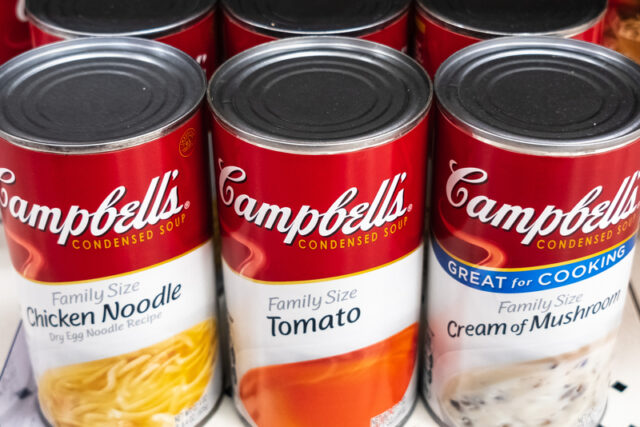
A day after Florida Attorney General James Uthmeier said that his office is investigating allegations that the Campbell’s Soup Co. uses bioengineered meat in their soups, the company is strongly denying that claim.
Uthmeier weighed in Monday following the release of comments made in a secret audio recording of a vice president of the company criticizing Campbell’s “bioengineered meat” and “chicken from a 3-D printer.”
“We have s*** for f***** poor people,” part of the recording said, as reported by WDIV Local 4 in Detroit. “Who buys our s***? I don’t buy Campbell’s products barely anymore. It’s not healthy now that I know what the f*******‘s in it. Bioengineered meat — I don’t wanna eat a piece of chicken that came from a 3-D printer.” (Elisions by Florida Phoenix)

Uthmeier seized on the media report.
“Florida bans lab-grown meat,” the attorney general posted on X Monday. “Our Consumer Protection division is launching an investigation and will demand answers from Campbell’s.”
When reached for comment, a spokesperson for Campbell’s directed the Phoenix to a newly created page on the company’s website that says: “The chicken meat used in Campbell’s soups come from long-trusted, USDA approved U.S. suppliers and meets our high-quality standards. Campbell’s does not use 3D-printed chicken, lab-grown chicken, or any form of artificial or bioengineered meat in our soups.”
Florida banned lab-grown meat in 2024
Florida became the first state in the country to ban the selling, manufacturing, or distribution of lab-grown or “cultivated meat” in 2024. Since then, six states have followed suit, according to the National Agricultural Law Center. The bill was sponsored by now-Florida Lt. Gov. Jay Collins in conjunction with the Florida Department of Agriculture.
“There are many concerns right here and, until we have those studies and there’s proof positive that this process is going to work, we want to ban this in the state of Florida because it’s just not there quite yet,” Collins told a Senate committee about the legislation.
The label on Campbell’s soups says that the company uses “bioengineered food ingredients,” but the company says that “[b]ioengineered food ingredients refers to genetically modified crops — canola, corn, soybean, sugar beets, etc. that are grown by the vast majority of American farmers. This language on our labels refers to ingredients derived from those crops, not chicken.”
Cultivated meat is animal meat (including seafood and organ meats) produced by growing animal cells directly. According to the Good Food Institute, cultivated meat is made of the same cell types that can be arranged in the same or similar structure as animal tissues, thus replicating the sensory and nutritional profiles of conventional meat.
While it’s been hailed by its supporters as better for the environment, a 2023 report from the University of California at Davis found that lab-grown or “cultivated” meat’s environmental impact is likely to be “orders of magnitude” higher than retail beef based on existing and near-term production methods.
Lawsuit
Upside Foods, one of two companies in the country authorized to sell cultivated meat, filed a lawsuit against the state after it banned its product, raising claims under the Commerce Clause and the Supremacy Clause of the U.S. Constitution.
In April of this year, Federal Judge Mark Walker threw out four parts of that lawsuit, but did not dismiss the suit outright, according to the Associated Press. Upside Foods argued the case before the U.S. Court of Appeals for the Eleventh Circuit earlier this month.
WDIV-TV in Detroit was the first station to report on the audio recording, which surfaced in a story about a former employee at Campbell’s, Robert Garza, who filed a lawsuit in Michigan. Garza claims he was fired after he complained about Campbell’s VP for Information Technology Martin Bally, who can be heard in a video released by the TV station blasting the quality of Campbell’s Soup and the people who buy it.
“We are proud of the food we make, the people who make it and the high-quality ingredients we use to provide consumers with good food at a good value. We know that millions of people use Campbell’s products, and we’re honored by the trust they put in us. The comments heard on the recording about our food are not only inaccurate — they are patently absurd.”
Campbell’s added that “the alleged comments heard on the audio were made by a person in IT who has nothing to do with how we make our food.”
Disclaimer
Artificial Intelligence Disclosure & Legal Disclaimer
AI Content Policy.
To provide our readers with timely and comprehensive coverage, South Florida Reporter uses artificial intelligence (AI) to assist in producing certain articles and visual content.
Articles: AI may be used to assist in research, structural drafting, or data analysis. All AI-assisted text is reviewed and edited by our team to ensure accuracy and adherence to our editorial standards.
Images: Any imagery generated or significantly altered by AI is clearly marked with a disclaimer or watermark to distinguish it from traditional photography or editorial illustrations.
General Disclaimer
The information contained in South Florida Reporter is for general information purposes only.
South Florida Reporter assumes no responsibility for errors or omissions in the contents of the Service. In no event shall South Florida Reporter be liable for any special, direct, indirect, consequential, or incidental damages or any damages whatsoever, whether in an action of contract, negligence or other tort, arising out of or in connection with the use of the Service or the contents of the Service.
The Company reserves the right to make additions, deletions, or modifications to the contents of the Service at any time without prior notice. The Company does not warrant that the Service is free of viruses or other harmful components.