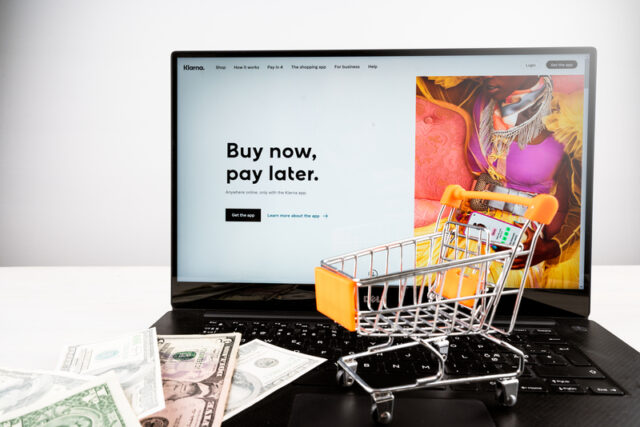
Have you bought now with plans to pay later this holiday season? The buy now, pay later (BNPL) industry — an installment lending approach that includes companies such as Affirm, Klarna and Afterpay — is enjoying rapid growth on top of rapid growth.
BNPL use was up 47 percent year-over-year on Black Friday and 43 percent on Cyber Monday this year, according to Adobe. Those are impressive figures, considering how much the industry has already surged in recent years. Affirm, for instance, grew its gross merchandise volume by 106 percent during its 2021 fiscal year, 87 percent in 2022 and 30 percent in 2023.
While the company’s growth rate has slowed, it makes sense for a fintech darling that has achieved significant scale in a relatively short period of time. Affirm facilitated more than $20 billion worth of transactions during its 2023 fiscal year that concluded at the end of June.
On Black Friday 2022, the Federal Reserve Bank of Atlanta estimated that BNPL was used in about 10 percent of all transactions. Based on the Adobe numbers, BNPL’s share was probably close to 15 percent this year.

How BNPL compares with credit cards
Buy now, pay later is still a nascent concept compared with the ubiquity of credit cards. Americans’ collective credit card balances add up to a staggering $1.08 trillion, the Federal Reserve Bank of New York reports.
In some respects, the lines are blurring, because Affirm and Klarna now offer debit cards which allow users to opt into installment loans, if they wish. And credit card issuers offer similar functionality through such programs as American Express Pay It, Plan It and My Chase Plan, available to cardholders who wish to separate certain purchases from the rest of their credit card charges.
Affirm founder and chief executive officer Max Levchin resists the comparison between traditional credit cards and the Affirm Card. “It should not be called a credit card, for sure, in part because it’s sort of the anti-credit card,” Levchin told CNBC. “You know exactly what you’re going to pay. You know exactly what the schedule for payment is and there will be no late fees under any circumstances, so I think it’s sort of the exact opposite in many ways. It does serve the same purpose: You get to pay for things right now or over time.”
Who is best suited for BNPL?
Buy now, pay later particularly appeals to people without much money and without a great credit score, since these short-term installment loans generally represent quick, easy access to credit. Even as consumer demand continues to surge, investors worry about BNPL lenders’ cost of funds as interest rates have risen, along with a potential surge in delinquencies if consumers get overextended or if a long-awaited recession hits.
Thus far, the much-feared tidal wave of delinquencies hasn’t materialized. Affirm’s delinquency rate actually fell during the most recent quarter due to underwriting adjustments, Barron’s reports. I still worry that the current surge in buy now, pay later usage is a bad sign for consumers.
After all, BNPL is still debt, even if it may feel gentler than making minimum payments on a credit card. The average credit card charges a record-high 20.72 percent. If you make $1,000 in holiday purchases and only make minimum payments at 20.72 percent, you could be in debt for 40 months and rack up $390 in interest charges. And that’s just on holiday debt. Almost half of credit cardholders already carry debt from month to month, according to a Bankrate survey.
The average American has a credit card balance of $6,088, TransUnion reports. If you make only minimum payments toward $6,088 at 20.72 percent, you’ll be in debt for 214 months and owe $9,063 in interest.
If possible, I believe the best approach is to use a credit card like a debit card — that is, pay in full to avoid interest, but take advantage of credit cards’ superior rewards programs and buyer protections. Credit card holders who pay in full get a grace period, too. Depending on when the purchase is made, it could be anywhere from three to eight weeks before the payment is due and the interest clock begins. That’s very similar to the classic buy now, pay later structure of four interest-free payments over six weeks.
That said, with almost half of credit card holders carrying debt from month to month, these consumers would be better off forgetting about rewards for now and focusing instead on paying that debt down (perhaps via a balance transfer card with a generous interest-free term).
The bottom line
I understand the appeal of buy now, pay later financing, especially if you already have a pricey credit card balance and you’re trying to avoid digging the hole any deeper. But make sure you’re not tricking yourself into overspending. Buy now, pay later may feel like a little bit of money here and a little bit there, but you can quickly run up a sizable tab — especially if you have multiple plans running at the same time.
I think the best scenario for a buy now, pay later plan is to partition a large purchase — such as a couch, or a TV, or a new set of tires — away from the rest of your finances, especially if you already have credit card debt. For instance, Affirm offers 12 months of interest-free Peloton Bike financing, and some longer-term plans charge as little as 4.99 percent APR. If this is a purchase you’re making anyway, a year of same-as-cash financing could represent a good deal. Even that 4.99 percent rate is a steal in the current interest rate environment (although we could question the wisdom of taking out any sort of debt for a four-figure discretionary purchase).
In summary, my best advice is to be careful, since some BNPL plans (especially the longer ones) have interest rates ranging all the way up to about 30 percent. It’s critical to examine your specific terms and consider how this purchase fits into your overall financial plan. It worries me that so many people are financing holiday gifts with plans to pay them off later. I think the holiday debt hangover could be especially potent this year.
Have a question about credit cards? Email me at ted.rossman@bankrate.com, and I’d be happy to help.
Disclaimer
Artificial Intelligence Disclosure & Legal Disclaimer
AI Content Policy.
To provide our readers with timely and comprehensive coverage, South Florida Reporter uses artificial intelligence (AI) to assist in producing certain articles and visual content.
Articles: AI may be used to assist in research, structural drafting, or data analysis. All AI-assisted text is reviewed and edited by our team to ensure accuracy and adherence to our editorial standards.
Images: Any imagery generated or significantly altered by AI is clearly marked with a disclaimer or watermark to distinguish it from traditional photography or editorial illustrations.
General Disclaimer
The information contained in South Florida Reporter is for general information purposes only.
South Florida Reporter assumes no responsibility for errors or omissions in the contents of the Service. In no event shall South Florida Reporter be liable for any special, direct, indirect, consequential, or incidental damages or any damages whatsoever, whether in an action of contract, negligence or other tort, arising out of or in connection with the use of the Service or the contents of the Service.
The Company reserves the right to make additions, deletions, or modifications to the contents of the Service at any time without prior notice. The Company does not warrant that the Service is free of viruses or other harmful components.