The smoke from “Operation Epic Fury”—the massive U.S. and Israeli air campaign launched on February 28, 2026—had barely cleared before the financial records of the weekend began to tell a story of immense, and sometimes suspicious, profit. As the conflict claimed the life of Iran’s Supreme Leader, Ayatollah Ali Khamenei, and effectively shuttered the Strait of Hormuz, the world watched in horror. However, in the high-stakes corridors of prediction markets, defense boardrooms, and energy trading floors, the “fog of war” was a window to a fortune.
From anonymous cryptocurrency traders netting half a million dollars in hours to defense contractors watching their backlogs swell to record highs, the “winners” of this conflict are emerging from the shadows.
The Digital Mercenaries: Prediction Market Windfalls
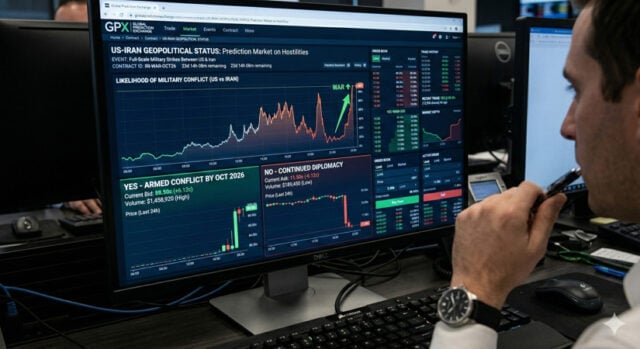
The most controversial profits have surfaced on decentralized prediction markets like Polymarket and Kalshi. As traditional stock exchanges remained closed over the weekend of the initial strikes, these platforms became the only way to speculate on—or hedge against—the outbreak of war.
The analytics firm Bubblemaps identified a cluster of six “suspected insider” wallets that accrued approximately $1.2 million in profit. These accounts were created and funded with cryptocurrency less than 24 hours before the military operation began. The timing was surgical: they purchased “Yes” shares on the contract “US strikes Iran by February 28, 2026?” just hours before the first Tomahawk missiles were launched.

Notable Speculators:
- “Magamyman”: This Polymarket trader became the face of the controversy, netting more than $553,000 by betting that Ayatollah Khamenei would be out of power. The trade concluded successfully after the Israeli-led strike killed the leader on Saturday.
- The Anonymous Cluster: One specific wallet in the Bubblemaps investigation turned a $60,816 investment into a $499,864 profit in a single day by betting on the February 28 deadline.
- “anoin123” (The Counter-Example): Not everyone won. One trader who had made $2 million betting against a conflict lost $6.5 million in a single day when the strikes commenced, proving that for every “insider” windfall, there is often a catastrophic loss on the other side of the ledger.
The “Security Supercycle”: Defense Giants at All-Time Highs
For the titans of the American military-industrial complex, the escalation in Iran represents the peak of what analysts are now calling the “Security Supercycle.” Even before the first bombs dropped, defense stocks were trading at 52-week highs, buoyed by the Trump administration’s $839 billion defense appropriation and record backlogs.
On Monday, March 2, as the rest of the S&P 500 struggled for direction, defense names surged:
- Lockheed Martin (LMT): Hit an all-time high of $666.51, up over 34% year-to-date.
- Northrop Grumman (NOC): Reached $736.87, driven by a record $95 billion backlog.
- RTX (formerly Raytheon): Reported a staggering $268 billion backlog, with its missile subsidiary increasing production of Patriot and AMRAAM systems by 20% to meet the demand of the Middle East buildup.
Investors are not just betting on the initial strikes; they are betting on the “maintenance tail.” Because modern weapon systems have 70% of their costs tied to long-term upkeep and software updates, companies like Boeing and Lockheed Martin have effectively turned war into a “subscription business.”
The Energy Arbitrage: Oil and the “Strait of Hormuz Premium”
The immediate economic victim of the strikes was the Strait of Hormuz, a maritime chokepoint through which 20% of the world’s oil passes. With traffic at a near-standstill due to Iranian retaliation and insurance risks, oil prices saw a “war premium” ignite.
By the close of Monday’s trading:
- Brent Crude surged nearly 7% to the high $70s, with some analysts at Barclays and Royal Bank of Canada warning of a spike toward $100 or $120 if the blockade persists.
- ExxonMobil and Chevron: These giants saw stock increases of 1.10% and 1.14%, respectively, as the prospect of higher global prices and increased domestic production became a reality.
- Natural Gas: Prices in European and Asian markets jumped 40% to 50% after Iranian drone strikes targeted QatarEnergy facilities, one of the world’s largest LNG producers.
Insider Trading Allegations and the Political Fallout
The speed and accuracy of the bets placed on Polymarket have sparked a firestorm in Washington. Senator Chris Murphy (D-Conn.) described the activity as “insane,” alleging that people close to the administration may be profiting from classified military timelines.
“People around Trump are profiting off war and death. I’m introducing legislation ASAP to ban this.” — Senator Chris Murphy
The controversy echoes a June 2025 incident where two Israeli army reservists were arrested for using classified info to bet on strikes during a 12-day skirmish with Iran. While the White House has denied any involvement, the proximity of Donald Trump Jr. to Polymarket—where his venture firm, 1789 Capital, is a major investor—has added fuel to the calls for regulation.
The “Safe Haven” Shift: Gold and Crypto
Beyond war and oil, the conflict triggered a massive flight to “safe haven” assets. Gold outperformed as a hedge against the “stagflationary” risks of the war (high inflation coupled with low growth).
Surprisingly, Cryptocurrencies also soared. On March 2, Bitcoin jumped over 5%, Ether over 6%, and Solana 6.6%. Investors are increasingly viewing digital assets as a hedge against the instability of traditional fiat currencies and the potential for government-imposed capital controls during global crises.
Sources and Links
- Janus Henderson Investors: What U.S. Strikes in Iran Mean for Markets
- Financial Standard: US and Israel strike Iran: What it means for investors
- The Guardian: US markets see-saw as investors keep close eye on Iran war
- Lombard Odier: US-Israel-Iran conflict: macroeconomic and investment scenarios
- NPR/WUFT: Trader ‘Magamyman’ made $553,000 on death of Iran’s supreme leader
- MarketWatch/Morningstar: Allegations of insider trading over prediction-market bets tied to Iran conflict
- The Block: Fresh accounts netted $1 million on Polymarket hours before US airstrikes
- Fintool News: Defense Stocks Hit All-Time Highs as Iran Tensions and Security Supercycle Converge
- BloombergNEF: Oil Can Hit $91 a Barrel in Late 2026 on Iran Disruption
Disclaimer
Artificial Intelligence Disclosure & Legal Disclaimer
AI Content Policy.
To provide our readers with timely and comprehensive coverage, South Florida Reporter uses artificial intelligence (AI) to assist in producing certain articles and visual content.
Articles: AI may be used to assist in research, structural drafting, or data analysis. All AI-assisted text is reviewed and edited by our team to ensure accuracy and adherence to our editorial standards.
Images: Any imagery generated or significantly altered by AI is clearly marked with a disclaimer or watermark to distinguish it from traditional photography or editorial illustrations.
General Disclaimer
The information contained in South Florida Reporter is for general information purposes only.
South Florida Reporter assumes no responsibility for errors or omissions in the contents of the Service. In no event shall South Florida Reporter be liable for any special, direct, indirect, consequential, or incidental damages or any damages whatsoever, whether in an action of contract, negligence or other tort, arising out of or in connection with the use of the Service or the contents of the Service.
The Company reserves the right to make additions, deletions, or modifications to the contents of the Service at any time without prior notice. The Company does not warrant that the Service is free of viruses or other harmful components.