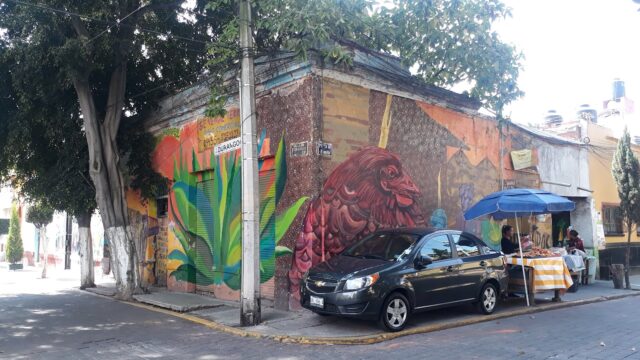
A tourist stands in the courtyard of the Secretaría de Educación Pública, neck craned upward at Diego Rivera’s murals.
She photographs the vibrant panels of workers, revolutionaries, and maize fields. Then she moves to the next wall, and the next, checking each image off her list.
I watch from the corner, clipboard in hand, and recognize the pattern. She sees paint. I see archaeology.
This is the gap that separates a visit from an understanding. Mexico City’s art does not begin with Rivera’s first brushstroke in 1923. It begins 700 years earlier, in the volcanic stone foundations beneath our feet, in the pigment recipes passed from Aztec priests to colonial artisans to modern muralists.

When I guide visitors through these spaces, I show them something most guidebooks miss: the city itself is a living excavation, and its art is the record of continuous cultural sedimentation.
Understanding the layers beneath the paint means understanding Mexico City. And that requires a different kind of looking. Mexico City welcomed over 14 million hotel visitors in 2023, surpassing pre-pandemic levels and showing off how travelers continue seeking cultural depth beyond surface attractions.
Why Art in Mexico City Begins Underground
The Templo Mayor sits at the heart of Centro Histórico, a pyramid excavated from beneath colonial buildings. When archaeologists uncovered it in 1978, they found more than architecture. They found design blueprints that would echo through centuries of Mexican art.
The Aztecs organized their visual world around cosmology. They painted cardinal directions in specific colors: red for east, blue for south, white for west, black for north.
They carved serpents and jaguars into stone with precise symbolic meaning. They used cinnabar, turquoise, and obsidian not just for beauty but for ritual power.
These choices did not disappear when Hernán Cortés arrived in 1521. They adapted. Indigenous artisans who built the Metropolitan Cathedral reused stones from the Templo Mayor.
They sculpted Catholic saints with the same attention to directional symbolism their grandparents had used for Huitzilopochtli. When you understand this continuity, you stop seeing colonial churches as European imports. You start seeing syncretic architecture, layers of belief pressed together like sediment.
By the 20th century, this archaeological consciousness became explicit. Rivera studied pre-Columbian codices before painting a single mural.
He knew that maize was not just a crop but the substance from which the gods created humanity. He knew that the sun represented not just light but cyclical time, death and rebirth. His murals do not reference Aztec imagery. They extend it.
For travelers who want to explore Mexico City through expert eyes, City Unscripted connects visitors with archaeologists, historians, and artists who uncover meaning beyond the canvas.
From Empire to Easel: 700 Years of Layered Expression
Mexico City’s artistic timeline moves through three major strata, each visible if you know where to dig.
The pre-Columbian layer reveals ritual symbolism encoded in stone and pigment. At the Museo Nacional de Antropología, you can see jade masks from Palenque and feathered shields from Tenochtitlan. It remains the most-visited museum in the country, attracting millions every year.
The color symbolism is precise. Turquoise meant water and fertility. Obsidian meant sacrifice and transformation. These were not decorative choices. They were theological statements.
The colonial layer shows what happens when two visual languages collide. In churches like Santa María Tonantzintla in nearby Puebla, indigenous artisans covered every inch of the interior with stucco figures.
Angels wear feathered headdresses. Vines twist into serpent forms. The European baroque style provided the structure, but the indigenous cosmology provided the content. This is not fusion. It is survival through adaptation.
The modern layer makes the connection explicit. Rivera, Orozco, Siqueiros, and Kahlo all studied indigenous art before developing their mature styles. Rivera spent years measuring pyramids and copying glyphs from codices.
Kahlo filled her paintings with pre-Columbian artifacts from her personal collection. Siqueiros used ancient Mexican color palettes mixed with modern industrial materials. They understood their work as continuation, not innovation.
The Mural as Modern Archaeological Site
At Palacio de Bellas Artes, I stand with visitors beneath Siqueiros’s “Nueva Democracia.” The central figure, a woman in a Phrygian cap, breaks chains as she rises. Most people photograph it and move on. I ask them to look at the layers.
Siqueiros applied paint in thick, sculptural strokes using industrial spray guns and synthetic polymers. Beneath the surface image of liberation, you can read his experimentation with materials that would last centuries, just as Aztec murals used mineral pigments that still glow today.
The woman’s red cap carries revolutionary symbolism, a recurrent liberation motif in Mexican art. Siqueiros was trained as an engineer. He thought in geological time.
At the Secretaría de Educación Pública, Rivera painted over 200 panels over four years. In one panel from the third floor, he depicts the Fiesta de Maíz.
Farmers carry stalks. Women grind kernels. At first glance, it looks like socialist realism celebrating agricultural labor. But when you understand Aztec cosmology, you see something else. Maize is not background. It is Centeotl, the maize god, and by extension, human flesh itself. Rivera painted theology disguised as politics.
The Polyforum Siqueiros, a 12-sided building covered inside and out with murals, functions as a walk-through archaeological site.
Each wall represents a different era of Mexican struggle: conquest, independence, revolution, modernization. Siqueiros designed it so visitors move chronologically through time, spiraling upward. The structure is a stratigraphic column, readable like any excavation.
When History Walks the Streets
Outside the museums, Mexico City’s streets offer their own excavations. In Tlatelolco, three eras literally overlap. The Plaza de las Tres Culturas contains an Aztec pyramid base, a colonial church, and a modern housing complex, all within 200 feet.
When I guide visitors here, I start with the stones. The church, Santiago Tlatelolco, was built in 1609 using blocks from the pyramid. You can see the joins where Spanish masonry meets Aztec limestone.
The UNAM Campus murals by Juan O’Gorman cover the Central Library’s exterior with stone mosaics depicting Mexican history from cosmic origins to the space age. O’Gorman used natural stones, just as pre-Columbian artists did, creating a work that is simultaneously modern and ancient.
The building, home to one of Mexico’s most important academic collections, opened in 1956, but most visitors photograph the exterior without entering. The disconnect between image and function tells you something about how we consume art.
In Centro Histórico, walking from the Zócalo toward Alameda Central, you pass through 500 years of building styles. Colonial balconies lean over Aztec drainage systems. Art Nouveau façades from the Porfiriato era sit next to brutalist government buildings from the 1960s.
Every layer tells a story about who held power and what they wanted to project. Echoes of ancient urban planning (like Teotihuacan’s axial logic) reappear as Mexico City is re-imagined across eras, layered over the colonial grid.
Contrast this with typical group tours that hit five murals in 90 minutes. You see paint. You do not see process. Experts who connect Teotihuacan’s urban planning to modern CDMX reveal patterns that transcend individual artworks.
The city did not evolve randomly. It grew through deliberate cultural choices, each generation building on the last.
Inside the Museums, Beneath the Surface
The Museo Nacional de Antropología is the most visited museum in Mexico City, attracting over 2.5 million visitors annually. Most tourists spend an hour in the Aztec room, then leave. That room is the endpoint of a 3,000-year timeline.
In the Gulf Coast room, Olmec heads carved from basalt show the same sculptural techniques later used by Aztec craftsmen. In the Oaxaca room, Zapotec glyphs reveal writing systems that influenced how Rivera and Siqueiros organized narrative across walls.
The museum is not a collection of artifacts. It is a diagram of artistic evolution, showing how techniques and symbols moved between cultures before Mexico was Mexico.
The Museo Anahuacalli, designed by Rivera himself, sits in the Coyoacán volcanic field. Rivera built it from volcanic stone to house his collection of pre-Columbian artifacts.
The building mimics a pyramid, dark and cool inside, with narrow windows that cast specific light on jade figurines and ceramic vessels. Rivera designed it as an educational tool. Each object is positioned to show its relationship to others, creating visual arguments about continuity and influence.
At the Museo Tamayo, contemporary artists respond directly to pre-Columbian forms. Rufino Tamayo himself spent decades studying ancient ceramics, incorporating their geometric abstraction into his paintings.
The museum, renovated in 2012, hosts rotating exhibitions that often pair modern works with archaeological pieces, making the dialogue explicit.
These museums function as research sites. Scholars use them to trace pigment chemistry across centuries, to map trade routes through shared motifs, to document how political power shapes artistic expression. For specialists, the difference between a tourist visit and a research visit is the ability to read objects as evidence, not decoration.
Why Expert Context Changes the Story
An archaeologist I work with tells visitors, “Every wall in Mexico City tells the story of what came before it.” That is not metaphor. It is stratigraphy. Buildings reuse stones. Artists reuse symbols. Politicians reuse myths. If you learn to recognize the patterns, the city becomes legible in a way most visitors never experience.
The benefit is not academic. It is experiential. When you stand in front of Rivera’s “Man, Controller of the Universe” at Palacio de Bellas Artes and recognize the Aztec calendar stone echoed in the central mechanism, the painting transforms from political propaganda to cultural archaeology.
When you walk through the Zócalo at dusk and understand that you are standing on the exact spot where Moctezuma’s palace once stood, the stones under your feet carry weight.
This kind of understanding supports sustainable tourism. Instead of racing through 12 murals for Instagram, you spend an hour with one, reading its layers. Instead of consuming Mexico City as a backdrop, you engage it as a living text. Instead of extracting images, you contribute attention.
The light at dusk over Templo Mayor turns the volcanic stone amber. Shadows pool in carved serpent mouths.
Nearby, in a second-floor room at the Secretaría de Educación Pública, Rivera’s panel of miners seems calibrated to late-day sun, catching the same angle of light that once lit the temple’s western face. The geometry appears deliberate. He painted with the sun in mind, as the Aztecs built with the sun in mind, as the city itself is oriented to celestial events.
[IMAGE: A Mexico City muralist restoring a section of the Secretaría de Educación Pública frescoes.]
Caption: Restoration work reveals the physical layers of Mexico City’s mural heritage.
Stand still long enough, and you see the layers. Beneath the paint, the city. Beneath the city, the temples.
Beneath the temples, the bedrock of an ancient lake. Everything here is built on something older.
And that, finally, is what Mexico City’s art teaches anyone willing to look carefully: nothing here is only surface.
Disclaimer
Artificial Intelligence Disclosure & Legal Disclaimer
AI Content Policy.
To provide our readers with timely and comprehensive coverage, South Florida Reporter uses artificial intelligence (AI) to assist in producing certain articles and visual content.
Articles: AI may be used to assist in research, structural drafting, or data analysis. All AI-assisted text is reviewed and edited by our team to ensure accuracy and adherence to our editorial standards.
Images: Any imagery generated or significantly altered by AI is clearly marked with a disclaimer or watermark to distinguish it from traditional photography or editorial illustrations.
General Disclaimer
The information contained in South Florida Reporter is for general information purposes only.
South Florida Reporter assumes no responsibility for errors or omissions in the contents of the Service. In no event shall South Florida Reporter be liable for any special, direct, indirect, consequential, or incidental damages or any damages whatsoever, whether in an action of contract, negligence or other tort, arising out of or in connection with the use of the Service or the contents of the Service.
The Company reserves the right to make additions, deletions, or modifications to the contents of the Service at any time without prior notice. The Company does not warrant that the Service is free of viruses or other harmful components.