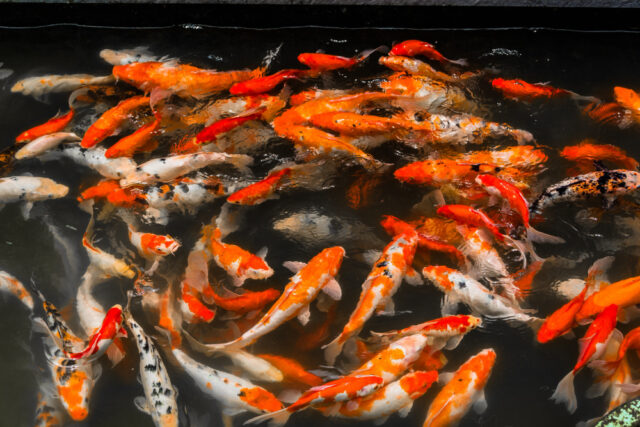
Koi keeping is both an art and a science that combines careful observation with practical husbandry. The practice traces back to Japan, where ornamental carp known as Nishikigoi were first developed through selective breeding. Farmers in the Niigata region noticed unusual color variations in common carp and gradually bred these fish to enhance their patterns, body shape, and coloration. Over generations, this process produced the distinct varieties of Nishikigoi recognized today, each shaped by decades of refinement and the aesthetic standards of Japanese breeders.
Each stage of development presents its own challenges, requiring adjustments in selection, evaluation, and daily care. According to Benjamin Hayt, successful koi development depends on monitoring several key factors throughout the fish’s growth. Genetics establish the foundation, while water quality and nutrition strongly influence how well a koi develops its body, skin quality, and coloration.
Stages of Koi Development
Koi produce very large numbers of eggs during spawning, often hundreds of thousands or more. As the fry are raised in mud ponds, breeders perform repeated hand selections during harvests, gradually narrowing hundreds of thousands of young fish down to thousands of juveniles, and eventually to a much smaller group with strong body shape, skin quality, and promising patterns.
Most koi reach peak growth between five and seven years of age, when body size, skin quality, and pattern balance come together. At this stage, koi often command their highest value because their development is largely realized while they still have many healthy years ahead. As koi age further, growth slows, and skin quality may gradually soften. While older koi can remain impressive and live for decades with proper care, their market value usually declines once they pass their physical peak.

Different varieties also develop at different rates. Well-known varieties include Kohaku, which display red markings on a white base; Taisho Sanke, which add black patterning to red and white; and Showa, in which black forms the base color with red and white layered over it. Varieties such as Shiro Utsuri display bold black-and-white contrast. In some koi, particularly Showa and Shiro Utsuri, the black pigment known as sumi may take several years to fully develop. Because of this, young koi often change significantly as they mature, and experienced keepers learn to judge both a fish’s current appearance and its future potential.
Core Traits for Evaluation
Body shape is the most important factor when evaluating koi because it determines how well the fish will develop as it matures. A high-quality koi should have a long, balanced frame with a broad head, thick shoulders, and a strong tail tube to support future growth. The body should carry depth through the midsection before tapering smoothly toward the tail. These structural traits indicate the potential for large size and proper proportions, which is why breeders focus heavily on bone structure, head size, and tail tube thickness when selecting young fish.
Scale structure and skin quality are also key indicators of long term potential. In Japanese terminology, the net-like appearance that develops between scales as a koi matures is called fukurin. When skin quality is strong, the scales sit evenly, and the slight separation between them becomes visible as the fish grows. This effect adds depth to the body and is most noticeable in large, mature koi with excellent skin.
Pattern ultimately determines how visually striking a koi appears, but it is one of the least reliable traits when selecting very young fish. Colors and markings often shift during early development, particularly in varieties where darker pigment emerges slowly. For this reason, early selection usually prioritizes body structure and skin quality over pattern alone. As koi mature, their colors stabilize, and the overall balance of the pattern becomes easier to judge, making older fish more predictable and therefore more valuable.
Environmental and Genetic Influences
Genetics establish the foundation for body shape, growth potential, and color stability. Over many generations, Japanese breeders refined specific traits through selective breeding, creating the bloodlines that define modern varieties. Some varieties naturally grow faster and larger than others. Chagoi and Karashigoi are well known for their rapid growth and ability to reach very large sizes, while Doitsu koi, which have scaleless bodies, tend to remain smaller on average. Understanding these genetic tendencies helps hobbyists anticipate how different varieties may develop.
Environmental conditions determine how much of that genetic potential is realized. Clean, stable water is essential for proper development. Effective koi ponds rely on mechanical filtration to remove debris and biological filtration to process waste through beneficial bacteria. Overstocking should be avoided because excess fish quickly degrades water quality.
Feeding practices also influence growth. Young koi benefit from smaller meals offered several times throughout the day, which supports steady growth and efficient digestion. Pond design also affects water quality. Bottom rocks and dense plantings are generally discouraged because they trap debris and uneaten food, leading to organic waste accumulation.
Water temperature strongly affects feeding behavior. In regions with seasonal changes, koi often feed heavily as water cools in the fall, building energy reserves before winter when their metabolism slows. During very warm summer periods, koi may feed less, as higher temperatures reduce dissolved oxygen levels. Stable conditions and consistent care allow koi to grow and develop properly over time.
Disclaimer
Artificial Intelligence Disclosure & Legal Disclaimer
AI Content Policy.
To provide our readers with timely and comprehensive coverage, South Florida Reporter uses artificial intelligence (AI) to assist in producing certain articles and visual content.
Articles: AI may be used to assist in research, structural drafting, or data analysis. All AI-assisted text is reviewed and edited by our team to ensure accuracy and adherence to our editorial standards.
Images: Any imagery generated or significantly altered by AI is clearly marked with a disclaimer or watermark to distinguish it from traditional photography or editorial illustrations.
General Disclaimer
The information contained in South Florida Reporter is for general information purposes only.
South Florida Reporter assumes no responsibility for errors or omissions in the contents of the Service. In no event shall South Florida Reporter be liable for any special, direct, indirect, consequential, or incidental damages or any damages whatsoever, whether in an action of contract, negligence or other tort, arising out of or in connection with the use of the Service or the contents of the Service.
The Company reserves the right to make additions, deletions, or modifications to the contents of the Service at any time without prior notice. The Company does not warrant that the Service is free of viruses or other harmful components.