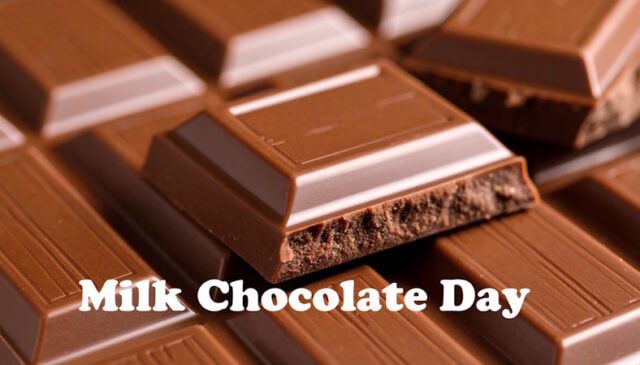
On July 28th dive into the ever-popular National Milk Chocolate Day. When it comes to chocolate, this sweet easily pleases.
- 1900 BC – The Olmec, one of the earliest civilizations in Latin America, turns the cacao plant into chocolate
- 1689 – While in Jamaica, Irish physician Hans Sloane adds milk to the ‘chocolate water’ to make it taste better and he brings his discovery back to England.
- Mid-17th Century – we’ve been adding milk to chocolate beverages since the mid-17th century.
- 1824 – Established in 1824 by John Cadbury in Birmingham, England, Cadbury is renowned for its dairy milk chocolate.
- 1828 – The Van Houten company in Amsterdam invents the cocoa pressing method to produce a light, fluffy chocolate powder that can be easily dissolved in water or milk.
- 1836 – Daniel Peter, the inventor of milk chocolate, was born in the village of Moudon, located in the Canton of Vaud, in beautiful, mountainous Switzerland in 1836.
- 1839 – The first known variation with donkey milk was developed by Jordan & Timaeus.
- mid-1800s – Spain introduced milk chocolate to Europe for the first time in the 1600s and the first commercial milk chocolate bars were produced by Cadbury’s in England in the mid 1800s.
- 1845 – Lindt is famous for its smooth-melting ‘Lindor’ truffles and high-quality chocolate bars, offering a range of luxurious milk chocolate options.
- 1852 – Domenico Ghirardelli in San Francisco, California, Ghirardelli is one of the oldest chocolate companies in the United States.
- 1875 – Swiss chocolatier Daniel Peter adds dried milk powder to chocolate to create milk chocolate.
- 1894 – Founded in 1894 by Milton S. Hershey in Hershey, Pennsylvania,
- 1926 – Pierre Draps, Godiva Chocolatier is known for its premium Belgian chocolates, including exquisite milk chocolate truffles and pralines sold worldwide.
- Solid chocolate, when combined with either powdered, liquid or condensed milk, is known as milk chocolate. While candy bar makers use milk chocolate to make their most popular candy bars, the treat isn’t the healthiest of the chocolates.
- More than 50 percent of adults in the US prefer chocolate to any other flavor.
- Americans eat 2.8 billion pounds of candy annually. About half of it is chocolate.
- The word chocolate comes from “Xocolatl,” the Aztec word that means “bitter water.”
- The overall taste of milk chocolate is altogether lighter and sweeter than dark chocolate, and its texture is softer.
- Hershey’s is the largest milk chocolate producer in the US.
- Research supports that chocolate can be enjoyed as part of a balanced, heart-healthy diet and lifestyle.
- The average serving of milk chocolate has about the same amount of caffeine as a cup of decaf coffee.
- Studies have demonstrated that one of the major saturated fats in chocolate does not raise cholesterol like other hard fats–meaning chocolate can be enjoyed in moderation.
- Chocolate comes from a fruit tree; it’s made from a seed.
- Benjamin Franklin sold chocolate in his print shop in Philadelphia.
- The Aztec emperor Montezuma drank 50 cups of cacao a day from a golden chalice.
- Champagne and sparkling wines are too acidic to pair well with milk or dark chocolate. Try pairing a sweet bubbly with white chocolate and red wine with dark. In general, you want to match the sweetness level of the wine with the sweetness level of the chocolate.
- It is said that chocolates have more than 500 flavors available, while wine has just about 200.
- Hot Chocolate Was The First Chocolate Treat, Not The Bars. Cocoa was brewed in both Aztec and Mexico; however, it wasn’t anything like the hot chocolate we get nowadays. It was primarily a bitter concoction that was often enjoyed during weddings and other occasions.
- Remember the famous shower scene in Alfred Hitchcock’s Psycho that assumed cult status among movies belonging to the psychological horror-thriller genre? Well, the blood that was shown in that scene was nothing but chocolate syrup!
- Increases heart health: The antioxidants in dark chocolate have been shown to lower blood pressure, reduce the risk of clotting and increase blood circulation to the heart, thus lowering the risks of stroke, coronary heart disease and death from heart disease.
- Balances the immune system: Flavonols prevent the immune system from going into overdrive and reduce oxidative stress, which is an imbalance caused by cells fighting against free radicals and a common cause of many diseases.
- Combats diabetes: Epicatechin protects cells, makes them stronger and supports the processes that help the body to use insulin better, which might prevent or combat diabetes.
- Improves brain function: Flavonols in dark chocolate have a positive impact on brain function, including better reaction time, visual-spatial awareness and stronger memory. Though research is ongoing, one reason for this may be that flavonols increase blood flow to the brain.
- Boosts athletic performance: The epicatechin in dark chocolate increases nitric oxide production in the blood, which supports circulation and reduces the oxygen an athlete uses during moderately intense exercise. This allows the athlete to maintain workout intensity for longer.
- Reduces stress: People who ate dark chocolate reported feeling less stressed, and researchers confirmed that cortisol levels decreased after eating dark chocolate. This may be related to dark chocolate’s effects on heart health, since stress is a risk factor for cardiovascular disease.
Sources:

Taste Essence
Disclaimer
Artificial Intelligence Disclosure & Legal Disclaimer
AI Content Policy.
To provide our readers with timely and comprehensive coverage, South Florida Reporter uses artificial intelligence (AI) to assist in producing certain articles and visual content.
Articles: AI may be used to assist in research, structural drafting, or data analysis. All AI-assisted text is reviewed and edited by our team to ensure accuracy and adherence to our editorial standards.
Images: Any imagery generated or significantly altered by AI is clearly marked with a disclaimer or watermark to distinguish it from traditional photography or editorial illustrations.
General Disclaimer
The information contained in South Florida Reporter is for general information purposes only.
South Florida Reporter assumes no responsibility for errors or omissions in the contents of the Service. In no event shall South Florida Reporter be liable for any special, direct, indirect, consequential, or incidental damages or any damages whatsoever, whether in an action of contract, negligence or other tort, arising out of or in connection with the use of the Service or the contents of the Service.
The Company reserves the right to make additions, deletions, or modifications to the contents of the Service at any time without prior notice. The Company does not warrant that the Service is free of viruses or other harmful components.