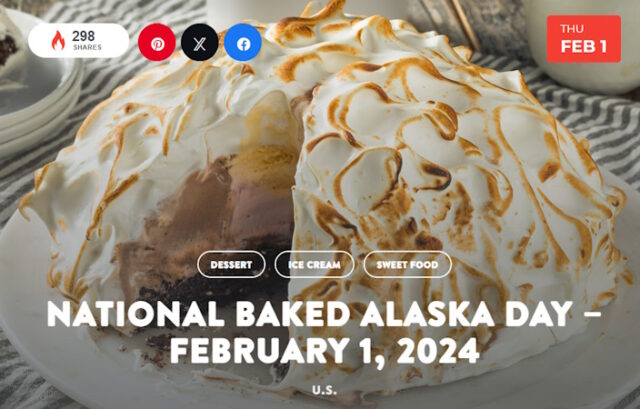
Ice cream and cake come together on February 1st in a celebration called National Baked Alaska Day.
- 1802 – Early versions of Baked Alaska appeared in 1802. President Thomas Jefferson was the first president to serve ice cream at a state banquet in the White House. Jefferson requested the ice cream to be served encased in a hot pastry.
- 1804 – American physicist Benjamin Thompson (Count Rumford) – who invented several cooking devices, including the double boiler and coffee percolator – was curious about the resistance of beaten egg whites to heat. What he discovered was a new dessert, naming it ‘omelette surprise.’
- 1850s – ice cream ‘bombes’ – uniquely shaped molds filled with creamy custard before frozen – and meringue-encased desserts were popular at teas and formal dinners.
- 1855 – Aunt Mary’s 1855 cookbook, The Philadelphia Housewife, was the first to feature a baked meringue, including ‘Apples aux Pommes’ and ‘Baked Alaska Apple Pie.’
- 1866 – Although it was already a popular dish, claims about its genesis continued to be made. In 1866, French food writer Baron Leon Brise stated it was French chef Balzac who introduced the dessert to France
- 1867 – An earnest debate erupted over the potential purchase of Alaska from Russia. Secretary of State William Seward agreed to a purchase price of $7 million, and Alaska became a United States territory in 1868. Those of the opinion that the purchase was a giant mistake referred to the purchase as “Seward’s Folly.”
- 1876 – Charles Ranhofer, the chef at Delmonico’s Restaurant in New York City. Capitalizing on the heated controversy surrounding the purchase in the frozen north, Baked Alaska fit the bill. It was cold, nearly frozen and quickly toasted in a hot oven before serving.
- 1895 – It was popularized worldwide by Jean Giroix, the chef in 1895 at the Hotel de Paris in Monte Carlo
- 1959 – Alaska’s statehood was confirmed when it was admitted into the Union.
- 2005 – As part of its “Lick Global Warming” campaign, in 2005, Ben & Jerry’s protested the drilling in the Arctic National Wildlife Refuge by whipping up the world’s largest Baked Alaska. The dessert weighed 1,140 pounds and measured 4 feet tall and 4 feet around, with the help of 3,600 four-ounce scoops of Ben & Jerry’s Fossil Fuel ice cream, 90 pounds of cake and 150 pounds of marshmallow cream.
- This dessert is also called omelette á la norvégienne, Norwegian omelette, omelette surprise, and glace au four (ice cream in oven).
- Early versions of this dessert used pie crusts instead of meringue.
- Baked Alaska was originally named Alaska Florida when it was first invented by Chef Charles Ranhofer of Delmonico’s restaurant, in New York City.
Sources:

National Today
Disclaimer
Artificial Intelligence Disclosure & Legal Disclaimer
AI Content Policy.
To provide our readers with timely and comprehensive coverage, South Florida Reporter uses artificial intelligence (AI) to assist in producing certain articles and visual content.
Articles: AI may be used to assist in research, structural drafting, or data analysis. All AI-assisted text is reviewed and edited by our team to ensure accuracy and adherence to our editorial standards.
Images: Any imagery generated or significantly altered by AI is clearly marked with a disclaimer or watermark to distinguish it from traditional photography or editorial illustrations.
General Disclaimer
The information contained in South Florida Reporter is for general information purposes only.
South Florida Reporter assumes no responsibility for errors or omissions in the contents of the Service. In no event shall South Florida Reporter be liable for any special, direct, indirect, consequential, or incidental damages or any damages whatsoever, whether in an action of contract, negligence or other tort, arising out of or in connection with the use of the Service or the contents of the Service.
The Company reserves the right to make additions, deletions, or modifications to the contents of the Service at any time without prior notice. The Company does not warrant that the Service is free of viruses or other harmful components.