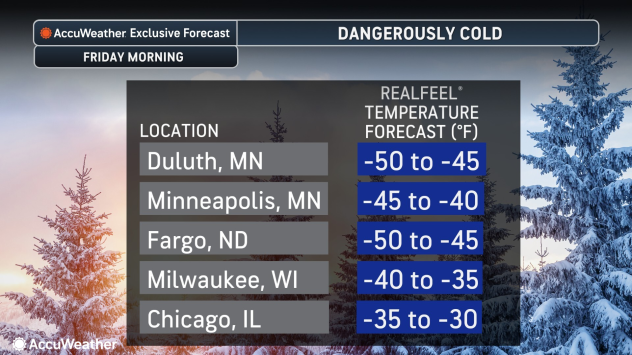
The most punishing cold of the winter season is preparing to descend upon a vast swath of the United States. According to the latest forecasts from AccuWeather, an immense mass of Arctic air currently gathering in northern Canada is set to surge southward and eastward later this week, threatening to shatter records and bring daily life to a frigid standstill for dozens of states.
Meteorologists warn that this isn’t just a standard winter chill; it is a high-impact weather event that could see RealFeel® Temperatures plummeting to as low as 50 degrees below zero in the most severely affected regions. The surge is expected to surpass the bitter cold experienced earlier this winter, moving through the Plains, gripping the Midwest, and eventually reaching as far south as Texas and deep into the Eastern Seaboard.
A Brutal Temperature Freefall
The heart of the Arctic outbreak will hit the Midwest and Northern Plains hardest starting Friday. Cities like Minneapolis are bracing for high temperatures that may remain in the double-digits below zero, while Chicago is expected to struggle to even reach the zero-degree mark. These temperatures represent a staggering departure of 10 to 40 degrees below historical averages for late January.

“This is the coldest air of the season so far,” says Alex Sosnowski, AccuWeather senior meteorologist. “The intensity of this air mass is significant, and the duration of the sub-freezing temperatures will put a massive strain on infrastructure and energy grids.”
As the cold front advances, energy demand is projected to skyrocket. Experts estimate that between 100 and 200 million people will be forced to turn up their thermostats simultaneously, testing the resilience of utility providers from the Dakotas down to the Gulf Coast.
Life-Threatening Conditions
The primary concern for officials is the “dangerously cold” air. When factoring in wind speeds, the AccuWeather RealFeel® Temperatures are expected to be 10 to 30 degrees lower than the actual thermometer readings. At 50 below zero, frostbite can occur on exposed skin in as little as five to ten minutes.
The risk of hypothermia and shock is extreme for anyone caught outdoors without specialized gear. Furthermore, the extreme cold poses a significant cardiovascular risk, as the body works overtime to maintain core temperatures, potentially leading to heart failure in vulnerable individuals. Residents are being urged to check on elderly neighbors and ensure that pets are brought indoors.
Infrastructure at Risk
For homeowners, the impending freeze is a final warning to insulate pipes. In Southern states, where homes are often not built to withstand sustained sub-freezing temperatures, the risk of bursting pipes is particularly high. The situation is further complicated by a massive southern storm system expected to track alongside the cold front. This storm could bring a combination of snow, sleet, and freezing rain to the Southern Plains and Appalachians.
If freezing rain leads to significant ice accumulation on power lines and trees, prolonged power outages could result. The combination of a blackout and sub-zero temperatures creates a “worst-case scenario” for emergency management teams, as residents would be left without primary heating sources during the peak of the Arctic surge.
Great Lakes and Travel Hazards
The cold will also have a dramatic impact on the Great Lakes. Currently, ice cover is below historical averages, but the upcoming deep freeze is expected to cause rapid ice growth, potentially pushing coverage above average within days. While this may eventually reduce lake-effect snow by “capping” the moisture source, the immediate transition will be dangerous.
Before the lakes freeze over, the clash of Arctic air and relatively warmer water will trigger intense snow squalls. These “whiteout” conditions can develop in seconds, creating treacherous travel on major highways. Already, a 100-vehicle crash has been reported in the region due to deteriorating conditions, and officials are advising against non-essential travel as the main Arctic front arrives.
As the week progresses, the “preview” of cold currently felt in the Northeast will be replaced by the true Arctic core. With millions in the path of this historic chill, meteorologists’ message is clear: prepare now, as the most dangerous days of winter are officially arriving.
Sources: Video and Images by AccuWeather
Disclaimer
Artificial Intelligence Disclosure & Legal Disclaimer
AI Content Policy.
To provide our readers with timely and comprehensive coverage, South Florida Reporter uses artificial intelligence (AI) to assist in producing certain articles and visual content.
Articles: AI may be used to assist in research, structural drafting, or data analysis. All AI-assisted text is reviewed and edited by our team to ensure accuracy and adherence to our editorial standards.
Images: Any imagery generated or significantly altered by AI is clearly marked with a disclaimer or watermark to distinguish it from traditional photography or editorial illustrations.
General Disclaimer
The information contained in South Florida Reporter is for general information purposes only.
South Florida Reporter assumes no responsibility for errors or omissions in the contents of the Service. In no event shall South Florida Reporter be liable for any special, direct, indirect, consequential, or incidental damages or any damages whatsoever, whether in an action of contract, negligence or other tort, arising out of or in connection with the use of the Service or the contents of the Service.
The Company reserves the right to make additions, deletions, or modifications to the contents of the Service at any time without prior notice. The Company does not warrant that the Service is free of viruses or other harmful components.