The eastern half of the United States is currently locked in the jaws of a life-threatening Arctic outbreak that is paralyzing recovery efforts and heightening the danger for hundreds of thousands of residents living without power. Following a weekend of historic ice and snow that stretched from the Southern Plains to New England, meteorologists are now sounding the alarm for a secondary coastal storm that could strike the Atlantic Seaboard by this weekend.
A “Dangerous Stretch” for the Nation
The current weather pattern is being described as one of the most volatile of the decade. According to AccuWeather Director of Forecasting Operations Carl Erickson, the country is facing a compounding crisis.
“This is a dangerous stretch of winter weather for the eastern half of the nation,” Erickson said. “The combination of extreme cold and back-to-back winter storms in the span of a week raises the risk of widespread and costly disruptions for millions of people.”
This “one-two punch” of weather systems has left infrastructure vulnerable. While the first storm has exited the coast, it has pulled a massive reservoir of Arctic air behind it, dropping temperatures to levels rarely seen in the Deep South.
Extreme Cold: The Immediate Threat
As of the afternoon of January 27, 2026, the focus has shifted from falling precipitation to the sheer brutality of the cold. Arctic air has firmly gripped regions from Texas to Georgia—areas that are still reeling from the weekend’s severe ice storm.

The primary concern for officials is the slowing of the recovery process. Typically, southern ice storms are followed by a quick thaw, but this event is different.
“The bitter cold is increasing the risk of hypothermia for people who are still without power and heat after the storm. This relentless stretch of bitter cold is slowing down work to restore power and clear icy roads in the hardest-hit communities,” Erickson explained. “Ice often melts within a day or two after most southern ice storms. That’s simply not happening with this Arctic air locked in.”
Current Impact Summary (as of Jan 27, 2 p.m. ET)
- Power Outages: More than 500,000 customers remain without electricity.
- Hardest Hit States: Tennessee, Mississippi, Louisiana, Texas, Kentucky, Georgia, South Carolina, and Virginia.
- Temperature Anomalies: 15 to 30 degrees below historical averages across 18 states.
- Economic Toll: AccuWeather experts estimate the total damage and economic loss at $105 billion to $115 billion.
The Economic and Human Cost
The sheer scale of the disruption is reflected in the preliminary damage estimates. The $105 billion to $115 billion figure accounts for:
- Damage to homes and businesses from burst pipes and fallen trees.
- Major disruptions to the national supply chain and shipping hubs.
- Significant losses in tourism and retail.
- Extensive damage to the power grid and public infrastructure.
The human cost is even more pressing. In many southern communities, the “freeze-thaw” cycle is not occurring. Instead, the limited melting that occurs during the day refreezes immediately at sunset, creating a “black ice” nightmare for utility crews. Nighttime lows are expected to dip into the teens and single digits in areas where residents are huddling in homes without heating.
Record-Breaking Cold Reaches Florida
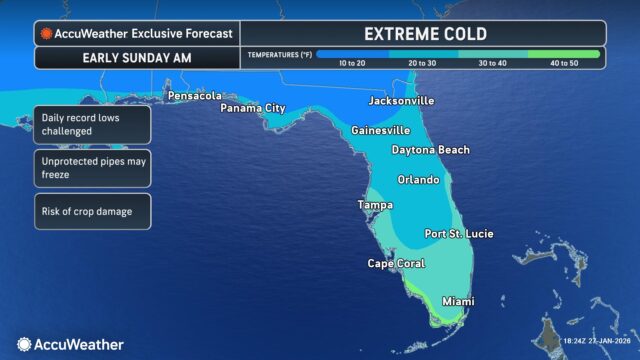
The cold front is showing no signs of slowing down. AccuWeather forecasters warn that the core of the Arctic air will surge even deeper into the Southeast. By Sunday, subfreezing temperatures are forecast to reach parts of central Florida.
Residents in these regions are urged to prepare for “unprotected pipe” bursts and significant damage to agricultural crops. This cold-air reinforcement is expected to arrive just as the next storm system begins to organize.
The Next Threat: A Strengthening Coastal Storm
The reprieve for the East Coast will be short-lived. AccuWeather expert meteorologists are tracking a powerful storm expected to develop near the Southeast coast between Friday and Saturday.
“There is an increasing risk for a rapidly strengthening coastal storm this weekend,” Erickson warned. “Communities along the East Coast still digging out and cleaning up from last weekend’s storm could be hit again with more snow.”
What to Expect This Weekend:
- Snowfall: Potential for heavy snow from the Carolinas through New England.
- Wind: Damaging gusts that could trigger a fresh round of power outages.
- Coastal Threats: High risks of coastal flooding and beach erosion, made worse by “astronomically high tides.”
- Drifting: Strong winds may cause massive snowdrifts from the previous storm’s accumulation, further blocking secondary roads.
While the exact track of the storm will determine the specific “snow-rain line,” experts agree that the immediate coast from the Carolinas to southern New England faces the greatest risk of significant accumulation by Sunday.
Staying Safe
With the potential for back-to-back outages and record-breaking cold, officials are urging citizens to check on elderly neighbors and ensure they have adequate non-electric heating sources. The combination of ice-laden trees from the previous storm and the high winds of the incoming system creates a “precarious situation” for the regional power grid.
As Arctic air remains locked in, meteorologists’ message is clear: the winter of 2026 is far from over, and the coming days will be a critical test of the nation’s resilience.
Source: AccuWeather
Disclaimer
Artificial Intelligence Disclosure & Legal Disclaimer
AI Content Policy.
To provide our readers with timely and comprehensive coverage, South Florida Reporter uses artificial intelligence (AI) to assist in producing certain articles and visual content.
Articles: AI may be used to assist in research, structural drafting, or data analysis. All AI-assisted text is reviewed and edited by our team to ensure accuracy and adherence to our editorial standards.
Images: Any imagery generated or significantly altered by AI is clearly marked with a disclaimer or watermark to distinguish it from traditional photography or editorial illustrations.
General Disclaimer
The information contained in South Florida Reporter is for general information purposes only.
South Florida Reporter assumes no responsibility for errors or omissions in the contents of the Service. In no event shall South Florida Reporter be liable for any special, direct, indirect, consequential, or incidental damages or any damages whatsoever, whether in an action of contract, negligence or other tort, arising out of or in connection with the use of the Service or the contents of the Service.
The Company reserves the right to make additions, deletions, or modifications to the contents of the Service at any time without prior notice. The Company does not warrant that the Service is free of viruses or other harmful components.