As the calendar turns from March to April 2026, millions of residents across the Eastern United States are preparing for a dramatic shift in weather patterns. After a period of atmospheric volatility, a sustained surge of spring warmth is forecasted to take hold, bringing temperatures that feel more like late May or early June to a broad swath of the country. According to a detailed report from AccuWeather, this upcoming surge follows a brief but sharp late-week cooldown that will remind many that winter’s grip has not entirely loosened. However, the overarching story for the start of April is one of record-challenging heat and a significant northward shift in the jet stream that will redefine the outdoor experience for everyone from baseball fans to spring breakers.
The Immediate Transition: A Meteorological Rollercoaster
Before the warmth settles in for the long haul, the atmosphere is staging one last dramatic act of thermal variance. As March winds down, a “potent cold front” is sweeping across the central and eastern regions, leading to what meteorologists describe as a temperature “yo-yo.” The contrast is stark: regions that experienced record-breaking highs on Thursday are seeing those gains erased within 24 hours.
In the wake of this southward-sagging front, temperatures are expected to plummet between 10 and 40 degrees Fahrenheit in a single day. AccuWeather highlights the dramatic swing in St. Louis, where a record-breaking high of 95 degrees on Thursday will be followed by a high only in the mid- to upper 50s on Friday. This type of thermal whiplash is common during the transition months, yet the scale of this particular drop is notable. Similarly, Oklahoma City will see its 92-degree peak on Thursday transition into the upper 50s by Friday afternoon. This rapid cooling serves as a prelude to the more stable warming pattern that will emerge as the first full week of April commences.

The Southeast Heat Surge: Record Highs on the Horizon
The most intense warmth is concentrated in the Southeastern United States. AccuWeather senior meteorologist Alex Sosnowski reports that “long-lasting warm air is forecast to surge into the Southeast during early April with highs in the 80s F.” This is not a fleeting afternoon of sunshine but a persistent pattern anchored by a shift in the jet stream.
By the end of the current week, a piece of the massive “heat dome” that has dominated the Western United States for the past ten days will break off and migrate eastward. This will result in the highest temperatures of the year so far for several major metropolitan areas. Atlanta is forecasted to reach 87 degrees, while Raleigh, North Carolina, could hit 90. Charlotte is projected to see a high of 91 degrees. These temperatures are well above historical averages for late March and early April, challenging records that have stood for decades.
For residents in these areas, the sudden jump into the 90s serves as an early introduction to the humidity and intensity of the southern summer. While the heat will be a welcome change for those tired of the damp chill of early spring, it also brings concerns regarding air quality and the rapid onset of the pollen season, which often peaks during these sustained warm spells.
Meteorological Mechanics: The Jet Stream and High Pressure
The engine behind this significant warming trend is a fundamental realignment of the atmospheric “steering currents.” According to AccuWeather’s analysis, the jet stream—the high-altitude river of air that dictates storm paths and temperature boundaries—is expected to shift significantly northward across the Eastern United States next week.
Simultaneously, a strong area of high pressure is expected to build along or just off the southern Atlantic coast. This configuration acts as a “block,” preventing cooler Canadian air from dipping southward while simultaneously pumping warm, moist air from the Gulf of Mexico and the tropical Atlantic into the interior of the continent.
A stronger version of this specific pattern was responsible for the intense heat dome that plagued the West earlier in the month. As this high-pressure ridge lingers along the Carolina coast, it will not only drive temperatures up but also influence moisture levels. In Florida, this high pressure will push moisture westward, potentially bringing sporadic showers to a state that has been “the driest in decades.” However, these showers may be too limited to provide substantial relief to the worsening drought conditions currently affecting the peninsula.
Regional Breakdown: From the Mississippi Valley to New England
While the Southeast takes the brunt of the heat, the warmth is expected to be widespread. The “surge of spring” will extend into the Mississippi and Ohio valleys, the Catskills, West Virginia, and potentially the mid-Atlantic coast.
The Midwest and Ohio Valley: The transition into this warm pattern is not without its hazards. Severe weather threatens the corridor from Missouri through Ohio. Fans attending MLB Opening Day in cities like Chicago, St. Louis, and Cincinnati are urged to monitor local forecasts closely. AccuWeather warns that severe thunderstorms could spoil the festivities as the warm air clashes with the departing cold front. Once the front clears, however, these regions will enjoy a multi-day stretch of temperatures running well above historical averages.
The Mid-Atlantic and Northeast: The forecast for the Northeast remains slightly more complex. While the potential for warmth exists as far north as southern New England, it is contingent on the position of a secondary cold front. If this front remains to the north, residents from the Appalachians to the coast can expect several days of pleasant, spring-like conditions. However, a southward push of that front could keep the most intense warmth confined to the Mason-Dixon line and points south.
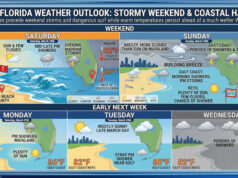
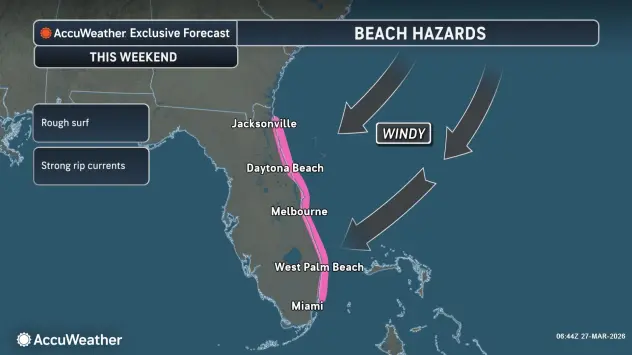
Florida and the Gulf Coast: For spring breakers and vacationers heading to Florida, the weather report is a mix of sunshine and caution. While the temperatures will be inviting, the onshore winds generated by the Atlantic high pressure will create “gusty winds, rough surf, and dangerous rip currents along Atlantic beaches.” Swimmers and boarders are advised to exercise extreme caution, as the pleasant air temperatures can mask the hazardous conditions of the water.
Looking Ahead: The First Full Week of April
As the first full week of April unfolds, the warmth is expected to be “long-lasting.” This suggests that the pattern is not a one-off event but a semi-permanent shift for the early part of the month. AccuWeather notes that where “strong April sunshine persists for several hours and strong onshore winds are limited, temperatures should climb well into the 80s over a broad area.”
This sustained warmth will likely accelerate the blooming of spring foliage across the Mid-Atlantic and Southeast. In Washington D.C., for example, the peak bloom of the cherry blossoms is expected to occur very soon, driven by these above-average temperatures. However, a front is likely to advance from the Plains late next week and into the first full weekend of April. This system carries the potential for another round of severe thunderstorms and perhaps widespread heavy rainfall, marking the end of the initial warm surge and the transition into a more active spring storm pattern.
The Broader Climate Context
This April warm surge occurs against a backdrop of significant climatic anomalies. March 2026 has already seen heat waves smashing 149-year-old records in seven states. The rapid transition into summer-like heat in the East is a continuation of a trend toward more extreme seasonal swings.
Furthermore, AccuWeather has already released its 2026 Atlantic hurricane season forecast, predicting 11 to 16 named storms. While the hurricane season does not officially begin until June 1st, the early development of high-pressure ridges and the warming of Atlantic waters—both of which are occurring now—are factors that meteorologists track closely when assessing the potential for tropical activity later in the year. The current drought in Florida, described as the worst in decades, adds another layer of complexity to the regional climate story, as the lack of early spring rainfall makes the state more vulnerable to wildfires before the tropical moisture arrives.
Summary and Safety Recommendations
The transition into April will be defined by a dramatic “surge of spring warmth” that will impact millions. Key takeaways from the AccuWeather report include:
- A major temperature swing: Expect a 10-40 degree drop late this week before the massive warmup begins.
- Record-challenging heat: Highs in the upper 80s and low 90s are expected in the Southeast (Atlanta, Raleigh, Charlotte).
- Severe weather risks: The Midwest and Ohio Valley must stay alert for thunderstorms, especially during high-profile events like MLB Opening Day.
- Coastal hazards: Florida beachgoers should be wary of dangerous rip currents despite the warm air.
- Drought concerns: Florida continues to see limited rainfall benefits, heightening fire risks.
For those planning outdoor activities, home maintenance, or travel during the first week of April, staying informed is critical. Utilizing the AccuWeather app for hyperlocal alerts can provide the necessary lead time to seek shelter during severe storms or to adjust plans based on the extreme heat. As the jet stream continues its northward trek, the “April Fool’s” nature of spring weather will be on full display, swinging from record heat to severe storms in a matter of days.
Sources:
Disclaimer
Artificial Intelligence Disclosure & Legal Disclaimer
AI Content Policy.
To provide our readers with timely and comprehensive coverage, South Florida Reporter uses artificial intelligence (AI) to assist in producing certain articles and visual content.
Articles: AI may be used to assist in research, structural drafting, or data analysis. All AI-assisted text is reviewed and edited by our team to ensure accuracy and adherence to our editorial standards.
Images: Any imagery generated or significantly altered by AI is clearly marked with a disclaimer or watermark to distinguish it from traditional photography or editorial illustrations.
General Disclaimer
The information contained in South Florida Reporter is for general information purposes only.
South Florida Reporter assumes no responsibility for errors or omissions in the contents of the Service. In no event shall South Florida Reporter be liable for any special, direct, indirect, consequential, or incidental damages or any damages whatsoever, whether in an action of contract, negligence or other tort, arising out of or in connection with the use of the Service or the contents of the Service.
The Company reserves the right to make additions, deletions, or modifications to the contents of the Service at any time without prior notice. The Company does not warrant that the Service is free of viruses or other harmful components.