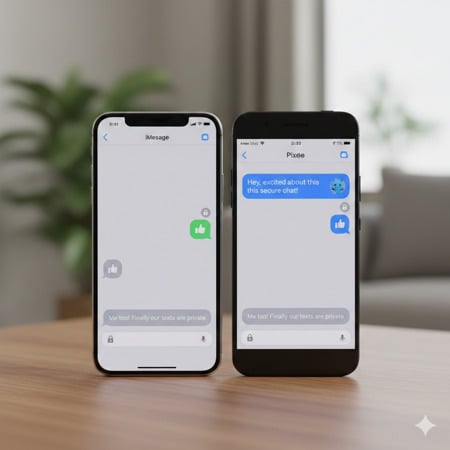
For over a decade, the “Green Bubble vs. Blue Bubble” war has been about more than just aesthetics and social status; it has been a significant security liability. While iPhone-to-iPhone (iMessage) and Android-to-Android (Google Messages) chats have long enjoyed end-to-end encryption (E2EE), the bridge between them was built on the shaky, decades-old foundation of SMS. That is finally changing.
As reported by LifeHacker, Apple has officially begun testing end-to-end encryption for RCS (Rich Communication Services) messages between iOS and Android devices. This move marks the final “missing piece” in the quest for a modern, secure messaging standard that works regardless of which smartphone you choose to carry.
The Security Loophole That Wouldn’t Close
When Apple first integrated RCS support in late 2024, it was hailed as a revolutionary step. Suddenly, iPhone users could send high-resolution photos to Android users, see typing indicators, and receive read receipts. However, the initial rollout used the standard RCS “Universal Profile,” which lacked a unified, cross-platform encryption layer.
As LifeHacker explains, “The biggest omission, however, is support for end-to-end encryption (E2EE). This is arguably the most important advantage RCS has over SMS.” Without E2EE, messages traveling between an iPhone and an Android device were technically readable by carriers or potentially interceptable by bad actors. While better than SMS in every functional way, it was still a security “green zone” in a world that increasingly demands privacy.

The current update, appearing in the latest developer betas of iOS 26.4, finally addresses this. By leveraging the GSMA’s RCS Universal Profile 3.0 and the Messaging Layer Security (MLS) protocol, Apple is creating a handshake with Android devices that locks the “digital tube” from sender to receiver.
Quoting LifeHacker: Why This Matters
The significance of this update cannot be overstated. For years, privacy-conscious users were forced to abandon their native messaging apps in favor of third-party platforms like Signal or WhatsApp just to ensure their cross-platform conversations were private.
LifeHacker notes the relief this brings to the average user: “If a hacker were to remotely access your messages from an untrusted device, they wouldn’t be able to read them: The only way to see these messages in plain text is to have access to the trusted device associated with them.”
This change effectively levels the playing field. For the first time, a user can rest easy knowing that a message sent from an iPhone to a Pixel or a Galaxy device is just as secure as one sent to another iPhone. As LifeHacker puts it, “You can rest easy knowing your messages are protected by end-to-end encryption,” provided both parties are on the supported software.
How the New Encryption Works
The technical wizardry behind this involves the “Universal Profile 3.0.” Previously, Google implemented its own encryption for Android-to-Android RCS, but because it wasn’t part of the official industry standard, Apple couldn’t (or wouldn’t) adopt it. Apple insisted on waiting for a standardized version that worked for everyone.
With the release of iOS 26.4 Beta 2, that standard is being put to the test. When an iPhone user on the beta sends a message to an Android user (also running the latest Google Messages beta), the two devices negotiate a secure key. From that point on, the message is scrambled before it ever leaves the device and is unscrambled only when it reaches the recipient.
The Catch: It’s Still a “Beta” World
While the news is groundbreaking, it comes with a significant caveat. This feature is currently limited to the developer and public beta cycles. Apple has been uncharacteristically transparent about the timeline, stating in its release notes that “This feature is not shipping in this release and will be available to customers in future iOS, iPadOS, macOS, and watchOS 26 releases.”
LifeHacker warns eager users against jumping into the beta just for this feature: “Beta software is in testing, which means there may be bugs and other instabilities you aren’t used to dealing with in iOS… I never recommend installing betas on your primary device.”
Furthermore, the “handshake” requires both sides to be on the cutting edge. If you are on the iOS beta but your Android friend is using an older version of Google Messages, the conversation will fall back to standard, unencrypted RCS. You’ll know the encryption is active when you see a specific “encrypted” label or a lock icon within the chat interface.
The End of the “Green Bubble” Stigma?
While the bubbles remain green—Apple is unlikely to ever give up its signature blue branding for iMessage—the functional and security differences are evaporating. Beyond encryption, the new RCS standards are expected to fix other lingering annoyances, such as broken group chats, erratic emoji reactions (tap-backs), and the inability to properly edit or unsend messages across platforms.
For the average consumer, this means the choice of a phone no longer dictates the safety of their data. Whether you’re a “blue bubble” enthusiast or an Android power user, your private conversations will finally stay that way.
Looking Ahead
As Apple prepares for the full public rollout of iOS 26.5 or 27, the mobile industry is nearing a historic milestone: the death of the unencrypted text message. Once this protocol moves out of beta and into the pockets of millions of users worldwide, the “dark ages” of SMS will finally be behind us.
Apple’s move to secure RCS is a rare moment of industry-wide cooperation. By working with the GSMA and even its rivals, Google and Apple are proving that while the competition for your wallet remains fierce, the protection of your privacy can—and should—be a shared goal.
As LifeHacker aptly concludes, “Perhaps the best thing to happen to smartphones in the past five years was Apple’s decision to start supporting RCS.” Now that encryption is finally on the table, that statement is truer than ever. We are moving toward a future where “just sending a text” doesn’t mean leaving the door unlocked.
Source: LifeHacker
Disclaimer
Artificial Intelligence Disclosure & Legal Disclaimer
AI Content Policy.
To provide our readers with timely and comprehensive coverage, South Florida Reporter uses artificial intelligence (AI) to assist in producing certain articles and visual content.
Articles: AI may be used to assist in research, structural drafting, or data analysis. All AI-assisted text is reviewed and edited by our team to ensure accuracy and adherence to our editorial standards.
Images: Any imagery generated or significantly altered by AI is clearly marked with a disclaimer or watermark to distinguish it from traditional photography or editorial illustrations.
General Disclaimer
The information contained in South Florida Reporter is for general information purposes only.
South Florida Reporter assumes no responsibility for errors or omissions in the contents of the Service. In no event shall South Florida Reporter be liable for any special, direct, indirect, consequential, or incidental damages or any damages whatsoever, whether in an action of contract, negligence or other tort, arising out of or in connection with the use of the Service or the contents of the Service.
The Company reserves the right to make additions, deletions, or modifications to the contents of the Service at any time without prior notice. The Company does not warrant that the Service is free of viruses or other harmful components.