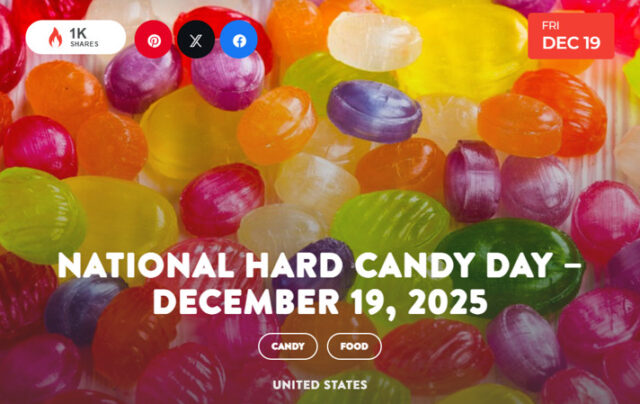
A favorite of young and old alike, National Hard Candy Day on December 19th, recognizes the sweet tooth in all of us.
- 15th Century – Crystallized sugar candy was being prepared and sold in countries rich in sugar cane.
- 17th Century – Hard candy became popular in the seventeenth century as sugar prices fell. Previously, hard candy was something that only the well-to-do could afford.
- 1800s – By the mid-1800s, over 400 companies were manufacturing this popular treat.
- 1844 – John Millar started a bakery in Leith and shortly after, started producing liquorice and blackcurrant hard candy.
- 1880 – Rock candy enjoyed great popularity as a cough-cold remedy and delicious confection. In addition, vast amounts were used in salons. Every bar had its own creation of rock and rye to “cure their patrons’ colds” or at least make them forget they had a cold in the first place. Prohibition was not kind to the rock candy industry and of the original manufacturers, only Dryden & Palmer remains today.
- 1900s – In the Subcontinent (Now partitioned as India and Pakistan), Chikkis became a popular hard candy, with molten sugar mixed with various dry fruit.
- 1946 – A pharmacist invented the first candy-making machine to crank out candy lozenges.
- 1949 – Bill and Dorothy Harmsen founded the Jolly Rancher company. Getting its start in Golden, Colorado, the company sold ice cream, candy, and chocolate at local stores. The fun fact here comes in the name. Since these tasty hard candies were created in the west, Bill wanted them to represent the spirit of the people. The name, “Jolly Rancher,” was chosen to connote a “hospitable western company.”
- 1985 – Sour Patch Kids, a modern candy staple, went through many name changes before landing on its current moniker. Initially, the colorful candies were called Sour Group Kids. Then, the manufacturer changed the name to Mars Men. Finally, in 1985, the sweets settled on their current name. “Sour Patch Kids” was meant to be evocative of the super-popular Cabbage Patch Kids taking the ’80s by storm.
- 2012 – The “World’s Largest Lollipop” weighed 7,003 pounds and was created by Sees Candy on July 18, 2012 in Burlingame, California. That’s the weight of more than 11 grizzly bears, 3.5 Clydesdale horses, or more than one BMW 7 series!
- 2015 – Jolly Rancher surpassed Werther’s Original as the best-selling hard candy. Other popular hard candies include Dum-Dum Pops, Life Savers, Tootsie Roll Pops, and Charms Blow Pops.
- Less than two percent of the calories in the American diet are supplied by candy.
- Germans consume twice as much candy as Americans.
- 65% of American candy bars were introduced more than 50 years ago
- The actual flavor of circus peanuts is banana
- 200 million Skittles are produced each day.
- The sucker’s “mystery” flavor is always a mix of two flavors. It’s created when the machine switches to producing a new flavor.
- Americans over 18 years old consume 65 percent of the candy produced each year.
- Some candies, such as lollipops, candy canes, gummy bears, gum drops, licorice twists, and sour balls are free of fat and cholesterol, making them a healthier treat than many people realize.
- Americans eat 25 pounds of candy per person per year. The people of Denmark eat more, 36 pounds of candy per person, per year.
- A lollipop, which was invented by George Smith in 1908, was named after Lolly Pop, a racing horse.
- Pop Rocks create their signature fizz and “explosion” thanks to a simple recipe of sugar, corn syrup, and a pressurized secret ingredient: carbon dioxide.While the candy is still hot during production, it is infused with the gas at high pressure. As the candy cools and hardens, it traps tiny CO₂ bubbles inside. When the sugar dissolves in your mouth (or a bottle of soda), those bubbles are suddenly released, creating the iconic snapping sensation.
Sources:

Candy Store
Candy Central
Disclaimer
Artificial Intelligence Disclosure & Legal Disclaimer
AI Content Policy.
To provide our readers with timely and comprehensive coverage, South Florida Reporter uses artificial intelligence (AI) to assist in producing certain articles and visual content.
Articles: AI may be used to assist in research, structural drafting, or data analysis. All AI-assisted text is reviewed and edited by our team to ensure accuracy and adherence to our editorial standards.
Images: Any imagery generated or significantly altered by AI is clearly marked with a disclaimer or watermark to distinguish it from traditional photography or editorial illustrations.
General Disclaimer
The information contained in South Florida Reporter is for general information purposes only.
South Florida Reporter assumes no responsibility for errors or omissions in the contents of the Service. In no event shall South Florida Reporter be liable for any special, direct, indirect, consequential, or incidental damages or any damages whatsoever, whether in an action of contract, negligence or other tort, arising out of or in connection with the use of the Service or the contents of the Service.
The Company reserves the right to make additions, deletions, or modifications to the contents of the Service at any time without prior notice. The Company does not warrant that the Service is free of viruses or other harmful components.