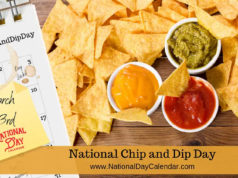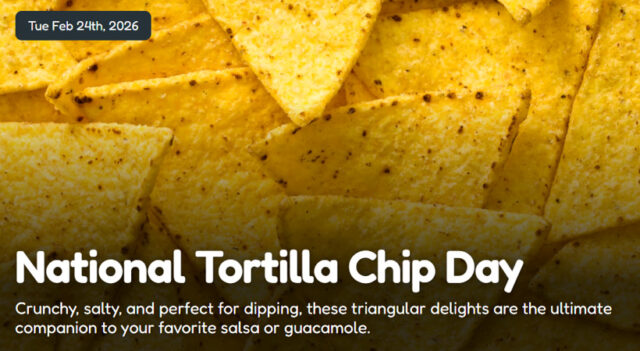
National Tortilla Chip Day on February 24th celebrates a crunchy chip that provides a multitude of ways to enjoy it! The day also shares the chip’s history and many ways to enjoy this delicious snack food.
- 10,000 BC – Certainly, the beauty of the Tortilla Chip would be nothing without its ancestor, the illustrious tortilla. It is developed right around the time that corn is first domesticated in the Sierra Madre region of Mexico. Mayan legend says the first tortilla was a gift to a king.
- 13th Century – People have been dipping their food for centuries. Hummus-like recipes date back to the 13th century.
- 1600 – The word “Tortilla” is first documented. Coming from the Spanish word meaning “little cake”, the word is first documented and was likely named such by Spaniards who were explorers in Central America
- 17th Century – French Onion as a flavor emerged in the 17th century.
- 1815 – Sour cream was invented in the U.S. between 1815 and 1825. Somewhere around there, the first dip as we know it must have come into being.
- 1853 – The potato chip was invented.
- 1940s – Rebecca Webb Carranza repurposes rejected tortillas from the automated line at her workplace… she decided to use the misshapen tortillas the automated tortilla manufacturing machine rejected. She turned them into a snack by cutting them into triangles and frying them.
- 1988 – Between 1988 and 1992, households in the US buying salsa increased from 16% to 36%. Sales of salsa overtook those of ketchup in 1991 (in terms of dollar value).
- 1950s – The popularity of chip and dip skyrockets at the end of World War II, with new entertainment fads and the introduction of Lipton’s new advertising campaign for their famous French Onion Dip.
- 1981 – Following on the heels of the popular flavored Doritos, the company introduces Tostitos, which is a plain tortilla chip that continues to top the charts in sales over the years
- 2003 – Tortilla Chips and Salsa were designated the Official State Snack of Texas. Students at an elementary school in Texas contacted their state Representative to request that Tortilla Chips and salsa be designated a state snack.
- 2010 – According to a report from The Snack Food Association, tortillas are outselling hot dog and hamburger buns.
- 2015 – Tostitos, a major U.S. brand of tortilla chips, offers free dip to any customer named Chip.
- 2020 – Americans dip over 11 million pounds of potato chips, 8 million pounds of tortilla chips, and 4 million pounds of pretzels during the Super Bowl!
- One of the earliest dips to become popular, long before chips ever existed, is Greek tzatziki.
- Guacamole, yet another iconic chip dip, was first made by the Aztecs.
- Hummus, as part of Middle Eastern and Mediterranean cuisines for centuries, did not appear in the United States until after World War II.
- For centuries, people have been using creamy concoctions as a dipping sauce for bread, chips and veggies.
- Salsa originated with the Inca people. Salsa (a combination of chilies, tomatoes, and other spices) can be traced to the Aztecs, Mayans, and Incas.
- Chips and Dip gained popularity in the US in the middle of the 20th century.
- During the Super Bowl, tons of chips and dips are served.
- You can serve dips with all types of chips, from tortilla chips to vegetable chips and more.
- Dips with corn chips became popular in the US in the late 1980s, when guacamole became a top dip choice.
- A whole avocado contains 200-300 calories and is a good source of vitamins A, C, E, and the B vitamins, as well as fiber and potassium. Dip without the guilt!
Sources:

Disclaimer
Artificial Intelligence Disclosure & Legal Disclaimer
AI Content Policy.
To provide our readers with timely and comprehensive coverage, South Florida Reporter uses artificial intelligence (AI) to assist in producing certain articles and visual content.
Articles: AI may be used to assist in research, structural drafting, or data analysis. All AI-assisted text is reviewed and edited by our team to ensure accuracy and adherence to our editorial standards.
Images: Any imagery generated or significantly altered by AI is clearly marked with a disclaimer or watermark to distinguish it from traditional photography or editorial illustrations.
General Disclaimer
The information contained in South Florida Reporter is for general information purposes only.
South Florida Reporter assumes no responsibility for errors or omissions in the contents of the Service. In no event shall South Florida Reporter be liable for any special, direct, indirect, consequential, or incidental damages or any damages whatsoever, whether in an action of contract, negligence or other tort, arising out of or in connection with the use of the Service or the contents of the Service.
The Company reserves the right to make additions, deletions, or modifications to the contents of the Service at any time without prior notice. The Company does not warrant that the Service is free of viruses or other harmful components.