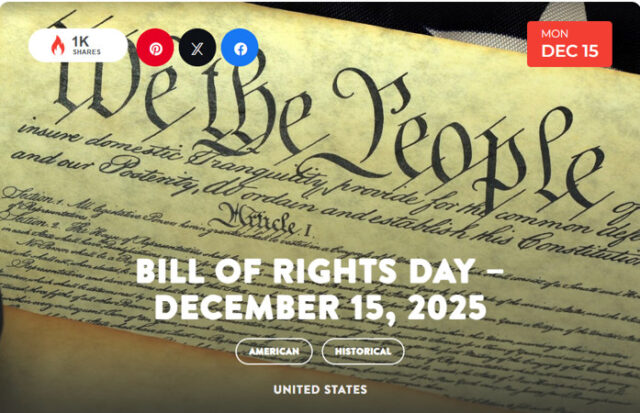
Now, Therefore, I, Franklin D. Roosevelt, President of the United States of America, do hereby designate December 15, 1941, as Bill of Rights Day. And I call upon the officials of the Government, and upon the people of the United States, to observe the day by displaying the flag of the United States on public buildings and by meeting together for such prayers and such ceremonies as may seem to them appropriate.
To view the official proclamation – http://www.presidency.ucsb.edu/ws/?pid=16046
- 1776 – The structure and content of the Bill of Rights were influenced by the Virginia Declaration of Rights drafted in 1776 by George Mason.
- 1789 – The first 10 amendments to the United States Constitution make up the Bill of Rights. Passed by Congress on September 25, 1789, these rights place limits on government power.
- 1791 – The first amendments to the Constitution are ratified — before this, the 13 sovereign states followed the Articles of Confederation, created by the Second Continental Congress.
- 1868 – The US government first supported the movement to abolish slavery. The ratification of the US Constitution’s 14th Amendment allowed citizenship to every person born or naturalized in the United States. On paper, this guaranteed the equal rights of all people and their protection under the law.
- 1920 – The 19th Amendment legally abolished practices that hindered women‘s suffrage.
- 1939 – Three states, Connecticut, Massachusetts, and Georgia, did not immediately send their approval of the Bill of Rights to Congress until 1939
- 1941 – President Franklin D. Roosevelt issues a proclamation dedicating December 15 as Bill of Rights Day to celebrate the document’s 150th anniversary.
- 1947 – The Bill of Rights toured the U.S. for 18 months from 1947 to 1949 on the Freedom Train.
- 1952 – During a ceremony that was held on December 15, 1952, Truman declared, “We are assembled here on this Bill of Rights Day to do honor to the three great documents which, together, constitute the charter of our form of government.”
- 1992 – The most recent, Amendment XXVII, was ratified on May 2, 1992. It was initially proposed on September 25, 1789, and was one of the two that were not passed in the original Bill of Rights. Amendment XXVII deals with compensation to members of the Senate and House of Representatives.
- 2003 – North Carolina’s copy of the Bill of Rights was missing for nearly 140 years after being stolen by a Union soldier during the Civil War. The National Constitution Center played a key role in the recovery of the document in 2003, including assisting in an FBI sting operation.
- 2019 – President Donald Trump proclaims December 15 as Bill of Rights Day again, noting that “people around the world are empowered when human rights are protected by law”.
- The Bill of Rights is the first 10 amendments to the United States Constitution. These amendments guarantee essential rights and civil liberties, such as the right to free speech and the right to bear arms, and reserve rights to the people and the states.
- James Madison introduced the Bill of Rights. He later became the 4th President of the United States.
- The Bill of Rights initially had 12 proposed amendments. One concerned the number of constituents for each Representative. The other addressed the compensation of a Congressman. Neither was ratified.
- The Bill of Rights is displayed in the Rotunda of the National Archives Building in Washington, DC.
- There were 14 copies of the Bill of Rights: one for each of the 13 states to sign and one for the federal archives. Only 12 copies survive today.
- Four states are missing their copies: Georgia, Maryland, New York, and Pennsylvania. Two unidentified copies are known to have survived; one is in the Library of Congress, and the other is in the collection of The New York Public Library.
- For the first 150 years, the US Bill of Rights had little impact on judicial decisions.
Sources:

Disclaimer
Artificial Intelligence Disclosure & Legal Disclaimer
AI Content Policy.
To provide our readers with timely and comprehensive coverage, South Florida Reporter uses artificial intelligence (AI) to assist in producing certain articles and visual content.
Articles: AI may be used to assist in research, structural drafting, or data analysis. All AI-assisted text is reviewed and edited by our team to ensure accuracy and adherence to our editorial standards.
Images: Any imagery generated or significantly altered by AI is clearly marked with a disclaimer or watermark to distinguish it from traditional photography or editorial illustrations.
General Disclaimer
The information contained in South Florida Reporter is for general information purposes only.
South Florida Reporter assumes no responsibility for errors or omissions in the contents of the Service. In no event shall South Florida Reporter be liable for any special, direct, indirect, consequential, or incidental damages or any damages whatsoever, whether in an action of contract, negligence or other tort, arising out of or in connection with the use of the Service or the contents of the Service.
The Company reserves the right to make additions, deletions, or modifications to the contents of the Service at any time without prior notice. The Company does not warrant that the Service is free of viruses or other harmful components.