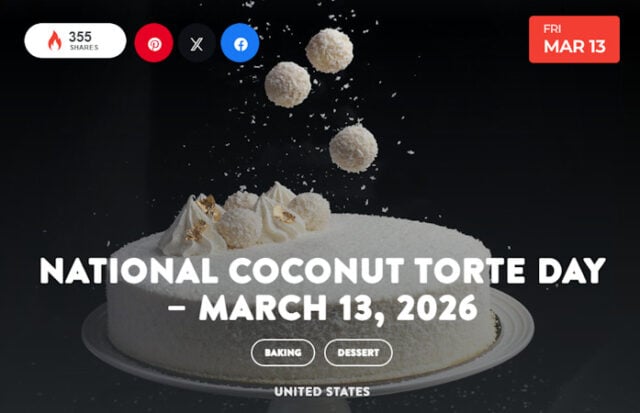
National Coconut Torte Day is celebrated every year on March 13. It’s a day to celebrate a rich and creamy dessert that has people smacking their lips all over the world.
A torte is basically a form of cake without flour. It is a dense, multi-layered cake made with a breadcrumb or groundnut base and layered with a heavy helping of cream, jam, buttercream, ganache, or fruit.
- 100 AD – Coconuts have been around longer than people think; originally traded by Arab merchants who carried them from India to East Africa almost 2,000 years ago.
- 1200s – Resulting from his venture to Egypt, Marco Polo christens the coconut ‘the Pharaoh’s nut.’
- 13th Century – traders introduced the coconut to Europeans along the Asian Silk Roads, one of the more famous being Marco Polo, who called the coconut “The Pharaoh’s Nut.”
- 1400s – An edition of Dioscorides’ Tractatus De Herbis, an illustrated document of medicinal plants, alludes to the existence and value of coconuts.
- 1600s – Claiming fame from Linz, Austria, it’s known as the oldest cake in the world, originally believed to have begun in the 1600s at the Vienna Stadt und Landesbibliothek.
- 1653 – A handwritten recipe for Linzer Torte in the Vienna City Library shows an almond pastry with fruit jam, making it one of the oldest documented European tortes.
- 1718 – Recipes similar to that of the Sacher torte appeared as early as the eighteenth century, one instance being in the 1718 cookbook of Conrad Hagger.
- 19th Century – Until now, many have used the coconut as decorations and food, believing it had magical healing powers,
- Mid-19th Century – Coconut Becomes Widely Available in the United States. Improved shipping and processing allow dried and shredded coconut to be imported regularly, making it a popular ingredient in American home baking.
- Late-19th Century – Manufacturers begin selling factory‑processed, shredded coconut, making it safe, convenient, and affordable for home cooks to add to cakes and tarts.
- 1800s – Coconuts become available in America.
- 1832 – Sacher Torte, a chocolate cake filled with apricot jam and covered with chocolate icing. It was created in Vienna in 1832 by a 16-year-old apprentice baker, Franz Sacher, for Prince Metternich.
- 1870s – With cheaper sugar and better ovens, American bakers embraced tall, iced layer cakes, setting the stage for elaborate coconut cakes and tortes.
- 1920s – The idea of coconut cake emerged in the 1920s and was served at ladies’ gatherings. From there, people began experimenting with coconut and eventually created the coconut torte.
- 1920s – Community cookbooks and women’s clubs help spread recipes for coconut layer cakes, encouraging home bakers to experiment with richer, torte‑style desserts.
- 20th Century – In the American South, tall white cakes covered in coconut gained a reputation as festive showpieces, often baked for holidays and special gatherings.
- Mid-20th Century – As Central European tortes gain popularity in North America, bakers begin combining nut‑based layers, whipped creams, and coconut to create modern coconut tortes.
- 2011 – A study by the National Geographic Society reveals the Southeast Asian and Indian origin of the coconut tree.
- The word torte is German and means cake.
- All tortes are cakes, but not all cakes are tortes
- Torte refers to both a multi-layered cake filled with buttercream, jam, or cream, and to a rich, moist, and dense single-layered cake. A torte may be made with little to no flour, instead using ground nuts or breadcrumbs, along with sugar, eggs, and flavorings.
- The word ‘coconut’ is derived from the Iberian word ‘El coco,’ which refers to a mythical, hairy monster, which must have been a nod to the coarse hairs outside a coconut.
- A coconut tree can grow up to ninety feet.
- Coconut is rich in fiber, Vitamin B6, iron, and minerals like magnesium, manganese, phosphorus, selenium, and zinc.
- Coconut oil moisturizes our skin and helps keep it clear and hair silky, too.
- Tortes are commonly baked in a springform pan.
- All tortes are cakes, but not all cakes are tortes.
- Cakes are usually made with the main ingredient of flour, but tortes usually don’t contain flour.
- Tortes are much shorter than cakes because they have much thinner layers.
- The most well-known of the typical tortes include the Austrian Sacher torte.
- Coconuts are Not Nuts. “Coconuts are drupes, which are fleshy fruits with thin skin and a central stone containing the seed,” says Len Monheit, executive director of the Coconut Coalition of the Americas
- Coconuts contain a high amount of dietary fiber, as well as protein and many essential minerals, such as manganese, copper, iron and selenium, making them a beneficial health food you can feel good about feeding your family.
- Coconuts are used in oils, flour, water, non-dairy milk, snacks and more
- After drying, the meat of the coconut is called “copra.”
- There are 280 calories per cup of coconut.
- Makapuno, cultivated in the Philippines, is the most expensive coconut.
- Smashing a coconut in Hindu mythology symbolizes getting rid of ego.
- The three holes or eyes on coconuts are pores for germination. This is the point from where seedlings emerge.
Sources:

National Days Today
Disclaimer
Artificial Intelligence Disclosure & Legal Disclaimer
AI Content Policy.
To provide our readers with timely and comprehensive coverage, South Florida Reporter uses artificial intelligence (AI) to assist in producing certain articles and visual content.
Articles: AI may be used to assist in research, structural drafting, or data analysis. All AI-assisted text is reviewed and edited by our team to ensure accuracy and adherence to our editorial standards.
Images: Any imagery generated or significantly altered by AI is clearly marked with a disclaimer or watermark to distinguish it from traditional photography or editorial illustrations.
General Disclaimer
The information contained in South Florida Reporter is for general information purposes only.
South Florida Reporter assumes no responsibility for errors or omissions in the contents of the Service. In no event shall South Florida Reporter be liable for any special, direct, indirect, consequential, or incidental damages or any damages whatsoever, whether in an action of contract, negligence or other tort, arising out of or in connection with the use of the Service or the contents of the Service.
The Company reserves the right to make additions, deletions, or modifications to the contents of the Service at any time without prior notice. The Company does not warrant that the Service is free of viruses or other harmful components.