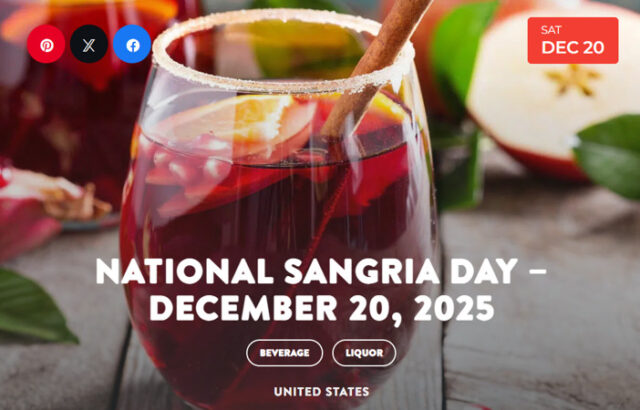
Across the nation, National Sangria Day is observed each year on December 20 by enjoying a well-mixed sangria.
- 2000 BC – Ancient Romans, over 2,000 years ago, mixed wine with water and herbs to purify unsafe drinking water. This practice is considered an early form of Sangria.
- 700s – The Moors conquered the Spanish peninsula and prohibited alcohol, causing the Spanish wine and sangria industries to falter.
- 1700s – England and France developed their own styles of sangria, using French grapes.
- 1736 – British Gentleman’s Magazine mentions that a punch seller, in London, England, concocted a blood-colored drink with the strong, fortified Madeira wine and called it Sangre. The origins point towards Spain, Portugal, and the Caribbean. Over the next 20 years, the drink somehow developed the name Sangaree.
- 1800s – Various versions pop up in recipe books of the 1800s, such as Jerry Thomas’ 1862 Bartender Guide or Miss Leslie’s 1840 Directions for Cookery
- 1964 – Sangria was introduced to the United States at the 1964 World’s Fair in New York City by Alberto Heras.
- 2008 – The state of Virginia had declared the serving of Sangria illegal, as it violated the law that prohibited mixing wine or beer with spirits. Violators could face hefty fines and nearly a year in jail.
- Sangria is a beverage made with wine and sweetened with fresh fruit and fruit juices. Other ingredients can include herbs, spices, carbonation, and liquor.
- Sangria made with white wine is called Sangria Blanca.
- Sangria is a wine punch typical of Spain and Portugal, which is also consumed in Argentina and Uruguay.
- The name sangria comes from sangre, the Portuguese word for blood.
- Sangria has a Caribbean cousin! In the tropics, there’s a popular beverage called sangaree, a spiced, fruit-infused wine.
- The first sangrias were heavily watered-down mixes of wine, water, herbs, and spices. They’d add anything to kill off the bacteria in the water and to disguise the terrible table wine.
- The word Sangria is rarely used on labels in Europe. Since 2014, only sangria sold in Spain and Portugal can be labeled as Sangria. If it’s made elsewhere in Europe, for example, Germany, then it must be labeled “German Sangria”.
- Sangria in music:
- Sangria by Blake Shelton (2015). Country music lovers will appreciate this song by this famous singer/songwriter who is married to Gwen Stefani.
- Sangria Wine by Jerry Jeff Walker (1973). Head back a few years to this folk, a laid-back song that sounds like it was recorded on a back porch while drinking a pitcher of Sangria!
- Red Sangria by Jordin Sparks (2020). A more recent release, this one features this pop star who won American Idol as a teenager–and now she’s proving she’s still relevant at over 30 years old.
- Sangria Wine by Pharrell Williams and Camila Cabello (2018).
- Though most Americans prefer to drink it in the summer months, sangria’s popularity continues to grow year-round.
- 120 million Americans drink wine. Among wine enthusiasts, Millennials and Baby Boomers make up the majority of wine consumers.
- Five hundred fifty thousand locations sell wine in the US. That’s about a 120,000 increase in outlets over the past ten years.
- Traditional sangria contains red wine, which is rich in antioxidants and is great for maintaining a healthy heart. Although many people are still on the fence about this claim, everyone agrees that drinking sangria with family and friends fills the heart with joy.
Sources:

Disclaimer
Artificial Intelligence Disclosure & Legal Disclaimer
AI Content Policy.
To provide our readers with timely and comprehensive coverage, South Florida Reporter uses artificial intelligence (AI) to assist in producing certain articles and visual content.
Articles: AI may be used to assist in research, structural drafting, or data analysis. All AI-assisted text is reviewed and edited by our team to ensure accuracy and adherence to our editorial standards.
Images: Any imagery generated or significantly altered by AI is clearly marked with a disclaimer or watermark to distinguish it from traditional photography or editorial illustrations.
General Disclaimer
The information contained in South Florida Reporter is for general information purposes only.
South Florida Reporter assumes no responsibility for errors or omissions in the contents of the Service. In no event shall South Florida Reporter be liable for any special, direct, indirect, consequential, or incidental damages or any damages whatsoever, whether in an action of contract, negligence or other tort, arising out of or in connection with the use of the Service or the contents of the Service.
The Company reserves the right to make additions, deletions, or modifications to the contents of the Service at any time without prior notice. The Company does not warrant that the Service is free of viruses or other harmful components.