The 2026 Atlantic hurricane season is shaping up to be a year of atmospheric contradictions. On one hand, the raw numbers suggest a season that might look “quiet” on paper—at least compared to the hyperactive years we’ve seen recently. On the other hand, meteorologists are sounding a loud alarm for coastal residents: fewer storms do not equate to lower danger.
According to the official AccuWeather 2026 Atlantic Hurricane Season Forecast, the tropics are expected to produce a near- to below-historical-average number of systems. However, a combination of record-breaking ocean heat and “homegrown” development patterns means the threat of direct impacts to the United States remains significantly elevated.
The 2026 Forecast by the Numbers
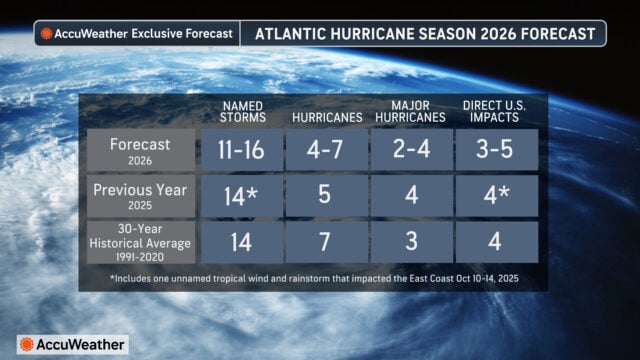
AccuWeather’s team of long-range experts has crunched the data, looking at everything from Saharan dust plumes to deep-sea thermal layers. Here is the statistical breakdown for the season, which officially begins on June 1, 2026:

2026 Atlantic Season Expectations
| Metric | 2026 Forecast | 10-Year Average |
| Named Storms | 11–16 | 18 |
| Hurricanes | 4–7 | 8 |
| Major Hurricanes (Cat 3+) | 2–4 | 4 |
| Direct U.S. Impacts | 3–5 | 2–4 |
While the total number of storms is forecast to fall below the 10-year average, the crucial “Direct U.S. Impacts” category is expected to stay at or above typical levels. This discrepancy is what has experts like Alex DaSilva, AccuWeather’s Lead Hurricane Expert, urging the public not to be lulled into a false sense of security.
“It’s very important that everybody from South Texas all the way to Maine prepares equally for each and every hurricane season, regardless of the forecast,” says DaSilva. “Even if it’s expected to be a slightly below average hurricane season, we can still see major hits across the United States.”
The Tug-of-War: El Niño vs. Ocean Heat
The 2026 season is defined by two massive climatic forces pulling the atmosphere in opposite directions. Understanding this “tug-of-war” is key to understanding why this year’s forecast is so unique.
The Inhibitor: A Developing El Niño
The primary reason for the lower storm count is the anticipated development of El Niño. During El Niño years, the waters of the central and eastern Pacific Ocean become warmer than average. This shift in the Pacific triggers a ripple effect that reaches the Atlantic, typically through increased vertical wind shear.
Wind shear is the “hurricane killer.” It refers to the change in wind speed and direction at different heights in the atmosphere. Strong shear can effectively tilt or rip apart a developing tropical cyclone before it can form a cohesive eye. AccuWeather experts indicate there is a 15% possibility of a “Super El Niño” developing in the second half of the season.
“The climatological peak of the Atlantic hurricane season is Sept. 10,” DaSilva explains. “If a Super El Niño occurs, there could be even less activity in the Atlantic. On average, El Niño seasons produce about 10 named storms and five hurricanes, compared to 15 storms and eight hurricanes during La Niña years.”
The Accelerator: Deep Ocean Heat
Counteracting the disruptive winds of El Niño is a recurring nightmare for forecasters: exceptional ocean heat. Water temperatures across the Gulf of Mexico, the Caribbean, and the Atlantic Main Development Region (MDR) are forecast to reach record or near-record levels again this summer.
Crucially, this is not just surface-level warmth. AccuWeather notes that the heat extends hundreds of feet deep. This “deep-layer” heat content acts as high-octane fuel for hurricanes. When a storm moves over warm water, it draws energy from it. If the warm water is only a thin layer, the storm’s own winds will churn up colder water from below, effectively self-limiting its strength. However, when the heat goes deep, there is no “cold water brake.”
“That heat provides additional fuel for storms,” says DaSilva. “As a result, we are very concerned about the risk of rapid intensification this hurricane season.”
High-Risk Zones: Who Should Watch Closest?
While no portion of the coastline is truly “safe,” AccuWeather has identified specific regions where the risk of significant tropical impacts is higher than the historical average for 2026.
Increased Risk Areas:
- Central and Eastern Gulf Coast: From the Louisiana bayous through the Florida Panhandle, the bathymetry and water temperatures make this a prime target for intensification.
- The Carolinas and Virginia: The positioning of the Bermuda High—a semi-permanent high-pressure system over the Atlantic—will play a major role in steering. Current projections suggest a “slot” may open up, allowing storms to recurve toward the Mid-Atlantic coast rather than staying out at sea.
Decreased Risk Areas:
- Central and Southern Texas: While still vulnerable to “homegrown” development, long-range steering patterns suggest a slightly lower probability of landfalls in the Lone Star State compared to previous years.
The Danger of “Homegrown Development”
One of the most concerning aspects of the 2026 forecast is the potential for storms to form close to the U.S. mainland. Known as “homegrown development,” these systems spin up in the Gulf of Mexico, the western Caribbean, or just off the Southeast U.S. coast.
Because these storms form so close to land, the traditional “lead time” provided by storms trekking across the Atlantic from Africa is non-existent.
“Storms that form within a few hundred miles of the coast can leave people, businesses, and officials with less time to prepare and evacuate,” DaSilva explains. “These ‘homegrown’ storms can pose bigger threats with a lot less time to react, compared to storms that take a week or more to trek across the open Atlantic.”
This was a major factor in AccuWeather’s decision to classify the U.S. impact risk as “elevated.” A storm doesn’t need to be a Category 5 “Long-Track” monster to be devastating; a Category 1 that develops in 48 hours and hits a major metro area can be just as deadly.
Caribbean Vulnerability and the Shadow of 2025
The forecast also highlights a humanitarian concern in the Caribbean. The region is still reeling from the 2025 season, which saw three Category 5 hurricanes. Most notably, Hurricane Melissa made a historic landfall in Jamaica as a Category 5 storm, leaving behind a path of destruction that will take years to repair.
For 2026, Cuba is highlighted as particularly vulnerable. This isn’t just because of the weather, but because of the island’s ongoing energy crisis. A fragile power grid means that even a minor tropical storm or a “Direct Impact”—defined by AccuWeather as passing within 60 miles of the coast or bringing tropical-storm-force winds—could trigger island-wide, prolonged power outages that hamper emergency response and recovery.
Why “Average” Can Be Misleading
It is a common mistake for the public to hear “below average” and assume they can take a year off from hurricane shutters and emergency kits. History proves this is a dangerous gamble.
The 1992 season, for example, was a “below-average” year with only seven named storms. However, the first storm of that year was Hurricane Andrew, which decimated South Florida. Similarly, 2025 produced a near-average number of named storms, yet it managed to spawn three “extremely powerful” Category 5 hurricanes.
The 2026 season is expected to follow this trend of “quality over quantity.” The presence of Saharan dust may keep the total number of storms down by drying out the air in the mid-levels of the atmosphere, but once a storm finds a pocket of moist air and sits over those deep, warm waters, the ceiling for its potential intensity is incredibly high.
Prepare Early: The AccuWeather Call to Action
With the potential for early-season or even pre-season development (development before June 1), the time for preparation is now.
AccuWeather defines a Direct U.S. Impact as:
- A direct landfall.
- A storm passing within 60 miles of the coast.
- Tropical-storm-force winds reaching land.
- Flooding from a tropical system.
- More than 2 feet of storm surge.
“There is no reason to let your guard down this year. It only takes one storm to cause major damage, disruption and heartache,” warns DaSilva. “Review your insurance coverage, safety plans, and local evacuation routes now. Make sure your emergency supplies are stocked up.”
As we move into the summer of 2026, the message from the experts is clear: the Atlantic may be quieter in terms of frequency, but it remains a volatile and dangerous environment. Residents from the Gulf to the Atlantic must remain vigilant, as the “tug-of-war” between El Niño and record-warm waters could result in some of the season’s most intense impacts occurring right on our doorstep.
Sources Used and Links
- AccuWeather 2026 Atlantic Hurricane Season Forecast
- National Hurricane Center Historical Averages
- NOAA El Niño/Southern Oscillation (ENSO) Technical Reports
Disclaimer
Artificial Intelligence Disclosure & Legal Disclaimer
AI Content Policy.
To provide our readers with timely and comprehensive coverage, South Florida Reporter uses artificial intelligence (AI) to assist in producing certain articles and visual content.
Articles: AI may be used to assist in research, structural drafting, or data analysis. All AI-assisted text is reviewed and edited by our team to ensure accuracy and adherence to our editorial standards.
Images: Any imagery generated or significantly altered by AI is clearly marked with a disclaimer or watermark to distinguish it from traditional photography or editorial illustrations.
General Disclaimer
The information contained in South Florida Reporter is for general information purposes only.
South Florida Reporter assumes no responsibility for errors or omissions in the contents of the Service. In no event shall South Florida Reporter be liable for any special, direct, indirect, consequential, or incidental damages or any damages whatsoever, whether in an action of contract, negligence or other tort, arising out of or in connection with the use of the Service or the contents of the Service.
The Company reserves the right to make additions, deletions, or modifications to the contents of the Service at any time without prior notice. The Company does not warrant that the Service is free of viruses or other harmful components.