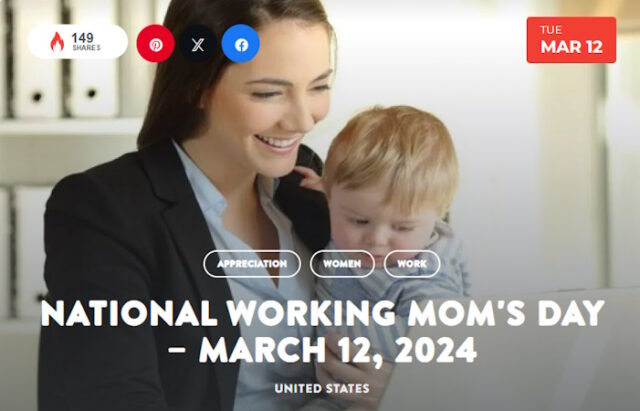
National Working Moms Day is celebrated on March 12 every year. It’s a day to celebrate all the mothers who work for their children — the teachers, the doctors, the accountants, the cashiers, and yes, even the housewives and homemakers. All of them work; all of them are role models.
Even beyond their paid jobs, mothers tend to assume the roles of substitute teachers, first aiders, cooks, cleaners, and more. This is why, inspired by the Working Moms of Milwaukee organization, we support their businesses, recognize all that they do, and express how much it means on this day.
- 2017 – Working Moms of Milwaukee was founded in December 2017 by a local mom who needed some more support.
- 2020 – March 12 is officially proclaimed as National Working Moms Day.
- 2020 – The March date complements the timing of International Women’s Day, as well as Women’s History Month
- Working mothers are frequently pressured to work longer hours and they burn out.
- A study published by the American Psychological Association revealed that mothers with jobs tend to be healthier and happier than those who stay at home during their children’s infancy and preschool years.
- 82.5 million is the rough number of mothers in the United States.
- 2% of women have adopted. Each person has a different reason for adopting children.
- A baby’s first sound is usually ‘ma’. For this reason, the word for mother begins with the letter ‘M’ in almost every language.
- 70 years old is the age of the oldest mother who gave birth — she opted for in-vitro fertilization.
- 40 hours a year is how much time a mother spends a year changing diapers on average.
- Approximately 23 million women are working moms. About 66% of them work full-time and year-round.
- About 1/3 of working women are working moms. (US Census Bureau)
- 76% of working moms are between the ages of 30 and 49
- Women with children average higher earnings ($44,190) than the average of all women combined ($42,295). (US Census Bureau)
- The most common types of jobs for working moms include healthcare, education, and social services (making up 40% of all jobs). (US Census Bureau)
- 1.3 million women with children under 18 are teachers, and 1.1 million are registered nurses. (US Census Bureau)
- 77% of adults say women have a lot of pressure on them to be involved parents, while only 49% say the same about men. (Pew Research)
- 50% of moms say advancing in their career is harder because they are a parent, and 39% of dads agree that advancing in their career is negatively impacted by being a parent. (Pew Research)
- 11% of fathers and 8% of mothers say working makes it easier to be a good parent. (Pew Research)
- Women are becoming mothers later in life. In 2014 the average age a woman had her first child was 26, and in 1994 the average age was just 23. (Pew Research)
- Women make up 93% of dental assistants. (US Bureau of Labor and Statistics)
- 82% of social workers are women. (US Bureau of Labor and Statistics)
- 60% of pharmacists are women. (US Bureau of Labor and Statistics)
- Just 36% of all lawyers are female. (US Bureau of Labor and Statistics)
- Only 11% of civil engineers are women. (US Bureau of Labor and Statistics)
- Daughters of working women earn more than women who had stay-at-home moms. (Harvard Business School)
- Sons of working moms spend 50 minutes more per week caring for family members than their counterparts. (Harvard Business School)
- Both sons and daughters of working moms have more education than folks who had unemployed mothers. (Harvard Business School)
- Working mothers spend an average of 98 minutes per day on childcare activities in 2020.
- Mothers who work from home spend an extra 49 minutes per day on childcare when compared to those who work exclusively in the office.
- 21% of single working mothers live below the poverty line.
- 36% of working mothers report that their career progression has been negatively impacted as a result of having children.
Sources:

Disclaimer
Artificial Intelligence Disclosure & Legal Disclaimer
AI Content Policy.
To provide our readers with timely and comprehensive coverage, South Florida Reporter uses artificial intelligence (AI) to assist in producing certain articles and visual content.
Articles: AI may be used to assist in research, structural drafting, or data analysis. All AI-assisted text is reviewed and edited by our team to ensure accuracy and adherence to our editorial standards.
Images: Any imagery generated or significantly altered by AI is clearly marked with a disclaimer or watermark to distinguish it from traditional photography or editorial illustrations.
General Disclaimer
The information contained in South Florida Reporter is for general information purposes only.
South Florida Reporter assumes no responsibility for errors or omissions in the contents of the Service. In no event shall South Florida Reporter be liable for any special, direct, indirect, consequential, or incidental damages or any damages whatsoever, whether in an action of contract, negligence or other tort, arising out of or in connection with the use of the Service or the contents of the Service.
The Company reserves the right to make additions, deletions, or modifications to the contents of the Service at any time without prior notice. The Company does not warrant that the Service is free of viruses or other harmful components.