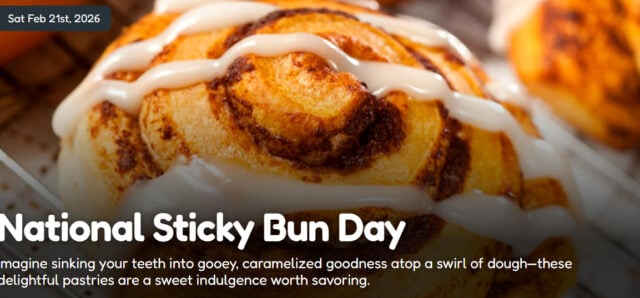
What goes better with coffee than something a little sweet, nutty, and possibly oozing with caramel? Yup, you know what we’re talking about. February 21 is National Sticky Bun Day!
This delightful confection, a Philadelphia specialty originally known as “Schnecken,” is thought to have been brought to the United States by German settlers in the 18th century. Often served for breakfast, Sticky buns are also sometimes known as cinnamon rolls, caramel rolls or monkey bread.
- Ancient Egyptians were the first people to add honey and nuts to their bread.
- 18th Century – Sticky buns primarily have German origins, known as ‘Schnecken.’
- 19th Century – Known as “schnecken,” meaning “snail,” the sticky bun is rolled into a sweet spiral, resembling its German name. Still considered a Pennsylvania specialty, many believed the sticky bun’s origin in the United States dates to the 19th century.
- 1914 – Sticky buns reportedly fueled soldiers in World War I. Bakers in the U.S. sent sticky buns to troops overseas, offering comfort through home-baked treats. This cemented their association with warmth and support during hard times.
- 1920s – The cinnamon bun’s origin is a hotly debated topic. The Swedes claim it originated there in the 1920s.
- 1954 – Hungarian baker Grace Hasz begins selling cinnamon buns daily at the University of British Columbia.
- Monkey Bread is a variation of sticky buns. Instead of rolling the buns into swirls and slicing them, the dough is made into small balls that are piled high and then baked into their caramel sauce and nuts.
- An installation in New York’s Museum of Food and Drink featured an oversized sticky bun sculpture to highlight the artistry of classic pastries. This drew attention to sticky buns as cultural icons, not just desserts.
- A sticky bun should always be made of yeast dough.
- In the UK and Canada, sticky buns are known as “Chelsea buns” and are made with raisins!
- A Nordic cinnamon bun is typically made with a bit of ground cardamom in the dough – this is what differentiates it from other cinnamon buns, such as the over-the-top sticky sweet buns you often see in North America.
- A real cinnamon bun (a Scandi one) does not have icing on the top. In Norway, a sprinkle of normal granulated sugar – in Sweden, those lovely big-ish sugar crystals called Pearl Sugar.
- A typical Swede eats 316 cinnamon buns per year
- Sticky Buns and Cinnamon Buns are not the same. The difference is an ingredient – nuts. Sticky buns have them, while cinnamon buns do not.
- Monkey Bread is a variation of sticky buns. Instead of rolling the buns into swirls and slicing them, the dough is made into small balls that are piled high and then baked into their caramel sauce and nuts.
- Another cousin to the sticky bun is the Chelsea Bun, which is a London speciality that features the use of currants or raisins.
- Pecans and walnuts are quite popular in sticky bun recipes.
- A cousin to the sticky bun is the Chelsea Bun, a London specialty that uses currants or raisins.
- Pecans are typically the nut of choice for sticky buns, but toasted almonds or walnuts would certainly be just as delicious!
- Sticky buns appear in cozy mystery novels and children’s books, often as symbols of warmth and indulgence. In culinary-focused mysteries, sticky buns frequently lead to surprising plot twists, like uncovering family secrets.
- Some believe sticky buns baked on a full moon attract good luck and prosperity.
Sources:

Cobs Bread
Disclaimer
Artificial Intelligence Disclosure & Legal Disclaimer
AI Content Policy.
To provide our readers with timely and comprehensive coverage, South Florida Reporter uses artificial intelligence (AI) to assist in producing certain articles and visual content.
Articles: AI may be used to assist in research, structural drafting, or data analysis. All AI-assisted text is reviewed and edited by our team to ensure accuracy and adherence to our editorial standards.
Images: Any imagery generated or significantly altered by AI is clearly marked with a disclaimer or watermark to distinguish it from traditional photography or editorial illustrations.
General Disclaimer
The information contained in South Florida Reporter is for general information purposes only.
South Florida Reporter assumes no responsibility for errors or omissions in the contents of the Service. In no event shall South Florida Reporter be liable for any special, direct, indirect, consequential, or incidental damages or any damages whatsoever, whether in an action of contract, negligence or other tort, arising out of or in connection with the use of the Service or the contents of the Service.
The Company reserves the right to make additions, deletions, or modifications to the contents of the Service at any time without prior notice. The Company does not warrant that the Service is free of viruses or other harmful components.