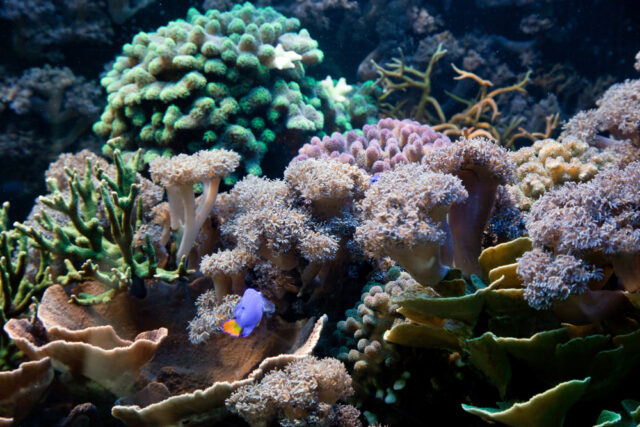
In the turquoise waters just off the coast of Fort Lauderdale, a silent, ancient struggle is unfolding. While much of the Florida Barrier Reef has succumbed to a “death by a thousand cuts”—warming oceans, acidic waters, and lethal diseases—a remarkably resilient stretch of reef near Port Everglades has remained a stubborn stronghold of life. Now, life faces a man-made existential threat. A massive federal project to deepen and widen the shipping channel at Port Everglades is moving forward, pitting the economic engine of one of the world’s busiest cruise and cargo ports against an ecosystem that scientists describe as one of the last “strongholds” of coral health in the United States.
The Scale of the Ambition—and the Risk
The Port Everglades Navigation Improvements Project is a $1.35 billion endeavor led by the U.S. Army Corps of Engineers. Its goal is to allow the world’s largest Neo-Panamax container ships and tankers to navigate the port more efficiently. By deepening the channel from 42 to 48 feet and widening the entrance, the Corps argues it can improve maritime safety and secure the economic future of South Florida.
However, the price of this expansion is measured in more than just dollars. Beneath the surface lies a dense urban reef system that even the scientists who study it were surprised to find. A recent analysis by the National Oceanic and Atmospheric Administration (NOAA) and the Shedd Aquarium documented an estimated 10 million corals living in and around the project’s footprint. This includes thousands of staghorn coral colonies, a species once common but now listed as threatened under the Endangered Species Act.
The environmental alarm is being sounded at the highest levels of government. In a blunt assessment of the plan’s potential for damage, The Washington Post highlights the severity of the situation, noting that federal scientists have warned the project could “wipe out one of Florida’s last thriving coral reefs.” This isn’t merely a localized concern; NOAA Fisheries’ Southeast regional administrator, Andy Strelcheck, famously described the proposal as representing “the largest impact to coral reefs permitted in U.S. history.”

Ghosts of PortMiami
For conservationists, the anxiety surrounding the Port Everglades project is fueled by a disastrous precedent just 30 miles to the south. Between 2013 and 2015, a similar dredging operation at PortMiami resulted in what many call an ecological catastrophe. During that project, the Army Corps predicted minimal impacts to the surrounding reefs. Instead, fine sediment from the dredging spread far beyond the predicted boundaries, smothering more than 250 acres of reef.
The sediment didn’t just cloud the water; it acted like a heavy blanket, preventing corals from feeding and photosynthesizing. According to reporting by The Washington Post, the fallout from the Miami project was so severe that it “killed more than half a million corals,” a figure far exceeding the Corps’ initial estimates. “We can’t let history repeat itself,” says Rachel Silverstein, executive director of Miami Waterkeeper. “The Corps is using many of the same flawed methodologies that led to the disaster in Miami.”
The Mechanics of Destruction
The dredging process is a violent one. To reach the required depths, heavy machinery must chew through the rocky seafloor. This creates massive plumes of “turbidity”—clouds of silt and crushed rock that can stay suspended in the water column for weeks, traveling miles on the current.
Beyond the sediment, the project involves underwater blasting. The Army Corps estimates it will need roughly 280 blast events over a five-year period to break up the hardest rock. As The Washington Post details, these “blasts will occur as often as once a day,” creating shockwaves that can be lethal to local marine life. For the local ecosystem, this is more than just noise; the pressure waves from high explosives can cause significant acoustic trauma to dolphins and manatees, which rely on sound for navigation and communication.
Furthermore, the area is a primary breeding ground for the queen conch, a marine snail that was recently added to the threatened species list. Unlike fish, which might swim away from the construction, corals and conchs are sedentary or slow-moving. They are effectively “sitting ducks” for the machinery and the sediment that follows.
The Port’s Defense: A Billion-Dollar Compromise
Port Everglades officials and the Army Corps are not ignoring these concerns. They argue that the current plan is the most environmentally sensitive dredging project ever conceived in the U.S. Nearly half of the project’s massive budget—several hundred million dollars—is earmarked for environmental mitigation and coral protection.
The proposed safeguards include:
- Coral Relocation: Moving tens of thousands of corals larger than 3 centimeters to offshore nurseries or artificial reefs before dredging begins.
- Technological Monitoring: Using advanced sensors to monitor water quality in real-time.
- Restoration Efforts: Planting over 100,000 nursery-raised corals to offset those lost and creating new mangrove and seagrass habitats nearby.
Despite these efforts, the scale of the potential loss is staggering. The Washington Post reports that while the Corps plans to relocate some corals, “millions of others would be left behind to perish.” Scientists like Ross Cunning of the Shedd Aquarium remain skeptical. Relocating 10 million corals is a logistical impossibility, and “outplanting” nursery corals—while helpful—cannot replicate the complex, three-dimensional architecture of a centuries-old natural reef.
The Economic vs. Ecological Calculus
The debate over Port Everglades represents a broader global conflict: the clash between the demands of global trade and the limits of planetary health. The port is a vital hub for Florida’s fuel supply and a massive driver of the regional economy. Proponents argue that without the expansion, Florida will lose its competitive edge to other East Coast ports that have already deepened their harbors.
Yet, the reef provides its own economic value—one that is often overlooked until it is gone. Healthy reefs act as natural breakwaters, reducing the energy of storm surges and waves by up to 97%. In a state increasingly vulnerable to rising sea levels and intensifying hurricanes, the reef is a multi-billion-dollar insurance policy for the very coastal infrastructure the port serves.
A Critical Crossroads
As of March 2026, the project remains in a state of high-stakes regulatory limbo. Legal challenges from groups like Earthjustice and the Center for Biological Diversity are winding through the courts, while federal regulators continue to debate the “Biological Opinion” that will ultimately decide the project’s fate.
The thriving corals off Fort Lauderdale are more than just a local treasure; they are a genetic reservoir. Because they have survived the heatwaves and diseases that killed their neighbors, these corals may hold the secrets to reef survival in a warming world. To lose them for the sake of six more feet of channel depth is a gamble that many believe we cannot afford to take.
As The Washington Post aptly summarizes, the project has become a “test case for how the federal government balances economic development with the preservation of critical ecosystems.” The decision made at Port Everglades will serve as a definitive statement on what we value more: the speed of our commerce or the survival of our natural world.
Source: The Washington Post
Disclaimer
Artificial Intelligence Disclosure & Legal Disclaimer
AI Content Policy.
To provide our readers with timely and comprehensive coverage, South Florida Reporter uses artificial intelligence (AI) to assist in producing certain articles and visual content.
Articles: AI may be used to assist in research, structural drafting, or data analysis. All AI-assisted text is reviewed and edited by our team to ensure accuracy and adherence to our editorial standards.
Images: Any imagery generated or significantly altered by AI is clearly marked with a disclaimer or watermark to distinguish it from traditional photography or editorial illustrations.
General Disclaimer
The information contained in South Florida Reporter is for general information purposes only.
South Florida Reporter assumes no responsibility for errors or omissions in the contents of the Service. In no event shall South Florida Reporter be liable for any special, direct, indirect, consequential, or incidental damages or any damages whatsoever, whether in an action of contract, negligence or other tort, arising out of or in connection with the use of the Service or the contents of the Service.
The Company reserves the right to make additions, deletions, or modifications to the contents of the Service at any time without prior notice. The Company does not warrant that the Service is free of viruses or other harmful components.