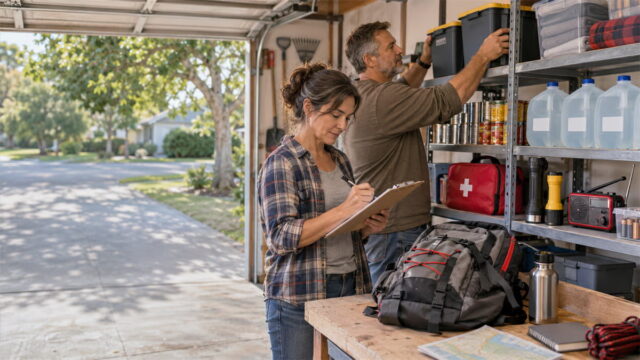
Several countries have recently updated their emergency guidance, asking residents to store enough food, water, and supplies to get through as long as 90 days, and social media hasn’t stopped talking about it.
In light of this, MarketBeat, a financial media company, surveyed 3,056 respondents on whether and how they are preparing for major disruptions, from natural disasters and political instability to a stock market collapse or AI-driven job losses.
The research found that 41% of Florida households are actively “prepping,” equivalent to an estimated 3,569,107 statewide.
The Top 5 States for Household Prepping

1. Washington: 50% (1,532,410 households)
2. Minnesota: 47% (1,089,870 households)
3. Nebraska: 43% (346,890 households)
4. Rhode Island: 43% (189,244 households)
5. Indiana: 42% (1,143,583 households)
Infographic showing study results (and methodology)
Floridians Rate Their Preparedness Score a 5.27/10
Asked to rate their preparedness for a national emergency on a scale of 1 to 10, with 10 being the most prepared, Floridians gave themselves an average score of 5.27. This compares to a national average of 5. On self-rated readiness, Floridians are the 11th best prepared in the nation.
Groceries Are More Valuable Than Gold
When it comes to practical preparations for an emergency situation, groceries rank in the top spot. Extra food and water lead the emergency measures reported, followed by first-aid supplies or an emergency reserve of essential medication.
The breakdown of selections was:
- 21%: Extra food and drinking water beyond usual household supplies.
- 19%: First-aid supplies or an emergency reserve of essential medication.
- 12%: Backup power, such as a generator, power station, or solar charger.
- 12%: Cash kept at home or elsewhere outside a bank.
- 11%: Money set aside in an emergency savings fund.
- 10%: Emergency equipment, such as a radio, water filter, or evacuation kit.
- 9%: A household emergency or evacuation plan.
- 4%: Physical gold, silver, or other precious metals.
- 2%: Cryptocurrency held specifically as an emergency asset.
How Long Until Existing Supplies Run Out
Florida respondents were asked a hypothetical question: If buying more food suddenly became impossible, how long could households manage to get by with what they already had?
The average time in the Sunshine State was 20.2 days, compared to a national average of 19.7.
More Floridians are Paying Attention to Prepping
Emergency preparation is getting more attention from a substantial minority of people: 12% said their attention to it had increased significantly over the past year.
The Financial Emergency Kit
Worries about a major crisis are also changing how people handle their money.
- 23%: increased the amount of physical cash held outside a bank
- 20%: Paid down their debt faster.
- 14%: Allocated their money across more than one bank or credit union.
- 7%: Purchased physical gold, silver, or other precious metals.
- 4%: Reduced their individual stocks or stock fund investments.
- 3%: Purchased cryptocurrency.
- 2%: Purchased U.S. government securities, such as Treasury bills or savings bonds.
In a Crisis, Cash Is King
Respondents were also asked to choose the single asset they would trust most to preserve the value of their money during a severe economic crisis, and 47% of them chose physical cash. Savings accounts and physical gold or silver were the next most popular choices, each at 20%.
U.S. government securities, diversified stock funds, and real estate each received 4%, while cryptocurrency attracted 1%.
The Crises Floridians Fear
Respondents were also asked which potential threats worry them most when thinking about their household’s future:
- A stock market collapse reducing investments or retirement savings: 6.1%
- Natural disasters or extreme weather: 13.7%
- Political instability or civil unrest: 9.4%
- AI or automation causing job losses or reducing earning opportunities: 5.3%
- Bank failures or being unable to access money: 8%
- A recession or widespread unemployment: 6.9%
- Rising prices making everyday essentials unaffordable: 10.7%
- Cyberattacks disrupting banking, payments or essential services: 5.5%
- Prolonged power outages: 7.4%
- War or a major international conflict: 6.7%
- Another pandemic or public health emergency: 6.7%
- Shortages of food, fuel or other essentials: 9.5%
AI Anxiety
AI adds a different kind of uncertainty to household planning. Its potential effect on people’s financial security divides respondents between optimism, indifference, and concern:
- 14% expect AI to improve their household’s financial security over the next five years.
- 41% expect little or no effect.
- 33% worry it could harm their financial security but have not taken any action
- 12% share that concern and have taken financial steps.
“These findings show how differently people think about protecting their money when they are worried about the future,” says Matt Paulson, founder of MarketBeat. “Some are building cash reserves, while others are reconsidering their investments in the stock market. People’s strong preference for physical cash is particularly revealing – having money within reach during a disaster can feel reassuring. For investors, the question is how to prepare for short-term disruptions while keeping longer-term financial goals in view.”
Disclaimer
Artificial Intelligence Disclosure & Legal Disclaimer
AI Content Policy.
To provide our readers with timely and comprehensive coverage, South Florida Reporter uses artificial intelligence (AI) to assist in producing certain articles and visual content.
Articles: AI may be used to assist in research, structural drafting, or data analysis. All AI-assisted text is reviewed and edited by our team to ensure accuracy and adherence to our editorial standards.
Images: Any imagery generated or significantly altered by AI is clearly marked with a disclaimer or watermark to distinguish it from traditional photography or editorial illustrations.
General Disclaimer
The information contained in South Florida Reporter is for general information purposes only.
South Florida Reporter assumes no responsibility for errors or omissions in the contents of the Service. In no event shall South Florida Reporter be liable for any special, direct, indirect, consequential, or incidental damages or any damages whatsoever, whether in an action of contract, negligence or other tort, arising out of or in connection with the use of the Service or the contents of the Service.
The Company reserves the right to make additions, deletions, or modifications to the contents of the Service at any time without prior notice. The Company does not warrant that the Service is free of viruses or other harmful components.