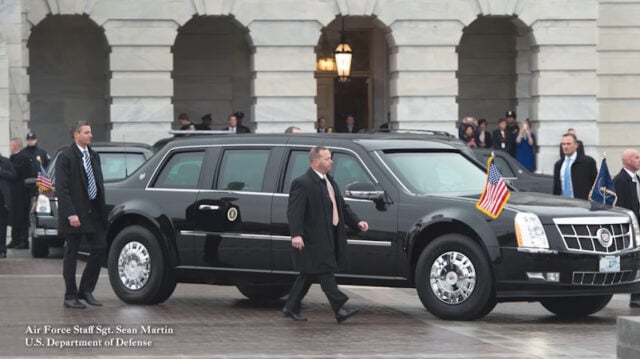
The American presidency comes with a fascinating secret vocabulary. Most people know the president’s armored limousine as “The Beast.” However, that famous vehicle actually carries three distinct names. In its article THE PRESIDENT’S CAR HAS THREE NAMES, HERE’S WHY, Dictionary Scoop explores the surprising origins behind presidential terms. “Presidents seem to speak a vocabulary of their own,” Dictionary Scoop notes in its fascinating breakdown.
Alongside “The Beast,” the armored car is officially called “Cadillac One.” Secret Service agents also use a third code name on their radios: “Stagecoach.” According to Dictionary Scoop, this naming tradition actually began high in the sky rather than on the road. In December 1953, a commercial airliner and President Eisenhower’s plane shared the same flight number. That dangerous airspace mix-up prompted the Air Force to create a dedicated call sign: Air Force One.
The Secret Service soon applied the same logic to ground travel. “The Secret Service later applied that same idea to the limousine, giving it its own name,” explains Dictionary Scoop. Today, two identical armored limousines travel together in every presidential motorcade. That clever decoy strategy ensures nobody outside the Secret Service knows which car holds the president.
That aviation rule also shaped how helicopters and private planes are named. Whenever the president boards a Marine Corps helicopter, its call sign immediately becomes “Marine One.” If the president flies on a private jet instead, air traffic controllers call it “Executive One.” As Dictionary Scoop explains, “the moniker was never tied to a single helicopter.”

Beyond vehicles, presidential history is packed with colorful nicknames for everyday items and historic landmarks. Oval Office presidents work at the Resolute Desk, built from timbers of a rescued British Arctic ship. Meanwhile, Camp David started out as “Shangri-La” under Franklin D. Roosevelt before Dwight D. Eisenhower renamed it. Even the White House only received its official name from Theodore Roosevelt in 1901.
Other terms carry much heavier weight behind closed doors. The laminated card holding nuclear launch codes is casually called “the biscuit.” Similarly, the United States Marine Band has proudly gone by “The President’s Own” since Thomas Jefferson coined the title. Through its deep dive into White House lore, Dictionary Scoop shows how every presidential nickname tells a unique historical story.
Even common acronyms like POTUS and FLOTUS trace their roots back to nineteenth-century telegraph operators. As Dictionary Scoop proves, ordinary words take on extraordinary meaning inside the White House.
Sources
Disclaimer
Artificial Intelligence Disclosure & Legal Disclaimer
AI Content Policy.
To provide our readers with timely and comprehensive coverage, South Florida Reporter uses artificial intelligence (AI) to assist in producing certain articles and visual content.
Articles: AI may be used to assist in research, structural drafting, or data analysis. All AI-assisted text is reviewed and edited by our team to ensure accuracy and adherence to our editorial standards.
Images: Any imagery generated or significantly altered by AI is clearly marked with a disclaimer or watermark to distinguish it from traditional photography or editorial illustrations.
General Disclaimer
The information contained in South Florida Reporter is for general information purposes only.
South Florida Reporter assumes no responsibility for errors or omissions in the contents of the Service. In no event shall South Florida Reporter be liable for any special, direct, indirect, consequential, or incidental damages or any damages whatsoever, whether in an action of contract, negligence or other tort, arising out of or in connection with the use of the Service or the contents of the Service.
The Company reserves the right to make additions, deletions, or modifications to the contents of the Service at any time without prior notice. The Company does not warrant that the Service is free of viruses or other harmful components.