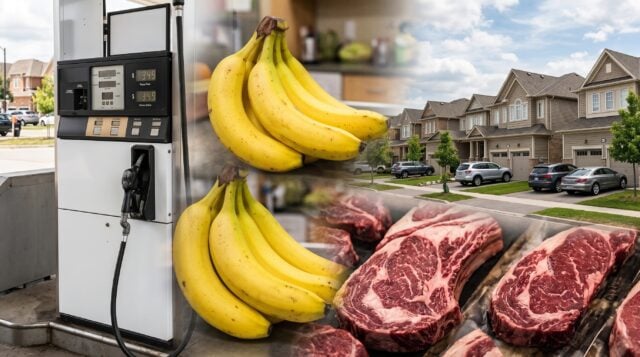
The U.S. has hit some eye-popping inflation milestones in recent years, from the average new car selling for over $50,000 to the price of a pound of ground beef matching the federal minimum wage.
It feels like each year, the cost for at least one major item jumps off the charts. So far, 2026 has been defined by painfully high gas prices — or rising energy and transportation costs in general. The year before that, the big story was the price of eggs. And remember when car insurance premiums skyrocketed in 2024?
Must Read
- You’re probably eligible to save money on car insurance. Compare rates for your ZIP code with this free — and fast — tool from Money.
- These 6 hacks can help retirees save money on things they’re already buying.
- A $10,000 investment 10 years ago would be worth over $30,000 today. It wasn’t a stock. See how investors are adding gold to their IRAs with Goldco’s free guide.
Wage growth has helped households keep up, but some Americans are becoming sensitive to certain price increases, switching to cheaper alternatives or resisting purchases altogether. As prices rise, spending data shows that consumers are increasingly looking for value, Taylor Bowley, a Bank of America economist, wrote in a report Monday.
“Apparel and dining show clear signs of consumers trading down, but when it comes to travel, some households may be opting out of trips entirely rather than shifting to lower-cost options,” Bowley wrote.

So what will be the item that sees the most extreme inflation next year? Money asked a handful of economists that question, finding agreement on a few categories — and one that could be a curveball. Here’s what they’re predicting for early 2027:
Food
Despite how it might seem, groceries have not been a leading driver of inflation this year. Food inflation has actually cooled from the high levels observed between 2021 and 2023. As of September, food away from home inflation was 3.5%, while food at home inflation was 1.8%, according to the consumer price index (CPI).
Be prepared for that to change.
“We expect food prices to be the major inflation narrative during 2027,” Joe Brusuelas, chief economist at RSM, writes in an email.
Grocery prices tend to be volatile — and it’s hard to say now what next year’s economic equivalent of beef or coffee might be. Globally, wholesale food commodity prices are expected to rise 7% in 2027 as military conflicts impact grain prices, according to a World Bank outlook. The U.S. Department of Agriculture has a more optimistic view, forecasting food inflation of just 1.7%.
Electronic goods
Rising prices for electronics in 2027 wouldn’t be a new trend, but multiple economists expect them to be a key part of the inflation story early next year.
As of September, the CPI inflation rate for “computers, peripherals and smart home assistants” was 9.7%. Gregory Daco, chief economist at EY-Parthenon, explains that this inflation stems from the AI investment boom and the related memory chip shortage.
It could get worse before it gets better.
“Computer and electronic goods, such as PCs, smartphones and gaming consoles, are likely to see the biggest price increases in early 2027,” says Mark Zandi, chief economist at Moody’s Analytics. “The booming demand from AI data centers for memory chips and other components used to make these goods is driving up their costs.”
Rents
Tenants may receive some unpleasant rent renewal notices in 2027.
“We are seeing signs that the prior disinflationary trend in residential rents is coming to an end, and now we look to be entering a period of rising inflation for rent,” Kathy Bostjancic, chief economist at Nationwide, tells Money.
The median asking rent for two-bedroom apartments in the country’s 100 largest cities is $1,901, according to Zumper. The September CPI report showed that rents were up 2.8% over the past year.
Why is the rental market becoming more competitive? Bostjancic points to high home prices and mortgage rates that are “keeping potential homebuyers locked into the rental market.”
Energy: A ‘wildcard’
The cost of gas finally fell below $4 for the first time since July on Tuesday, according to AAA. But it’s still one of consumers’ top economic concerns.
“Energy remains the biggest wildcard,” Daco says, adding that “higher gasoline and diesel prices can rapidly feed through transportation, construction, manufacturing and distribution costs.”
In a 60 Minutes interview Sunday, President Donald Trump hung his party’s poor performance in the midterms on the surge in gas prices.
“They didn’t like the war. They didn’t like the fact that gasoline went up,” he said. “And there’s a great dislike, incredibly, for Israel.”
The president has argued that higher gas prices are worth it to stop Iran from developing nuclear weapons. But the next phase of the war now looks even more uncertain.
“If the conflict with Iran heats up further, that would mean higher energy prices,” Gus Faucher, chief economist at PNC, tells Money. “This, in turn, would pass through to other items dependent on energy costs, such as airfare (jet fuel) and food (shipping costs). Alternatively, a drop in energy costs from reduced hostilities with Iran would slow inflation for these items.”
Disclaimer
Artificial Intelligence Disclosure & Legal Disclaimer
AI Content Policy.
To provide our readers with timely and comprehensive coverage, South Florida Reporter uses artificial intelligence (AI) to assist in producing certain articles and visual content.
Articles: AI may be used to assist in research, structural drafting, or data analysis. All AI-assisted text is reviewed and edited by our team to ensure accuracy and adherence to our editorial standards.
Images: Any imagery generated or significantly altered by AI is clearly marked with a disclaimer or watermark to distinguish it from traditional photography or editorial illustrations.
General Disclaimer
The information contained in South Florida Reporter is for general information purposes only.
South Florida Reporter assumes no responsibility for errors or omissions in the contents of the Service. In no event shall South Florida Reporter be liable for any special, direct, indirect, consequential, or incidental damages or any damages whatsoever, whether in an action of contract, negligence or other tort, arising out of or in connection with the use of the Service or the contents of the Service.
The Company reserves the right to make additions, deletions, or modifications to the contents of the Service at any time without prior notice. The Company does not warrant that the Service is free of viruses or other harmful components.