|
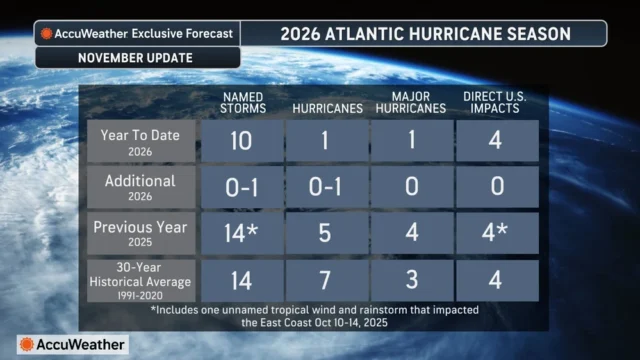
The risk of additional tropical impacts to the United States is over for the 2026 Atlantic hurricane season, as El Niño brings an early end to activity across the basin, AccuWeather hurricane experts say. This follows a season that, despite being quieter than average in number of storms, brought flooding rains, repeated Gulf Coast landfalls and Hurricane Isaias’ destructive Category 3 strike on Florida. This announcement comes three weeks before the Atlantic hurricane season officially ends on Nov. 30. AccuWeather hurricane experts do say tropical storms could develop elsewhere in the Atlantic basin, which will stay out to sea if a storm does form. “The 2026 Atlantic hurricane season has been anything but typical, and El Niño has played a significant role in limiting tropical activity across the Atlantic. While tropical storms can still develop this late in the season, the weather patterns we’re seeing give us confidence that the United States will avoid additional direct tropical impacts this year. It’s an unusually quiet conclusion to a season that broke a 121-year-old hurricane record,” said AccuWeather lead hurricane expert Alex DaSilva. Four storms impacted the U.S., falling within the range of three to five direct U.S. impacts AccuWeather first predicted back in March.
|

 |
 |
 |
Disclaimer
Artificial Intelligence Disclosure & Legal Disclaimer
AI Content Policy.
To provide our readers with timely and comprehensive coverage, South Florida Reporter uses artificial intelligence (AI) to assist in producing certain articles and visual content.
Articles: AI may be used to assist in research, structural drafting, or data analysis. All AI-assisted text is reviewed and edited by our team to ensure accuracy and adherence to our editorial standards.
Images: Any imagery generated or significantly altered by AI is clearly marked with a disclaimer or watermark to distinguish it from traditional photography or editorial illustrations.
General Disclaimer
The information contained in South Florida Reporter is for general information purposes only.
South Florida Reporter assumes no responsibility for errors or omissions in the contents of the Service. In no event shall South Florida Reporter be liable for any special, direct, indirect, consequential, or incidental damages or any damages whatsoever, whether in an action of contract, negligence or other tort, arising out of or in connection with the use of the Service or the contents of the Service.
The Company reserves the right to make additions, deletions, or modifications to the contents of the Service at any time without prior notice. The Company does not warrant that the Service is free of viruses or other harmful components.