By Susan Murphy
Mayo Clinic’s Biobank is enabling discovery on a new scale as genomic data from 52,000 participants can be studied alongside medical records, imaging, pathology and a growing body of research data across Mayo Clinic.
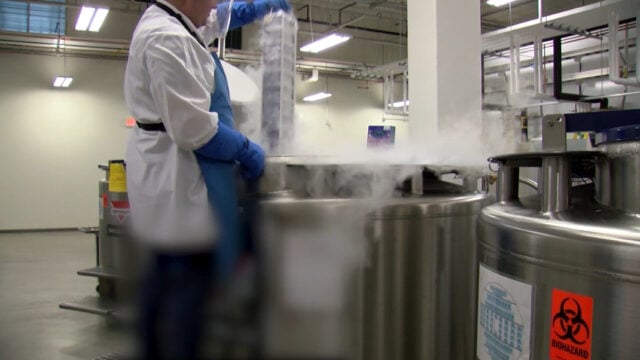
A Mayo Clinic Biobank team member works with samples stored in cryogenic tanks for use in research.
Inside Mayo Clinic’s Marvin Building, Janet Olson, Ph.D., walks past rows of freezers containing more than 1 million tubes of biological samples donated for research to the Mayo Clinic Biobank. The collection she helped develop starting in 2009 has supported more than 650 studies spanning heart disease, cancer, neurological disorders and many other conditions.

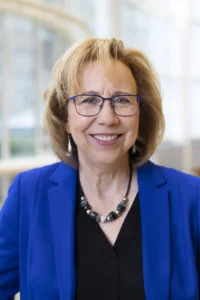
Now, advances in genomic sequencing and analysis have made it possible to read those samples in extraordinary new ways. Researchers have analyzed the protein-coding regions of DNA from all 52,000 participants, identifying genetic changes linked to disease.
The findings add a new layer to the health information participants have contributed over the years, giving researchers a richer view of how genetics may influence health. The genomic data have also become part of a much larger research resource: Mayo Clinic’s Research Data Atlas, which brings together more than 6,000 research datasets.
“This is beyond the scope of what we even imagined when we started the Biobank,” says Dr. Olson, an epidemiologist and principal investigator of the Biobank. “We never would have dreamed that this kind of research would be possible at this scale.”
Watch: Dr. Janet Olson discusses the Biobank: Videography by Kevin Sullivan, Mayo Clinic
Connecting the Biobank to a broader research ecosystem
The genetic data have become even more revealing when viewed alongside what happened to participants over time. Biobank participants consented to have their samples studied alongside their Mayo Clinic medical records, allowing researchers to connect genetic risk with years of health history.
“One of our strengths is our medical record and how deep our medical records are,” Dr. Olson says. “There are patients that we have data from the time they were born.”
The Biobank’s genomic data can now be studied alongside thousands of other datasets in the Research Data Atlas, including clinical, imaging, pathology and other research data. That gives researchers a way to examine connections across large groups of people and across different aspects of human biology.
Artificial intelligence can help researchers search those vast collections of information for relationships that might be difficult to spot otherwise. Such analyses could help researchers better understand how disease develops, identify people at greater risk and explore why the same disease can take different paths.
Uncovering hidden genetic risk in nearly 2,500 participants
The growing ability to understand genetic risk is also creating opportunities to return potentially important findings to the people who made the research possible.
Large-scale genomic analysis has identified about 2,500 participants with potentially medically actionable findings, including inherited risks for serious cancers and cardiovascular diseases. Over 1,000 have been offered the opportunity to receive their results, leading some of them to clinical confirmation, additional testing, surveillance or specialty care. Genetic counselors help participants decide whether they want to learn the result and, if they do, arrange confirmatory clinical testing and follow-up care.
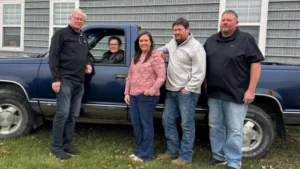 Related Story: A shattered leg, a blood sample and a discovery that may have saved a family
A Mayo Clinic Biobank sample led to the discovery of a rare inherited mutation in Chad Rockow and three family members.
“Ten years ago, only a fraction of the things that are now being returned were returnable,” Dr. Olson says. “As more and more knowledge is gained, more and more patients are going to have results that are returnable.”
A research resource built for future discoveries
Long before “biobank” became a familiar term, Dr. Olson was helping build one. She and her colleague, Fergus Couch, Ph.D., established one of Mayo Clinic’s early biobanking resources through the Mayo Clinic Breast Cancer Study. The collection brought together blood samples and health information from approximately 10,000 women with breast cancer.
That resource has enabled collaborations with researchers across the globe and contributed to important discoveries through the Breast Cancer Association Consortium (BCAC), CARRIERS (Cancer Risk Estimates Related to Susceptibility), and the Triple Negative Breast Cancer Consortium.
Dr. Olson calls genomic data a “renewable resource” because the same genetic information can be studied again and again without using up the original sample. Preserving physical specimens means researchers can return to them as new technologies emerge, sometimes uncovering biological information that could not be measured when the samples were first collected. In this way, biobanking allows samples donated today to continue supporting discoveries well into the future.
She is applying that thinking to Mayo Clinic’s next generation of research, advising a collection envisioned to eventually include as many as 1 million participants and contributing to Precure Research, a Mayo Clinic initiative which is building cohorts to study biological changes before illness becomes clinically apparent.
“We’re always aware that samples that we collect, we’re going to set aside a portion, so that when the technology comes along, we have the samples ready,” Dr. Olson says.
For Dr. Olson, the Biobank’s greatest significance lies in the people behind it: Every sample carries the trust of someone who chose to help science move forward for someone else.
The bigger picture
This research aligns with Mayo Clinic’s broader Precure Research initiative, which focuses on developing tools and approaches to identify disease-related risk earlier, before symptoms emerge or conditions become more difficult to treat. Visit mayo.edu/research/precure for more information.
Disclaimer
Artificial Intelligence Disclosure & Legal Disclaimer
AI Content Policy.
To provide our readers with timely and comprehensive coverage, South Florida Reporter uses artificial intelligence (AI) to assist in producing certain articles and visual content.
Articles: AI may be used to assist in research, structural drafting, or data analysis. All AI-assisted text is reviewed and edited by our team to ensure accuracy and adherence to our editorial standards.
Images: Any imagery generated or significantly altered by AI is clearly marked with a disclaimer or watermark to distinguish it from traditional photography or editorial illustrations.
General Disclaimer
The information contained in South Florida Reporter is for general information purposes only.
South Florida Reporter assumes no responsibility for errors or omissions in the contents of the Service. In no event shall South Florida Reporter be liable for any special, direct, indirect, consequential, or incidental damages or any damages whatsoever, whether in an action of contract, negligence or other tort, arising out of or in connection with the use of the Service or the contents of the Service.
The Company reserves the right to make additions, deletions, or modifications to the contents of the Service at any time without prior notice. The Company does not warrant that the Service is free of viruses or other harmful components.