As Americans prepare for Black Friday and holiday shopping, AARP is warning consumers about fake delivery messages and shopping scams. But where are scam concerns and reports highest?
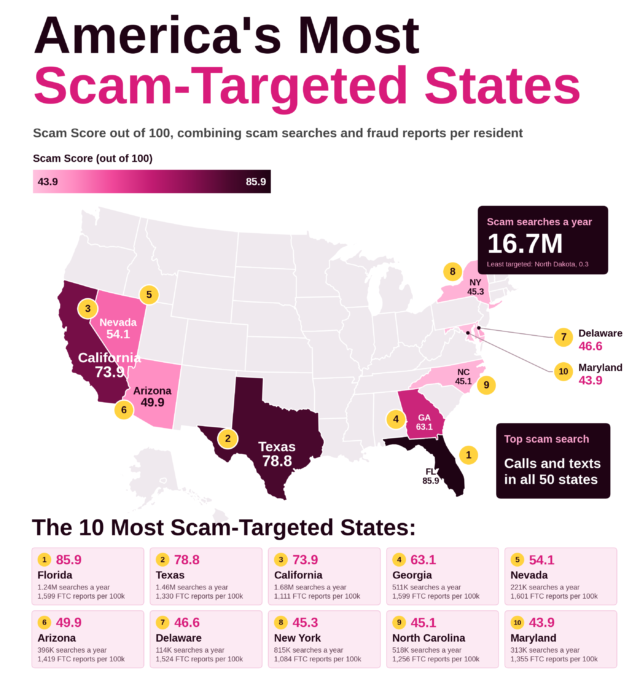
A new study reveals Florida is the most scam-targeted state in America, scoring 85.9 out of 100, ahead of Texas (78.8) and California (73.9), as experts at Gamble Mind analysed more than 16.7 million scam-related searches a year across the 50 states.
Key findings:
- Florida, Texas and California are the three most scam-targeted states, with Georgia (63.1) and Nevada (54.1) completing the top five.
- Nevada has the highest rate of FTC fraud and other reports in the country, at 1,601 per 100,000 residents, followed by Georgia and Florida (both 1,599) and Delaware (1,524). That is more than 50% above the average state (1,056) and 2.4 times the rate in North Dakota (661).
- Delaware has the highest search rate of any state with more than one million residents, at 10,755 scam-related searches per 100,000 people a year, before ranking seventh overall.
- Scam calls, texts and messages are the most-searched specific scam type in all 50 states, making up 37% of category-specific scam searches, ahead of payment and banking scams (15%) such as Zelle, Venmo and Cash App.
- The Dakotas are the least targeted: North Dakota (0.3) and South Dakota (2.0) score lowest, followed by Nebraska, Iowa and Vermont.
The experts at Gamble Mind analyzed 193 scam-related search terms across 12 categories, from scam calls and texts to fake casino sites, and combined each state’s annual search volume with its 2025 Federal Trade Commission (FTC) fraud and other reports per 100,000 residents to give every state a score out of 100. The ranking reflects how heavily states are targeted and how concerned residents are, not confirmed losses.

The 10 most scam-targeted states in America
|
Rank |
State |
Score / 100 |
Annual scam searches |
FTC reports per 100k (2025) |
|---|---|---|---|---|
|
1 |
Florida |
85.9 |
1,236,600 |
1,599 |
|
2 |
Texas |
78.8 |
1,463,400 |
1,330 |
|
3 |
California |
73.9 |
1,680,000 |
1,111 |
|
4 |
Georgia |
63.1 |
510,600 |
1,599 |
|
5 |
Nevada |
54.1 |
221,400 |
1,601 |
|
6 |
Arizona |
49.9 |
396,000 |
1,419 |
|
7 |
Delaware |
46.6 |
114,000 |
1,524 |
|
8 |
New York |
45.3 |
814,800 |
1,084 |
|
9 |
North Carolina |
45.1 |
517,800 |
1,256 |
|
10 |
Maryland |
43.9 |
313,200 |
1,355 |
The full data set is available here.
Florida leads a Sun Belt cluster
Florida takes the top spot with the highest combined score in the country. It pairs more than 1.2 million scam-related searches a year with 1,599 FTC fraud and other reports per 100,000 residents, one of the three highest rates in the nation. Georgia matches that report rate exactly, while Arizona (1,419) and North Carolina (1,256) also sit in the top ten, which puts six of the ten most targeted states in the South or Sun Belt.
Texas and California top the search volume
California (1.68 million) and Texas (1.46 million) record the most scam-related searches of any state, reflecting their size. Texas also reports fraud at a rate well above the state average (1,330 per 100,000), while California’s rate (1,111) is closer to the middle of the pack, so its third-place finish is driven mainly by the sheer number of residents looking for help.
Nevada tops the country for fraud reports per resident
Nevada ranks fifth overall on the combined score, but it records the highest FTC fraud and other reports rate of any state at 1,601 per 100,000 residents. Delaware is another state that punches above its weight: it ranks seventh overall, with a search rate of 10,755 per 100,000 residents that is the highest of any state with more than a million people.
What are Americans searching for?
Strip out generic searches such as “scam” or “is it legit” and the picture is consistent in every state: scam calls, texts and messages come first, driven by searches like “smishing,” “spam call” and “phishing email.” Payment and banking scams (15%) are second, led by Zelle, Cash App, Venmo and PayPal, followed by shopping and ticket scams (9%), delivery and toll scams (7%) and government and donation scams (7%).
How do gambling scams compare?
Casino and gambling scams account for around 4% of category-specific scam searches, so calls and messages draw roughly eight times as many searches. But gambling is far from a niche worry: searches about fake casinos, unlicensed sites and fake betting apps (27,350 a month across the 50 states) are on a par with AI and deepfake scams (28,200) and romance scams (26,700), and ahead of crypto and investment scams (22,200) and job scams (16,150).
Where scams are searched least
North Dakota (0.3), South Dakota (2.0), Nebraska (6.3), Iowa (6.3) and Vermont (8.4) record the lowest scores, with North Dakota’s FTC rate of 661 reports per 100,000 residents the lowest in the country. Lower scores do not mean residents are safe from scams, only that fewer are searching for or reporting them.
Paulius Cubera, iGaming expert and Chief Editor at Gamble Mind, comments on how to spot and avoid a gambling scam:
“Scammers go where the attention is, and right now that is scam calls and texts, but gambling has its own playbook, and it is getting more convincing. AI has made it cheap to clone a celebrity’s voice, fake a winning screenshot or run a ‘giveaway’ video that looks entirely real. The tools have changed, but the trap has not: the moment you are asked to pay before you can win or withdraw, it is a scam.
“Most importantly, scams rely on urgency, so a countdown timer, a ‘last chance’ bonus or a message from ‘support’ that rushes you is the signal to stop and verify through a channel you found yourself.”
- Treat any giveaway that asks for money as fake. Real operators never charge a ‘verification,’ ‘tax’ or ‘release’ fee to pay out winnings. Be especially wary of videos where a famous voice promises to double your deposit; AI voice and face cloning means it no longer proves anything.
- Check the license, then check it with the regulator. Only a handful of states license real-money online casinos, so look the operator up on the state gaming regulator’s website rather than trusting a badge on the site itself. Many sweepstakes-style casinos operate in a gray area and are being restricted in a growing number of states.
- Download apps only from official stores or the operator’s own site. Fake sportsbook apps copy real branding and arrive through ads, texts and social posts.
- Be suspicious of guarantees. Fixed matches, ‘insider’ tipsters and bonuses that look too good to be true are almost always bait, and an AI chatbot or a screenshot of winnings is not proof.
- Beware recovery services. After a loss, scammers pose as experts who can retrieve your money for an upfront fee. Contact your card issuer or bank first and report it to the FTC at ReportFraud.ftc.gov.
Search data: Google Keyword Planner, US, 193 scam-related terms grouped into 12 categories, aggregated annually. Official data: FTC Consumer Sentinel, 2025 fraud and other reports per 100,000 residents. Population: 2025 US Census estimates. Scores are normalized from 0 to 100 and equally weight search volume and FTC report rate. District of Columbia is excluded from the ranking because FTC state data was not available.
Handout – Gamble Mind
Disclaimer
Artificial Intelligence Disclosure & Legal Disclaimer
AI Content Policy.
To provide our readers with timely and comprehensive coverage, South Florida Reporter uses artificial intelligence (AI) to assist in producing certain articles and visual content.
Articles: AI may be used to assist in research, structural drafting, or data analysis. All AI-assisted text is reviewed and edited by our team to ensure accuracy and adherence to our editorial standards.
Images: Any imagery generated or significantly altered by AI is clearly marked with a disclaimer or watermark to distinguish it from traditional photography or editorial illustrations.
General Disclaimer
The information contained in South Florida Reporter is for general information purposes only.
South Florida Reporter assumes no responsibility for errors or omissions in the contents of the Service. In no event shall South Florida Reporter be liable for any special, direct, indirect, consequential, or incidental damages or any damages whatsoever, whether in an action of contract, negligence or other tort, arising out of or in connection with the use of the Service or the contents of the Service.
The Company reserves the right to make additions, deletions, or modifications to the contents of the Service at any time without prior notice. The Company does not warrant that the Service is free of viruses or other harmful components.