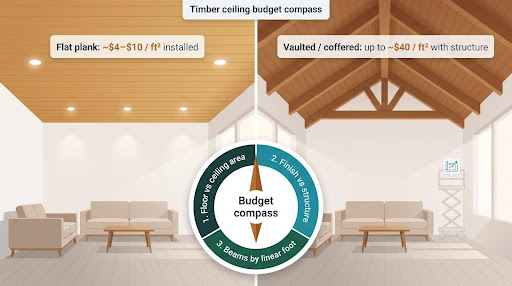
Timber ceiling cost per square foot isn’t one-size-fits-all. In 2026, you’ll spend roughly $4–$10 to clad a flat pine tongue-and-groove lid, while the same room—vaulted or coffered—can top $40 once scaffolds, engineers, and hurricane hardware enter the job. Geometry, height, and scope—not wood species—drive that jump.
Budget compass
- Confirm whether the bid measures floor area or the actual ceiling surface.
- Separate finish work from any structural change.
- Price beams by the linear foot.
Lock in those three rules, and your quotes will finally compare apples to apples.
Identify the ceiling style before comparing prices
Before any numbers matter, you need to name the ceiling you want. A flat pine lid, a vaulted cedar shell, and a grid of box beams live in different price worlds.
British Columbia-based timber frame designer and manufacturer Hamill Creek Timber Homes groups the most popular timber frame ceiling styles into three families: wood paneling or tongue-and-groove, drywall, and hybrid tray or coffered ceilings. Its guide notes that when building from scratch, most styles cost about the same, with tongue-and-groove a bit more expensive, while complex designs such as cathedral ceilings raise the price. Vaulted ceilings always cost more because of the extra space, although good insulation can make up the difference over time.

Below, we price the most common timber options, flat planks, vaulted or cathedral, tray, coffered, and exposed-beam ceilings, and explain how each one shifts both surface area and labor. First up: the flat plank ceiling most homes use as a starting point.
Flat planked ceilings
Swap drywall for continuous wood boards on an eight-foot lid, and you have a flat plank ceiling. Because the surface stays level, crews work from ladders instead of lifts and seldom need an engineer.
- Typical installed cost: $4 – $10 per square foot for pine or cedar tongue-and-groove, labor included (HomeGuide cost guide)
– Board width. Six-inch faces need about 200 linear feet per 100 ft²; three-inch boards double that, which doubles fasteners, cuts, and setup.
– Wood grade. Clear cedar or cypress raises material cost, while paint-grade pine or poplar lowers it.
– Finish. Factory prefinish often beats on-site sanding, priming, and painting.
Remember to measure the actual ceiling surface, not the room’s floor area; flat planks keep that math one-to-one and set the baseline every other style must exceed.
Vaulted and cathedral ceilings
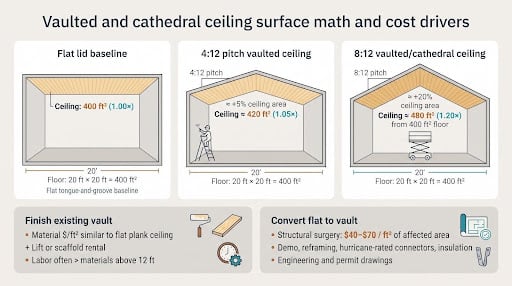
Tilt your room so two roof planes meet at a ridge, and the square footage overhead quietly expands. A vaulted surface is larger than the floor below, and every extra square foot must travel up a ladder or lift.
Surface math
– A modest 4-in-12 pitch adds about five percent to the ceiling area.
– An 8-in-12 pitch adds roughly twenty percent, turning a 400 ft² floor plan into about 480 ft² of boards to cut and nail.
Why costs diverge
- Finishing an existing vault
- Material rates mirror a flat plank ceiling, but add lift or scaffold rental, plus slower setup. Labor typically overtakes materials once work rises above 12 feet.
- Converting a flat ceiling into a vault
- Structural surgery (demo, new rafters or a ridge beam, hurricane-rated connectors, insulation, and permit drawings) runs $40 to $70 per square foot of affected area before any wood finish is installed (HomeGuide vaulted-ceiling guide).
Quick check
Most online “vaulted ceiling cost” figures cover only the structural conversion. Ask whether a quote includes framing changes or only cedar boards and trim; the answer can swing the bill by tens of thousands of dollars.
Tray and coffered ceilings
Walk into many Florida dining rooms and you’ll see a shallow drywall recess edged with crown; that’s a tray ceiling. Deepen the recess and add a grid of beams, and you get a coffered ceiling. Both feel upscale, but they pressure your budget in different ways.
Tray ceilings
– Typical installed cost: $3 – $7 per square foot of ceiling area, plus a perimeter allowance for the riser walls (HomeGuide tray-ceiling guide)
– Why: Crews frame the drop, hang drywall, leave, then return to finish seams and crown. Two mobilizations lift labor slightly above a flat-plank baseline.
Coffered ceilings
– Typical installed cost: $10 – $40 per square foot of ceiling surface plus beam linear footage for dense grids (HomeGuide coffered-ceiling guide)
– Why: Every intersection needs four miters, sanding, and caulk. Doubling the squares doubles the beam faces, not just the paint.
Budget lever: keep beam spacing generous and stick with paint-grade material if you want visual depth without boutique pricing.
Exposed-beam and hybrid ceilings
A single timber beam can frame a room as strongly as paint, but costs follow linear-foot rules, not square-foot math.
Decorative box or faux beams
– Material: $12 – $35 per linear foot for polyurethane, MDF, or hollow wood shells
– Professional install: $15 – $35 per linear foot for blocking, hidden fasteners, and touch-up (Angi faux-beam cost guide)
Length, depth, and spacing, not room size, steer the bill. One 12-foot beam can equal the price of 40 ft² of planks because carpenters build a mounting spine and finish three visible faces.
True structural timber
Engineering, hurricane-rated hardware, and lift time add a zero, so structural beams are priced job by job. Equipment rental and inspection fees often outstrip the beam itself.
Cost-savvy design
Keep spans wide, choose paint-grade box beams over kiln-dried oak, and limit exposed timber to sight lines such as above the island, over the dining table, or framing the lanai, where guests will focus.
Why the vault usually changes the price more than the species
A vaulted ceiling reshapes both the quantity of material and the kind of work required. Three forces drive the jump:
1. More square feet to cover
A sloped plane enlarges the surface. In a 20 × 20-foot room, an 8 : 12 vault turns 400 ft² of floor into about 481 ft² of ceiling. At $8 per square foot installed, the finish climbs from about $3,200 to about $3,850 before lifts or ridge trim, and you still order about 10 percent extra boards for waste.
2. Structure may change
Cutting truss webs or adding a ridge beam moves the job into engineering and high-velocity-wind hardware, all priced as fixed dollars, not square feet.
3. Trades must chase the ceiling
Higher cans need IC-rated housings; fans want longer downrods; ducts and sprinkler drops extend. Late coordination triggers costly change orders.
Design lever: If volume matters more than rustic texture, keep the existing structure and specify wider boards. You’ll capture the drama of height without paying twice, in surface and in structure.
South Florida factors that can change a timber-ceiling quote
Humidity, acclimation, and finishing
South Florida air can hover above 70 percent RH on summer afternoons. EPA guidance says indoor humidity should stay between 30 and 50 percent to limit swelling, cupping, and mold (EPA indoor air guide). Crews stage boards on-site until moisture readings sit within two percent of the conditioned space; the one- to three-day hold adds storage labor but prevents costly callbacks.
Finish strategy shifts as well. Oil varnish cures slowly in damp air, so many shops prefinish boards under controlled RH, wrap them, then deliver just in time. Freight and careful handling replace on-site sanding in the bid.
Drywood and subterranean termites
The Florida Department of Agriculture and Consumer Services lists drywood and subterranean termites statewide. Drywood species fly in through tiny eave gaps, so kiln-dried, factory-sealed boards and a post-install inspection for “kick-out” holes provide the first defense. Whole-house fumigation follows only after a confirmed infestation and is usually pricier than the ceiling itself.
Hurricane rules when structure changes
Florida Building Code prohibits cutting or splicing trusses without stamped engineering. Retrofit vaults, therefore, add ridge-beam calculations, hurricane clips, and tie-downs; hardware that costs $5 – $10 each multiplies fast at cathedral height. Keeping joists intact keeps the hurricane chapter mostly out of your permit fee.
Conclusion: Where to Save Money Without Cheapening the Ceiling
Keep the structure. Leave joists and trusses intact, and you skip engineering fees, hurricane hardware, and weeks of permits.
Concentrate the wow. Timber the great room, entry, or island vault, and let bedrooms keep smooth drywall. One showpiece beats blanket coverage.
Choose wider, off-the-shelf boards. A 6-inch face halves the rows and fasteners versus a 3-inch profile.
Lock the lighting plan first. Pre-drilled boards for cans and fan boxes remove on-site cuts that add scrap and overtime.
Simplify beam layout. A three-beam grid anchors the space without the miter marathon of dense coffers.
Compare pre- and site-finished bids. Factory stain cures dust-free, while on-site painters fight humidity. Pick the cheaper total, not the cheaper gallon.
Blend drywall and timber. A wood tray center with painted risers keeps depth and trims both material and paint dollars.
Small pivots like these protect warmth and craftsmanship while keeping the quote in range.
Disclaimer
Artificial Intelligence Disclosure & Legal Disclaimer
AI Content Policy.
To provide our readers with timely and comprehensive coverage, South Florida Reporter uses artificial intelligence (AI) to assist in producing certain articles and visual content.
Articles: AI may be used to assist in research, structural drafting, or data analysis. All AI-assisted text is reviewed and edited by our team to ensure accuracy and adherence to our editorial standards.
Images: Any imagery generated or significantly altered by AI is clearly marked with a disclaimer or watermark to distinguish it from traditional photography or editorial illustrations.
General Disclaimer
The information contained in South Florida Reporter is for general information purposes only.
South Florida Reporter assumes no responsibility for errors or omissions in the contents of the Service. In no event shall South Florida Reporter be liable for any special, direct, indirect, consequential, or incidental damages or any damages whatsoever, whether in an action of contract, negligence or other tort, arising out of or in connection with the use of the Service or the contents of the Service.
The Company reserves the right to make additions, deletions, or modifications to the contents of the Service at any time without prior notice. The Company does not warrant that the Service is free of viruses or other harmful components.