Everyone makes a typo now and then. However, some errors become permanent parts of the historical record. As Dictionary Scoop notes, “even the smallest slip-ups can lead to catastrophic outcomes, no matter how unintentional.” Throughout history, these “unexpected linguistic detours, induced everything from laughter to financial ruin.”
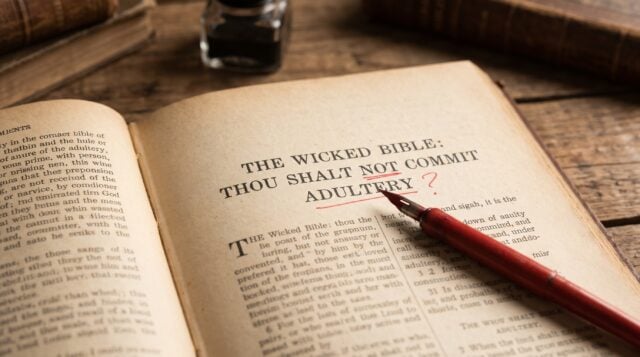
Take the infamous 1631 edition of the Bible, for example. Printers accidentally left out the word “not” from the Seventh Commandment. According to Dictionary Scoop, this error transformed “the original sentence into the scandalous directive, ‘Thou shalt commit adultery.‘” This printing blunder earned the book the permanent nickname “The Wicked Bible.” Centuries later, politicians proved just as vulnerable to public spelling failures. In 1992, Vice President Dan Quayle visited a New Jersey elementary school. A twelve-year-old student wrote the word “potato” on the chalkboard. Dictionary Scoop explains that Quayle “promptly added an e to the end of the word.” He created an awkward viral moment as “he insisted that ‘potatoe’ was the correct spelling.”
While Quayle only lost his pride, other typos cost millions of dollars. In 1962, NASA lost almost eighty million dollars over a single character. Dictionary Scoop reports that “a missing mathematical symbol in Mariner I’s code” doomed the mission. That tiny missing overbar “led to the spacecraft blowing up in a million pieces over the Atlantic.” Punctuation has proven equally expensive for the United States government. In 1872, a clerk placed a comma instead of a hyphen in the Thirteenth Tariff Act. Dictionary Scoop writes that the law exempted “fruit, plants tropical and semi-tropical” from import taxes. Because of that misplaced comma, importers argued that all fruits were tax-exempt. The mistake cost taxpayers over forty million dollars before Congress fixed it.
Journalism and literature also boast plenty of legendary printing slip-ups. In 2015, the Associated Press published an obituary for baseball legend Yogi Berra. However, Dictionary Scoop recalls that it ran under a “hysterical title: ‘Yogi Bear has died. He was 90.'” Two years later, a British newspaper forgot to write a headline altogether. They accidentally printed a front-page placeholder reading “100PT SPLASH HEADING HERE.” Even literary genius James Joyce welcomed accidental words into his work. While dictating Finnegans Wake to Samuel Beckett, someone knocked on the door. Joyce said “Come in,” and Beckett dutifully wrote the words down. Joyce kept the mistake inside the book. As Dictionary Scoop concludes, “even the most brilliant people are not immune to making mistakes.”

Sources
- Dictionary Scoop: https://www.dictionaryscoop.com/article/The-10-Funniest-Mistakes-Typos-And-Misprints-In-History?x_title=0&utm_source=blog&utm_campaign=blog-20261027
Disclaimer
Artificial Intelligence Disclosure & Legal Disclaimer
AI Content Policy.
To provide our readers with timely and comprehensive coverage, South Florida Reporter uses artificial intelligence (AI) to assist in producing certain articles and visual content.
Articles: AI may be used to assist in research, structural drafting, or data analysis. All AI-assisted text is reviewed and edited by our team to ensure accuracy and adherence to our editorial standards.
Images: Any imagery generated or significantly altered by AI is clearly marked with a disclaimer or watermark to distinguish it from traditional photography or editorial illustrations.
General Disclaimer
The information contained in South Florida Reporter is for general information purposes only.
South Florida Reporter assumes no responsibility for errors or omissions in the contents of the Service. In no event shall South Florida Reporter be liable for any special, direct, indirect, consequential, or incidental damages or any damages whatsoever, whether in an action of contract, negligence or other tort, arising out of or in connection with the use of the Service or the contents of the Service.
The Company reserves the right to make additions, deletions, or modifications to the contents of the Service at any time without prior notice. The Company does not warrant that the Service is free of viruses or other harmful components.