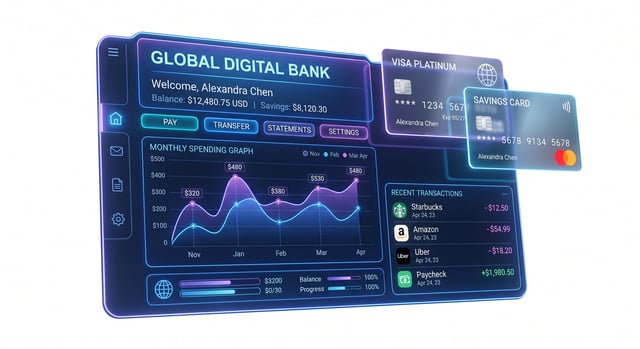
The financial landscape is being transformed at a massive pace, powered by innovative technology and changing consumer expectations. As the consumer moves away from traditional brick and mortar financial institutions, digital-first financial solutions like UR are setting new standards for speed, security and global accessibility. Financial technology is no longer just about digitizing cash; it’s actively rethinking how we engage with money across international borders.
Personal and corporate finance is entering a new era of frictionless, always-on ecosystems. Today’s banking infrastructure is based on predictive analytics, automated compliance and real-time transaction processing. These innovations enable users to manage wealth, perform cross-border transfers, and secure credit without delays in the system. “Anyone who wants to successfully navigate the modern global economy needs to understand these structural shifts.”
The Rapid Evolution of Digital Financial Infrastructure
Open Banking API and Cloud Native Architecture
Once, legacy core systems slowed retail finance’s rapid innovation. Today, modern institutions are building their foundations entirely in cloud native environments, using open banking APIs. This architectural change allows third party integrations. Now users can combine budgeting tools, investment platforms and primary savings into one user-centric dashboard.
Predictive AI-Driven Hyper-Personalization
Artificial intelligence is no longer simply a chatbot answering basic inquiries. Today, machine learning algorithms analyze your historical spending habits, consider your upcoming recurring bills, and proactively recommend the best money moves. These predictive models enable institutions to offer each account holder customized micro-investment opportunities and dynamic budgeting strategies.

7 Digital Banking Trends Impacting the Global Financial Landscape
1. Real-Time Cross-Border Settlement Protocols
Historically, international transfers have taken days, mired down by routing fees and currency conversion spreads from intermediaries. Today, distributed ledger systems and optimized routing mechanisms enable advanced financial networks to process cross-border transactions in real time. This change greatly reduces the cost of remittances for international workforces and enhances liquidity for SMBs involved in global work.
2. Embedded Finance Deep Integration
Financial services are moving out of standalone banking portals and into the software you use every day. Embedded finance provides financial services embedded in the decision-making process, from purchasing products via point-of-sale (POS) financing in an e-commerce app to obtaining instant transit insurance in a ride-hailing app.
3. Next Generation Biometric Verification & Fraud Protection
Passwordless authentication is quickly replacing legacy security practices. Institutions are utilizing biometric parameters to securely confirm access to accounts with facial recognition, continuous behavioral mapping, and fingerprint scanning. These adaptive security engines identify anomalies in real-time and stop a compromised transaction from executing.
4. The Emergence of Smart Micro-Lending Networks
Data-driven underwriting models allow platforms to assess credit risk based on a holistic set of data points instead of just traditional credit scores. Alternative data metrics allow the underbanked to access micro-loans at attractive terms, increasing access to capital and fuelling entrepreneurship globally.
5. Super-Apps Combining Daily Life Services
All-in-one ecosystems are replacing specialized financial apps. These comprehensive mobile platforms bring together conventional savings, payment gateways, lifestyle bookings, identity verification and investment offerings into one simplified interface. The result is a frictionless ecosystem where users can perform their daily operational routines without switching applications.
6. Programmatic Cash and Automated Asset Management
Wealth building is being automated by intelligent contracts and algorithmic rule engines. Account owners can create rule-based triggers, such as automatically investing spare change, dynamically rebalancing investment portfolios during market volatility, or automatically harvesting tax losses. Money management is moving from a manual task to a background automated task.
7. Online Assets and Stablecoins Going Mainstream
Regulated institutions are increasingly linking traditional fiat currencies to asset-backed digital tokens. The hybrid framework enables users to hold value in stablecoins, pay invoices on blockchain networks and earn competitive yields on holdings. It combines the stability of sovereign fiat with the operational agility of decentralized networks.
Strategic Change: Traditional Banking versus Digital Finance for the New Age
To understand why consumer adoption of new-gen platforms is accelerating, compare the metrics legacy banking systems use to measure up to next-gen digital financial platforms:
- Account Onboarding: Traditional banks require branch visits and paperwork, but next-gen platforms can offer instant biometric e-KYC in minutes.
- Transaction Velocity: The digital frameworks enable instant transfers 24/7 while traditional banking is batch based with settlement windows of multiple days.
- Traditional banking is constrained to the hours of local branches, digital platforms are available 24/7 with no downtime.
- Cost Structure: Legacy networks have high overheads on physical real estate, cloud-native applications have low to zero transaction fees, and higher savings yield.
- Personalization Engine: Legacy systems provide static, one-size-fits-all offers, while modern systems leverage AI to provide personalized, real-time financial insights.
Challenges in Security and Regulatory Compliance
Regulatory Systems in Different Countries
As you operate across regional jurisdictions, you must comply with the evolving financial frameworks. Next-generation platforms employ automated RegTech solutions that automatically monitor regulatory developments, apply Know-Your-Customer (KYC) standards and perform Anti-Money Laundering (AML) checks across multiple legal systems.
Increasing Resistance to Sophisticated Cyber Attacks
Threat vectors evolve as financial technology advances. Today’s institutions protect customer assets with multi-layer zero-trust security architectures, end-to-end data encryption in transit and at rest, and automated bug bounty programs that pinpoint system vulnerabilities before they can be exploited.
Understanding the Present Age of Digital Finance
The new financial sector is radically transforming the way capital moves, earns, and grows globally. Next-gen digital platforms remove traditional points of friction to provide unprecedented clarity and convenience, automate personal asset management and increase financial access. Individuals and businesses can build resilient, technology-enabled financial futures by adapting to these ongoing changes in an interconnected global economy.
Disclaimer
Artificial Intelligence Disclosure & Legal Disclaimer
AI Content Policy.
To provide our readers with timely and comprehensive coverage, South Florida Reporter uses artificial intelligence (AI) to assist in producing certain articles and visual content.
Articles: AI may be used to assist in research, structural drafting, or data analysis. All AI-assisted text is reviewed and edited by our team to ensure accuracy and adherence to our editorial standards.
Images: Any imagery generated or significantly altered by AI is clearly marked with a disclaimer or watermark to distinguish it from traditional photography or editorial illustrations.
General Disclaimer
The information contained in South Florida Reporter is for general information purposes only.
South Florida Reporter assumes no responsibility for errors or omissions in the contents of the Service. In no event shall South Florida Reporter be liable for any special, direct, indirect, consequential, or incidental damages or any damages whatsoever, whether in an action of contract, negligence or other tort, arising out of or in connection with the use of the Service or the contents of the Service.
The Company reserves the right to make additions, deletions, or modifications to the contents of the Service at any time without prior notice. The Company does not warrant that the Service is free of viruses or other harmful components.