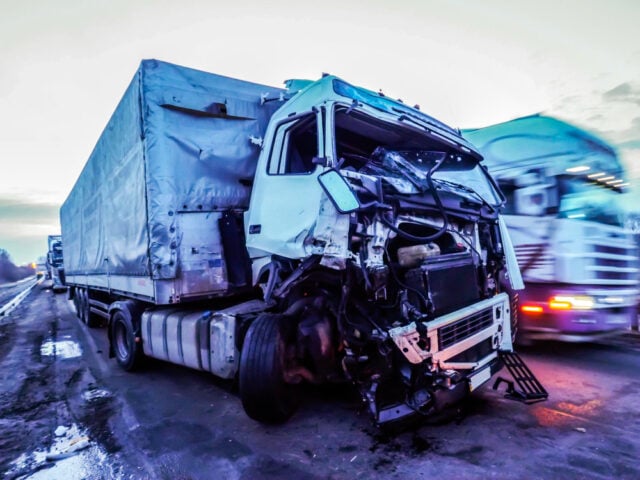
Two truck crashes can look almost identical in a police report. Same highway, similar impact, even similar-looking damage to both vehicles, and yet one claim resolves for far more than the other.
The value of a truck accident settlement in Florida depends on the injuries, medical evidence, lost income, available insurance, and each party’s share of fault. A Florida truck accident lawyer may also need the trucking company’s driver logs and maintenance records to establish responsibility.
Many of the same factors determine how car accident settlements work in Florida, while a truck accident case can involve additional companies and commercial insurance policies. Consider two hypothetical crashes on a Florida highway.
In the first, a commercial truck rear-ends a car in stopped traffic on I-75. The car’s driver develops neck and back pain, gets treated for a few weeks, and recovers on a normal timeline.

In the second, the collision looks almost the same from the roadside, but this driver needs surgery, can’t work for months, and may need more treatment down the road. During the investigation, questions come up about the truck’s maintenance history and how many hours the driver had been on the road that day.
The second claim may involve far greater damages and more parties, even though the collision looked similar from the roadside.
The injury matters more than the damage to the vehicle
A badly dented truck or a totaled car can make a crash look serious, but property damage doesn’t set the value of an injury claim.
Medical records do that work instead: the diagnosis, the treatment, whether surgery was needed, and whether a doctor expects any lasting limitations. Future care matters just as much as what’s already been billed. Someone who finishes treatment in six weeks is in a very different position from someone who may need another procedure two years from now.
Lost income adds another layer. A driver who can’t return to the same job — or can’t do it at the same capacity — is looking at a claim that extends well past the first hospital bill.
A truck crash can involve more than one company
A truck crash may involve more than the two drivers.
The driver behind the wheel is often just the first name on the list. Depending on the facts, the investigation may also look at the motor carrier that employed the driver, the company responsible for maintaining the truck, whoever loaded the cargo, and sometimes a separate leasing company that owns the vehicle. A carrier’s own hiring, training, and maintenance decisions may also be relevant to liability.
Federal hours-of-service rules add a concrete way to test whether the driver or the carrier was at fault. Property-carrying drivers generally may drive up to 11 hours within a 14-hour duty window after 10 consecutive hours off. After 8 cumulative hours of driving without a qualifying interruption, they must take a 30-minute break before driving again. A documented violation — pulled straight from the truck’s electronic logs — can turn a vague “the driver was careless” argument into something much more specific.
That’s part of why a firm handling a serious commercial crash pulls driver logs, maintenance records, and carrier paperwork early, because those documents can determine both who’s actually responsible and which insurance policy is even in play.
Available insurance sets a ceiling nobody sees on the police report
Proving serious damages doesn’t automatically mean there’s a large enough policy to reach.
The Federal Motor Carrier Safety Administration (FMCSA) requires at least $750,000 in liability coverage for many interstate, for-hire general-freight carriers operating vehicles of at least 10,001 pounds. Certain hazardous-material carriers must carry $5,000,000. That’s a very different starting point from an ordinary driver’s minimal Florida policy, and it’s one reason two crashes with comparable injuries can play out so differently: one may involve a single modest policy, while the other opens up several separate, much larger ones tied to the driver, the carrier, and possibly a third party.
A complete insurance review identifies every policy that could apply, including coverage held by the carrier and any other responsible company.
Fault still changes the numbers
Say the truck driver made an unsafe lane change — but the other driver was also speeding at the time.
For lawsuits filed after March 24, 2023, Florida no longer follows pure comparative negligence. Under Fla. Stat. § 768.81(6), added by House Bill 837, a claimant in most negligence cases who is found more than 50% at fault for their own injuries can’t recover anything at all: not a reduced amount, nothing. At 50% or less, the recovery is simply reduced by that percentage. That single rule turns fault allocation into one of the most contested parts of a truck claim, because insurers have a real incentive to push blame past that 50% line rather than just chip away at the total.
Even a small shift in the fault percentage can matter enormously once real damages are on the table.
Why an early settlement offer may not tell you much
An insurance offer can show up before the full picture is even clear.
At that point, a doctor may not yet know whether surgery is needed. The injured person may not know when — or whether — they can return to their old job. Records from the trucking company may not be fully reviewed, and other applicable insurance may not even be identified yet.
Accepting a settlement generally ends the claim. There’s no reopening it later because an injury turned out to be more serious, or more expensive, than it looked at first. That’s why it’s worth understanding whether a lawyer is actually necessary before signing anything, especially in a truck case where more than one party and more than one policy may be involved.
The more useful question after a Florida truck crash usually isn’t “what do these cases typically pay?” It’s: what are the actual injuries, who might be responsible, what evidence supports that, and what insurance is actually available in this specific case? Those answers are what explain why two crashes that look identical from the roadside can end up nowhere near the same place.
What to document and preserve after a Florida truck crash
Some of the evidence that separates a thin claim from a strong one disappears quickly. Carriers are generally required to keep electronic logs and supporting records for only six months, so waiting to ask for them can mean they are gone. Photos, witness details, and medical paperwork are easier to gather in the first days than months later.
- Photos of the scene, the truck’s unit number, the company name and USDOT number on the door, and all vehicle damage
- Names and contact details for witnesses and the responding officer, plus the crash report number
- Every medical record, bill, and work note from the first visit onward
- Notes on every call or message from an insurance adjuster, kept in writing
Florida also sets a filing deadline for most negligence claims, and it is shorter than it used to be: generally two years, instead of four, for injuries from accidents after March 24, 2023. Speaking with a Florida personal injury lawyer early helps make sure those records are requested and the deadline is not missed.
FAQ
Is there a typical truck accident settlement amount in Florida?
Not a reliable one. Injury severity, future treatment, lost income, fault, and how much insurance is actually available can vary enormously from one truck crash to the next, even when the crashes themselves look similar.
Does the trucking company automatically pay if its driver caused the crash?
Not automatically. Responsibility depends on the driver’s relationship to the company and the specific facts around the vehicle, its maintenance, and how it was being operated at the time. That’s why driver logs and maintenance records are often reviewed early in a serious truck case.
Can I still recover damages if I was partly at fault for a truck accident in Florida?
Yes, but only up to a point. Under Fla. Stat. § 768.81(6), which applies to lawsuits filed after March 24, 2023, a claimant in most negligence cases who is found more than 50% at fault recovers nothing. At 50% or less, the recovery is reduced by that percentage instead of being eliminated.
Disclaimer
Artificial Intelligence Disclosure & Legal Disclaimer
AI Content Policy.
To provide our readers with timely and comprehensive coverage, South Florida Reporter uses artificial intelligence (AI) to assist in producing certain articles and visual content.
Articles: AI may be used to assist in research, structural drafting, or data analysis. All AI-assisted text is reviewed and edited by our team to ensure accuracy and adherence to our editorial standards.
Images: Any imagery generated or significantly altered by AI is clearly marked with a disclaimer or watermark to distinguish it from traditional photography or editorial illustrations.
General Disclaimer
The information contained in South Florida Reporter is for general information purposes only.
South Florida Reporter assumes no responsibility for errors or omissions in the contents of the Service. In no event shall South Florida Reporter be liable for any special, direct, indirect, consequential, or incidental damages or any damages whatsoever, whether in an action of contract, negligence or other tort, arising out of or in connection with the use of the Service or the contents of the Service.
The Company reserves the right to make additions, deletions, or modifications to the contents of the Service at any time without prior notice. The Company does not warrant that the Service is free of viruses or other harmful components.