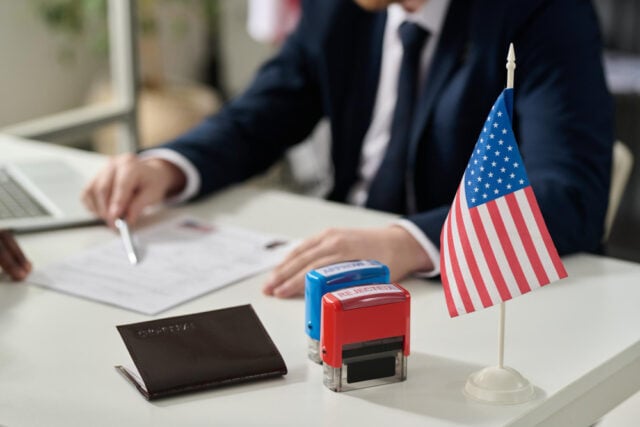
Applying for an E-1 visa can be a lot to handle. You need to prove that your business has a real and operating trading relationship with the country. You also need to provide documents that show how the business works, who owns it, and what kind of trade it conducts.
That is where an E1 visa lawyer can help. They can look at your situation, explain the requirements, organize your documents, and help you avoid common filing mistakes.
Table of Contents
What Does an E-1 Visa Application Require?

How Can a Lawyer Help With Your Business Evidence?
What Can an E-1 Lawyer Do During the Application Process?
What Happens After You File Your E-1 Visa Application?
What Does an E-1 Visa Application Require?
The E-1 is a nonimmigrant visa for people from countries that have the required treaty relationship with the United States. It is designed for a treaty trader who carries on qualifying trade with the U.S.
To qualify, you need to show that:
- You’re a national of a treaty country.
- Your business has the required ownership structure.
- The company conducts substantial trade in the United States.
- More than 50% of the company’s trade is between the U.S. and the treaty country.
- The trade is ongoing rather than based on one isolated transaction.
- You’ll work in a qualifying position if you apply for an employee position.
Trade does not have to mean physical products. It can include services, technology, banking, insurance, transportation, and other forms of commercial activity.
The company also needs to be a real and operating business. This is often referred to as a bona fide enterprise.
An immigration lawyer can review these requirements with you before you file. This can help you find problems early instead of discovering them after submitting the application.
How Can a Lawyer Help With Your Business Evidence?
One of the biggest parts of an E-1 case is the supporting evidence. The government needs to see that your company is actually carrying on a qualifying trade.
That can mean gathering a lot of paperwork.
Your documents may include:
- Invoices
- Purchase orders
- Sales contracts
- Shipping records
- Customs records
- Bank statements
- Tax returns
- Financial statements
- Business ownership documents
- Customer records
- Supplier agreements
An E-1 visa application often requires detailed documentation of trade. Your E1 visa lawyer can help sort through those records and determine which documents are useful for showing the company’s trading activity. They can review the company’s records and point out missing information before the application is filed.
What Can an E-1 Lawyer Do During the Application Process?
An E-1 lawyer can help with much more than filling out forms. They can look at the bigger picture and develop a legal strategy around your particular situation.
For example, they may help you:
- Check whether you meet the eligibility criteria.
- Review the company’s ownership.
- Analyze your trade records.
- Organize supporting evidence.
- Prepare application forms.
- Check that information is consistent across documents.
- Explain potential problems with your case.
- Prepare yourself for questions about the company.
- Help respond to requests for additional evidence.
E-1 visa lawyers also assist with preparing application forms like the DS-160. Applicants applying through a U.S. embassy or consulate generally need to complete this form.
De Wit Immigration Law can help clients review their application details, organize supporting documents, and better understand the requirements that apply to their case. Getting professional help with immigration services can be particularly useful when the business has several owners, multiple sources of trade, or complicated financial records.
What Happens After You File Your E-1 Visa Application?
Filing the visa application is not the final step. Depending on your case, you may need to attend an interview at a consulate or U.S. embassy.
You may be asked about:
- Your company’s ownership
- Your business activities
- Your customers
- Your suppliers
- The type of trade you conduct
- The amount of trade
- Your role in the company
- Your plans in the United States
A trusted lawyer can help you prepare for the visa interview. They can go over the types of questions you may face and help you understand the documents you should bring.
If your visa is approved, the issuance allows you to travel to the United States and request admission.
FAQs
Can my family come with me?
Yes. E-1 visa holders can bring both their spouse and children under 21. E-1 spouses may also be authorized to work in the United States under current rules.
How much trade is needed for an E-1 visa?
The law does not set one simple dollar amount for substantial trade. Instead, officers consider the overall volume and nature of the transactions. More than half of the company’s international trade must typically be between the United States and the relevant treaty country.
Is an E-1 the same as an E-2?
No. The E-1 visa is based on trade, while the E-2 is based on a substantial investment in a U.S. business. The two visa categories have different requirements.
Find the Best E-1 Visa Lawyer
An E-1 case involves more than completing a few forms. You need to show that your company has the right ownership, conducts qualifying trade, and continues to operate as a real business.
An immigration lawyer can help you with the requirements and prepare the supporting evidence. They can also review your forms, help you prepare for the interview, and guide you through the entire process.
Disclaimer
Artificial Intelligence Disclosure & Legal Disclaimer
AI Content Policy.
To provide our readers with timely and comprehensive coverage, South Florida Reporter uses artificial intelligence (AI) to assist in producing certain articles and visual content.
Articles: AI may be used to assist in research, structural drafting, or data analysis. All AI-assisted text is reviewed and edited by our team to ensure accuracy and adherence to our editorial standards.
Images: Any imagery generated or significantly altered by AI is clearly marked with a disclaimer or watermark to distinguish it from traditional photography or editorial illustrations.
General Disclaimer
The information contained in South Florida Reporter is for general information purposes only.
South Florida Reporter assumes no responsibility for errors or omissions in the contents of the Service. In no event shall South Florida Reporter be liable for any special, direct, indirect, consequential, or incidental damages or any damages whatsoever, whether in an action of contract, negligence or other tort, arising out of or in connection with the use of the Service or the contents of the Service.
The Company reserves the right to make additions, deletions, or modifications to the contents of the Service at any time without prior notice. The Company does not warrant that the Service is free of viruses or other harmful components.