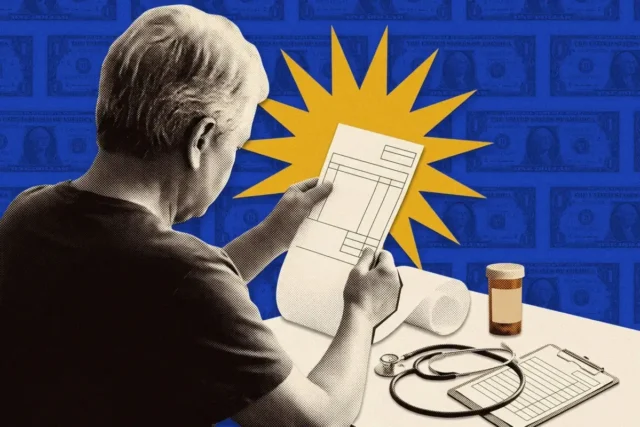
Medicare’s annual open enrollment period began last week. As many as 5 million retirees with Medicare Advantage plans stand to lose their coverage at the end of the year as insurance companies pare back their offerings to offset rising costs.
While being forced to choose a new plan if you’re happy with your current coverage can be frustrating, healthcare policy experts say this enrollment window offers an unusual opportunity for this group of retirees to enroll in a new plan that is potentially a better fit for their medical needs.
Must Read
- You’re probably eligible to save money on car insurance. Compare rates for your ZIP code with this free — and fast — tool from Money.
- Rising prices making credit card debt harder to manage? See whether you qualify for debt relief with this free, no-obligation check.*
- Meet your financial goals faster: Take this free, no-obligation quiz to get matched with an advisor today.
According to KFF, a nonprofit healthcare organization, about 55% of the roughly 70 million Americans eligible for Medicare are enrolled in a private Medicare Advantage plan in 2026. This is the fourth year in a row that a majority of eligible Americans have opted for a private option over traditional Medicare.
Medicare Advantage is popular for many reasons, but cost is one of the biggest, according to Heather Schreiber, founder of HLS Retirement Consulting. These plans generally have more affordable monthly premiums, with some as low as $0. (By comparison, the traditional Medicare premium is $202.90 a month per person in 2026, with surcharges for high-income enrollees.)

Insurers also market Medicare Advantage plans with a slew of additional benefits such as prescription drugs — traditional Medicare enrollees have to buy a separate policy for drug coverage. Many Medicare Advantage plans also offer dental and vision coverage, for which traditional Medicare enrollees have to pay out of pocket or buy standalone policies. Some plans have even more bells and whistles.
“Medicare Advantage plans can look attractive because often they have $0 premiums and benefits built in,” Schreiber says.
But the lower upfront costs and extras come with trade-offs. While retirees who pay for traditional Medicare have access to almost any doctor and hospital, Medicare Advantage plans have more restrictions. They control costs via provider networks, prior authorization requirements and other limitations — similar to the way most employer-sponsored health insurance operates.
What’s more, a lot of people who sign up for Medicare Advantage because of the perks — which can include debit cards to pay for over-the-counter medications, gym memberships and more — don’t even wind up using them. “About 3 in 10 Medicare Advantage enrollees in our surveys said that they hadn’t used any of their supplemental benefits in the prior year,” Gretchen Jacobson, vice president of Medicare policy at the nonprofit Commonwealth Fund, tells Money via email. If you’re picking a Medicare Advantage plan because its perks sound appealing, make sure you actually take advantage of those benefits.
Losing your plan offers a ‘rare opportunity’
Traditional Medicare offers more robust coverage and much greater freedom of choice, but there’s one big caveat: Although the program covers 80% of most medical services outside of long-term care, the enrollee is responsible for the other 20% — and there’s no limit.
A catastrophic diagnosis like cancer or a heart attack could easily be financially ruinous, so many Medicare enrollees also pay for a supplemental “Medigap” plan that covers most of those additional costs. When retirees first become eligible for Medicare, they have a window of eligibility to buy a Medigap plan without medical underwriting, but after that, insurers can charge more, impose limitations on coverage or deny them outright.
People who choose Medicare Advantage largely forfeit the opportunity to get a guaranteed-issue Medigap policy. One of the few exceptions is if their plan is discontinued or the insurer stops offering it where they live.
“This does provide a rare opportunity for folks,” Schreiber says. If you’ve lost your Medicare Advantage plan — especially if your health situation has worsened since you first enrolled — you might want to consider transitioning to traditional Medicare with a Medigap plan. (Keep in mind, you’ll also need a prescription drug plan, which has a separate premium.)
Other tips for picking a new plan
If you need to choose a new plan and decide that another Medicare Advantage plan is the best fit for you, the premium actually isn’t the initial place you should focus, experts say.
“The first thing they need to look at is the network,” says Paul Ginsburg, director of the Center on Health Policy at the Brookings Institution and professor of health policy at the University of Southern California.
People need to ask themselves, “Does this have my current doctor and the hospital I’d want to go to?” Ginsburg says. Prescriptions should come next, he advises. “Since most people get prescription drug coverage through Medicare Advantage, they’d want to look up if there’s an expensive medication they take regularly.”
“Don’t look at the marketing,” says Jenn Kerfoot, president and COO of health technology firm DUOS.
Instead, Kerfoot says, look at the fine print: What are the limitations on extra perks? What’s included — and what isn’t? She adds that this is a good exercise even for people who plan to keep their current plan, because insurers can and often do change or shrink benefits even if the premium stays the same.
“It might be that their formulary has changed, their network has changed, or their out-of-pocket has changed,” she notes.
Medicare Advantage brokers can help you sort through your options, but be aware: They might earn commissions for selling plans and be incentivized to steer you to a plan that enriches them rather than a plan that better suits your needs. The government’s plan finder can show options available to you without the sales pitch, and the nonprofit State Health Insurance Assistance Program can also help you sort through your options with unbiased advice.
Disclaimer
Artificial Intelligence Disclosure & Legal Disclaimer
AI Content Policy.
To provide our readers with timely and comprehensive coverage, South Florida Reporter uses artificial intelligence (AI) to assist in producing certain articles and visual content.
Articles: AI may be used to assist in research, structural drafting, or data analysis. All AI-assisted text is reviewed and edited by our team to ensure accuracy and adherence to our editorial standards.
Images: Any imagery generated or significantly altered by AI is clearly marked with a disclaimer or watermark to distinguish it from traditional photography or editorial illustrations.
General Disclaimer
The information contained in South Florida Reporter is for general information purposes only.
South Florida Reporter assumes no responsibility for errors or omissions in the contents of the Service. In no event shall South Florida Reporter be liable for any special, direct, indirect, consequential, or incidental damages or any damages whatsoever, whether in an action of contract, negligence or other tort, arising out of or in connection with the use of the Service or the contents of the Service.
The Company reserves the right to make additions, deletions, or modifications to the contents of the Service at any time without prior notice. The Company does not warrant that the Service is free of viruses or other harmful components.