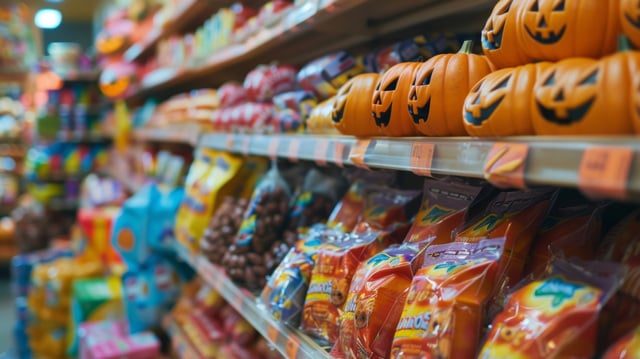
Walking down the seasonal aisle feels a bit spooky lately. You pick up a bag of chocolate bars and check the price tag. Your jaw drops before you even reach the register. Sweet treats now come with a surprisingly sour cost. Neighborhood trick-or-treat bowls are definitely feeling the strain of grocery inflation.
A comprehensive study by FinanceBuzz confirms what shoppers already suspected. Researchers tracked bulk candy pricing across Walmart, Target, Kroger, and Albertsons. FinanceBuzz found that “Halloween candy prices have risen 71% since 2021.” That massive increase is more than triple the overall national inflation rate. During that same five-year timeframe, normal goods rose by twenty-two percent. Candy prices clearly surged far ahead of ordinary household pantry staples.
Bulk bags now carry painful markups compared to recent autumn seasons. FinanceBuzz reported that “the average price for a 100-piece bag of candy is $16.96 this year.” Back in 2021, that exact same bag cost just $9.91. Shoppers must now pay over seven dollars more per bag. FinanceBuzz highlighted that “those three years’ worth of price hikes added $5.05 to the average cost.” Global cocoa shortfalls, sugar tariffs, and freight expenses drove these sharp retail increases.
Examining the numbers on a per-piece basis reveals an equally striking trend. Shoppers used to pay around ten cents for each fun-size bar. Today, that unit cost hovers closer to seventeen cents per piece. Handing out multiple treats to every visitor quickly adds up across a busy evening.

Households are actively rethinking how many treats they can give away. FinanceBuzz noted that “worries about rising candy costs are well-founded” among Halloween shoppers. Total spending across America will still hit a massive record of billions this autumn. Even so, growth in candy spending is finally beginning to slow down. Consumers are simply unwilling to stretch their budgets beyond reasonable limits. Many families refuse to pay exorbitant prices for miniature snack bars.
You do not have to turn off your front porch light to survive October. Smart shoppers can easily protect their wallets with a few practical habits. Estimate your neighborhood turnout before loading up your shopping cart. Buying only what you actually need prevents expensive candy leftovers. Mix premium chocolate treats with more affordable fruit-flavored candies and lollipops. Bulk non-chocolate assortments consistently offer a much lower cost per individual piece. Look for supermarket digital coupons and stack them with cashback credit card rewards. A bit of savvy planning keeps Halloween delightful without terrifying your bank balance.
Candy Budget Verification Checklist
- Estimate visitor counts based on neighborhood traffic patterns from prior seasons.
- Choose non-chocolate variety packs to minimize your average cost per unit.
- Check retailer digital circulars for store coupons before heading to the register.
- Set a firm holiday confectionery spending cap before filling your shopping cart.
Sources Used
Disclaimer
Artificial Intelligence Disclosure & Legal Disclaimer
AI Content Policy.
To provide our readers with timely and comprehensive coverage, South Florida Reporter uses artificial intelligence (AI) to assist in producing certain articles and visual content.
Articles: AI may be used to assist in research, structural drafting, or data analysis. All AI-assisted text is reviewed and edited by our team to ensure accuracy and adherence to our editorial standards.
Images: Any imagery generated or significantly altered by AI is clearly marked with a disclaimer or watermark to distinguish it from traditional photography or editorial illustrations.
General Disclaimer
The information contained in South Florida Reporter is for general information purposes only.
South Florida Reporter assumes no responsibility for errors or omissions in the contents of the Service. In no event shall South Florida Reporter be liable for any special, direct, indirect, consequential, or incidental damages or any damages whatsoever, whether in an action of contract, negligence or other tort, arising out of or in connection with the use of the Service or the contents of the Service.
The Company reserves the right to make additions, deletions, or modifications to the contents of the Service at any time without prior notice. The Company does not warrant that the Service is free of viruses or other harmful components.