By TOM MARQUARDT and PATRICK DARR
Winemakers are always looking toward the sky at harvest. Will that cloud bring rain? Will the birds descend on the ripe grapes? And is it just me, or does it seem like there are more Japanese beetles this year? California vineyard managers scan the sky for guidance—but in Ukraine, Giorgi Iukuridze is scanning it for missiles.

Both are reading the same sky for signs of what threatens the harvest. But where a California grower might reach for a weather app, the owner and CEO of Shabo Wines is calling the shots from his Odesa home about 120 miles from the frontlines of a deadly war that has already forced other Ukrainian estates to farm around shelling and land littered with rocket fragments. His winery and vineyards have been attacked by bombs and drones seven times since the war began—the most recent was last New Year’s Eve. One winemaker’s harvest anxiety is short and in season. The other’s is existential. Remarkably, both winemakers are still out there tending vines, watching the sky for insects and missiles, and harvesting grapes with fingers crossed.
The winemakers’ effort in this war zone is insanely dangerous, raising the question of why anyone would bother. But while some winemakers might throw in the towel after something as comparatively minor as a glassy-winged sharpshooter infestation, Iukuridze refuses to be deterred even by bombs. It wasn’t as if he was destined to make wine. He earned degrees in politics and international relations before catching the wine bug while working in vineyards in Bordeaux, Burgundy, and Languedoc-Roussillon.

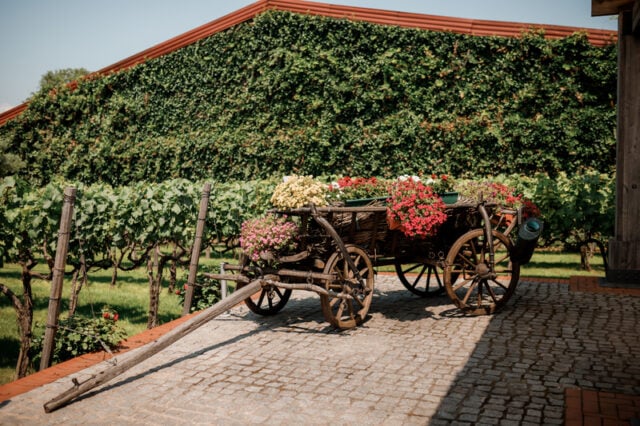
Weather is the least of Iukuridze’s concerns. The vineyards, located in southern Ukraine at near the same latitude as Bordeaux, are along the edge of an estuary about 2 to 3 miles from the open waters of the Black Sea. Winters are dry. Breezes cool the vines during hot summer days and there is plenty of water.
Despite the seemingly impossible war conditions, Iukuridze is feeling good about the current crop. “My dad says that after making wine for 50 years, he has never seen such a remarkable vintage,” Iukuridze said. His father, Vaja Iukuridze, founded Shabo in 2003 after making wine in Georgia.
The political trail of Shabo is as unsteady as the current conflict. Named after the local village, Swiss winemakers founded it after emigrating here in 1822. Russian revolutionaries nationalized it until 2003, when the Ukrainian government offered it for privatization.
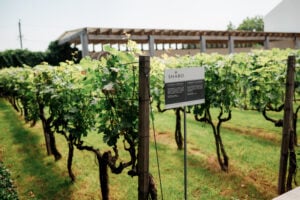
Although the winery grows a number of grape varieties common to Europe, Iukuridze takes the most pride in saperavi and rkatsiteli from Georgia. He raves about the native Ukrainian grape telti-kuruk grape grown in sand on Black Sea beaches. A white grape dating back to the Ottoman era, it escaped the phylloxera devastation.
Reaping grapes from an ideal harvest is the easy part; getting it into the hands of consumers is daunting when lives are at stake. But Iukuridze is not short of optimism. “You get used to it. Our family has been at war with the Russians four times,” he said of his time in Georgia and Ukraine.
He has gotten used to challenging distribution channels, for instance, after a crucial bridge was destroyed early in the war. International deliveries are routed through Moldova; U.S. deliveries pass through Romania. When the Russians recently bombed warehouses, he had to deliver wines directly to retail customers, something American wine producers would find hard to comprehend.
“As soon as they rebuilt the warehouses, the Russians would bomb them again,” he said.
Finding enough personnel is even more difficult. When the war started, 45 of his staff volunteered for the Ukrainian army. But military police plucked another 18 men from the vineyards. A key salesman for the industry was killed by a drone strike. There are times even the company’s accountants and lawyers are recruited to work in the vineyards.
When the Russians destroyed water plants, Iukuridze’s team redeployed their trucks to draw water from artisanal wells and deliver it to hospitals and schools. “I was bottling water instead of wine,” he said, proud to have contributed to the war effort.
Despite the ravages of war, Ukrainians still have a thirst for wine. Iukuridze recalled participating in a wine fair in Kyiv that no one attended the first year. But, the second year, he sold out his wine in the first 5 hours of a three-day festival. Iukuridze said high-end wines like his are second only to vodka in growth.
“Ukrainian are adapting to what’s happening much like they did during COVID. People appreciate every day and they’re not going to give Russians the pleasure of seeing them defeated.”
Although wine sales are important to Shabo, the money-maker is brandy. He makes 3 million bottles of wine each year, but brandy sales are 15 million.
Among Ukraine’s 250 wine producers, Shabo is one of 40 large-scale producers and is priced medium to high. Two large producers have been destroyed in bombing attacks.
At age 28, he avoided the military draft because his winery is generating 20 million euros a year in taxes. “When this war started, our president said everyone has their own front line for victory and independence. This is ours.”

These wines are worth buying just to support Ukrainians and the undeterred Giorgi Iukuridze, but you won’t be disappointed in the quality of these wines. They are distributed in Washington, D.C., and other locations. They are also available online: https://spyrtworldwide.com/shabo/
Shabo Original Collection Rose 2023 ($20). A blend of Pinot Noir and Merlot, this wine has bright strawberry and citrus notes with good acidity and length.
Shabo Original Collection Chardonnay 2023 ($20). Varietal apple and tropical fruit flavors with balanced acidity.
Shabo Telti-Kuruk Reserve 2023 ($30). Native to Ukraine, this pre-phylloxera grape offers a very unique profile. White floral aromas with citrus and stone fruit flavors, fresh acidity, and an intense burst of fruit at the end.
Shabo Saperavi Reserve 2023 ($30). The signature red grape of Georgia, Saperavi offers a funky yet oddly enticing aroma. On the palate, it’s lush with ripe blackberry and blueberry notes.
Shabo Grand Reserve Cabernet Merlot 2023 ($65). This blend comes with a powerful dose of tannins to give it body and longevity. Round in the mouth with plum and raspberry notes and a touch of toasty oak. It is fermented aged in French oak.
Wine picks
Tenuta Rapitala Alto Reale Nero D’Avola Sicilia 2024 ($18-23). Pure notes of cherries and berries with a hint of spice. Deep and rich from an organic single vineyard. We loved this wine!
Browne Family Vineyards Grenache Rosé Columbia Valley 2023 ($20). This is a very exciting rosé worth seeking out. Classic cherry and strawberry fruit notes in a perfectly balanced acidic package.
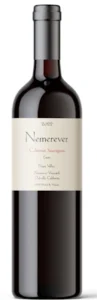
Nemerever Vineyards Estate Cabernet Sauvignon 2022 ($125). This wine tastes expensive and is. Just what you expect and want from a classically styled Napa Cabernet Sauvignon. Very smooth and elegant with abundant cassis and black cherry fruit notes.
Disclaimer
Artificial Intelligence Disclosure & Legal Disclaimer
AI Content Policy.
To provide our readers with timely and comprehensive coverage, South Florida Reporter uses artificial intelligence (AI) to assist in producing certain articles and visual content.
Articles: AI may be used to assist in research, structural drafting, or data analysis. All AI-assisted text is reviewed and edited by our team to ensure accuracy and adherence to our editorial standards.
Images: Any imagery generated or significantly altered by AI is clearly marked with a disclaimer or watermark to distinguish it from traditional photography or editorial illustrations.
General Disclaimer
The information contained in South Florida Reporter is for general information purposes only.
South Florida Reporter assumes no responsibility for errors or omissions in the contents of the Service. In no event shall South Florida Reporter be liable for any special, direct, indirect, consequential, or incidental damages or any damages whatsoever, whether in an action of contract, negligence or other tort, arising out of or in connection with the use of the Service or the contents of the Service.
The Company reserves the right to make additions, deletions, or modifications to the contents of the Service at any time without prior notice. The Company does not warrant that the Service is free of viruses or other harmful components.