By Iñaki Echeverría Huarte, Universidad de Navarra; Angel Garcimartín Montero, Universidad de Navarra, and Iker Zuriguel Ballaz, Universidad de Navarra
This story began, like so many in the history of science, with something we were not looking for.
In 2020, during the COVID-19 pandemic, we were studying a practical question: how do people move around in an enclosed space when you ask them to keep apart from one another? Watching the footage time after time, we noticed something odd: almost every participant walked in loops that turned in the same direction, always anticlockwise. Stranger still, none of them seemed to have noticed they were doing it.
That observation sent us on a five-year quest to work out why humans behave in this way.

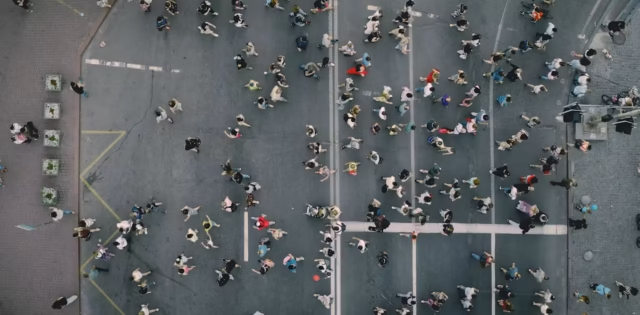
The effect itself is easy to describe. Let a crowd roam within a closed space with no particular destination, and it slowly begins to rotate, almost always to the left. Nobody directs that motion. Nobody decides it.
To a physicist, this looks like a textbook instance of “emergent behavior”: a collective pattern that grows out of countless small interactions, either between individuals or between individuals and their surroundings. These were our two prime hypotheses, which we tried to validate in isolation.
It wasn’t the room
Our first suspicion hinged on the interaction between pedestrians and the room’s walls. An earlier neuroscience study had found that right-handed people tend to turn left and left-handers to the right, a subtle bias linked to small differences between the two halves of the brain. Since the majority of our original crowd was right-handed, it was reasonable to hypothesise that the collective swirl was nothing more than the sum of individual preferences, turned into a loop by the walls that surrounded them.
To test this, we designed a new experiment that started before the crowd even gathered within the arena. One volunteer at a time, they walked straight towards a wall, and we recorded which way they turned when they got there.
Knowing everyone’s preference, we could then sort people by this feature and see the result. If walls and handedness were the answer, a group of left handed or, even better, pure right-turners, should eventually flip the rotation and move clockwise. It never happened. Whether we filled the room with right-turners or with left-handed people, the anticlockwise bias held.
Perhaps the presence of walls in itself was behind this steering effect. To find out, we took the experiment outdoors, into a very large open school playground of 3,000 square meters, without boundary walls, and let more than a hundred teenagers walk with nothing to guide them. The rotation effect did not just survive, it grew stronger. The room was evidently not to blame.
It wasn’t culture
That left our second suspect: the way we interact with one another. When two pedestrians meet head-on, each one steps aside leading to the well known lane-formation phenomenon.
But the side we choose is not random, and is usually determined by what side of the road people drive on. In Spain, as in the rest of mainland Europe, we dodge to the right, which leaves some space to our left for the oncoming person to do the same.
Perhaps, we reasoned, the origin of counterclockwise motion was nothing but a manifestation of this phenomenon. If pedestrians tend to step to the right in each interaction, they will end up walking with the wall on the right, moving counterclockwise. If this were true, a Japanese crowd should turn clockwise because, in Japan, people drive and step aside to the left, and lane-formation occurs on the opposite side to Spain.

Author’s own
We contacted a colleague in Tokyo, convinced that he would see the crowd would turn clockwise. New experiments resulted in a new failure. The Japanese crowd turned anticlockwise, so our hypothesis was wrong.
One cultural explanation was still standing: a habit picked up somewhere along the way, such as the anticlockwise direction in which almost every single athletics track is built. So we turned to nursery school children, who have barely begun to absorb adult conventions. Far from fading, their anticlockwise tendency was the strongest we measured anywhere.
The answer is inside us
If it is not the group, the surroundings or our social habits, there was only one place left: a purely individual feature, something biomechanical or ingrained in the brain.
To test this, we asked more than 200 volunteers to walk alone, one at a time, in an empty arena. With nobody to collide with, and no crowd to follow, a clear majority still moved anticlockwise.
For decades, our field had assumed that collective patterns like this one emerge from the interactions between pedestrians. In this case, the data shows the exact opposite; the pattern is already there in a single person walking on their own. Indeed, feeding nothing but that individual motion data into a model, we were able to reproduce the swirl of the full crowd. In this case, and contrary to what happens in emerging collective phenomena, the whole is not more than the sum of the parts; it is exactly the same.
And here is the honest punchline: we still don’t know why that causes this bias at the individual level. We looked for a relationship with handedness, the dominant foot, the dominant eye, sex, etc, etc… and found nothing. Studies of blindfolded walkers, who tend to spiral off to one side, hint at something deeper, perhaps faint asymmetries in the inner ear that leave our sense of straightness minutely modified. But as things stand, we cannot provide any reason for it.
In any case, knowing that the pull belongs to the individual rather than to the group is still valuable, and could change how we model and design the spaces we share: places like airports, train stations and museums, where the smooth flow of people matters.
The same leftward tilt even shows up in animals, for instance in schooling fish and in the spiralling mills of army ants. The force that nudges a lone human to the left may, ultimately, turn out to be far older than humanity itself.

A weekly e-mail in English featuring expertise from scholars and researchers. It provides an introduction to the diversity of research coming out of the continent and considers some of the key issues facing European countries. Get the newsletter!
Iñaki Echeverría Huarte, Assistant Professor, Universidad de Navarra; Angel Garcimartín Montero, Catedrático de Física de la Materia Condensada, Universidad de Navarra, and Iker Zuriguel Ballaz, Professor of Applied Physics, Universidad de Navarra
This article is republished from The Conversation under a Creative Commons license. Read the original article.
Disclaimer
Artificial Intelligence Disclosure & Legal Disclaimer
AI Content Policy.
To provide our readers with timely and comprehensive coverage, South Florida Reporter uses artificial intelligence (AI) to assist in producing certain articles and visual content.
Articles: AI may be used to assist in research, structural drafting, or data analysis. All AI-assisted text is reviewed and edited by our team to ensure accuracy and adherence to our editorial standards.
Images: Any imagery generated or significantly altered by AI is clearly marked with a disclaimer or watermark to distinguish it from traditional photography or editorial illustrations.
General Disclaimer
The information contained in South Florida Reporter is for general information purposes only.
South Florida Reporter assumes no responsibility for errors or omissions in the contents of the Service. In no event shall South Florida Reporter be liable for any special, direct, indirect, consequential, or incidental damages or any damages whatsoever, whether in an action of contract, negligence or other tort, arising out of or in connection with the use of the Service or the contents of the Service.
The Company reserves the right to make additions, deletions, or modifications to the contents of the Service at any time without prior notice. The Company does not warrant that the Service is free of viruses or other harmful components.