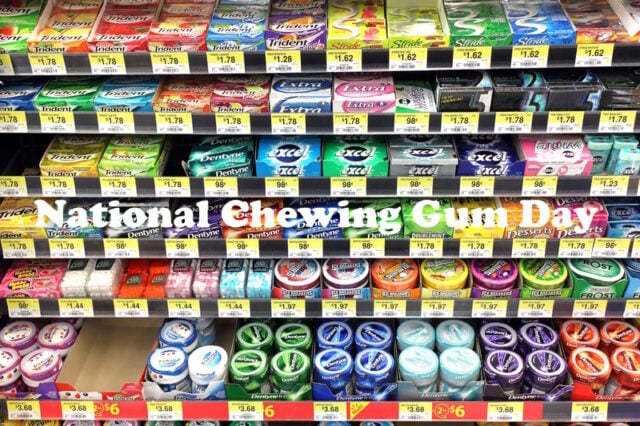
National Chewing Gum Day is on September 30th. Pop a bubble or freshen your breath with your favorite piece of chewing gum.
- 1848 – John B. Curtis developed and sold the first commercial chewing gum, which was called “The State of Maine Pure Spruce Gum.”
- 1850 – A gum made from paraffin wax was developed and surpassed the spruce gum in popularity.
- 1869 – William Semple filed an early patent on chewing gum, patent number 98,304.
- 1871 – Thomas Adams patented the first machine for making chewing gum.
- 1893 – William Wrigley Jr. launched Juicy Fruit and Wrigley’s Spearmint in 1893. You can still find both in supermarket checkout lanes today and, according to Statista, Wrigley’s Doublemint is still the leading regular gum brand in the U.S.
- 1906 – The first name for chewing gum was “Blibber-Blubber”. Frank Fleer was the first to try to develop a gum you could blow into a bubble. Developed around 1906, Blibber-Blubber proved too sticky for most people’s liking. More than 20 years later, a Fleer employee successfully revisited the formula, and Dubble Bubble was born.
- 1920 – Prohibition increased gum sales because people needed to mask the alcohol on their breath. When prohibition was enacted, Adam’s Clove gum hit the market with the slogan: “It takes your breath away!”
- 1928 – Walter Diemer created a gum that was less sticky than others and worked very well for blowing bubbles. After some trials and tests, this gum was dyed pale pink and eventually became known as Dubble Bubble.
- 1939 – Chewing gum is given to World War II soldiers as part of their rations.
- 1969 – Sugar-free gum hits the market.
- 1992 – Singapore tried to completely forbid gum, with heavy fines of over $6,000 for possession or use without a prescription. This Asian country banned the sale of chewing gum in 1992 (although it somewhat relaxed the law in 2004, allowing for therapeutic, dental, and nicotine chewing gum to be sold).
- 2000 – A study found around 250,000 globs of chewing gum stuck to London’s busy Oxford Street, and that in Rome, an estimated 15,000 pieces of chewed gum are discarded on the streets on a daily basis.
- 2007 – A British archaeology student discovered a 5,000-year-old piece of chewing gum made from bark tar with tooth imprints in it.
- Presumed to be the oldest piece of chewing gum, the discovery took place in Kierikki, Yli-li, Finland. Made from bark tar, scientists believed the gum to have antiseptic properties and other medicinal advantages.
- Many other cultures chewed gum made from the resin of the mastic tree, from plants, grasses, and other resins.
- Studies show chewing gum helps improve memory, reduce stress, and increase alertness.
- Chewing sugar-free gum improves oral hygiene while also curbing cravings and improving digestion.
- Chewing gum while cutting onions can help a person from crying.
- The first successful bubble gum was pink because it was the only color the inventor had left. The color “stuck,” and today bubble gum is still predominantly pink.
- Swallowed gum won’t clog up your intestines, but it will be with you for a few days. Gum base can’t be digested so it will pass through your system in one piece.
- Chewing gum burns around 11 calories per hour.
- Chewing gum on an airplane will keep your ears from popping. Chewing gum makes your salivary glands produce 250% more saliva than normally, so you swallow more. This helps balance the pressure in your head.
- The average American chews around 300 sticks of gum in one year. That averages to 25 sticks of gum per month.
- In the U.S. alone, the total amount of chewing gum sold in one year would make a stick 3.5 million miles long. That’s long enough to reach the moon and back seven times or to circle the Earth’s equator 150 times.
- Humans are the only animals on Earth that chew gum. If you give a monkey a piece, he will chew it for a couple of minutes, then he will take it out and stick it to his hair.
- Cinnamon, spearmint and peppermint are among the most popular flavors of chewing gum today.
- 100,000 tons of bubble gum is chewed every year all around the world.
- Turkey is the country with the most gum companies; the United States is second
- Another useful fun fact about chewing gum is that you can remove it from your hair using peanut butter. You will have to separate the area from the rest of your hair, cover it in peanut butter, and start rubbing it out. This is because the oil in peanut butter helps separate the gum.
- Studies have shown that having a chewing gum after a meal helps with heartburn, as it can reduce acid in the esophagus.
- Most people buy chewing gum between Halloween and Christmas.
- Bubblegum Alley in San Luis Obispo, California, and the Market Theater Gum Wall in downtown Seattle are gum-centric tourist attractions where the main attraction is a massive accumulation of chewed gum that people have stuck to walls.
- People with chiclephobia may fear chewing gum, including chewing it themselves, being near someone who is chewing it, or even the sight of previously chewed gum.
Sources:
Mobile-Cuisine

Disclaimer
Artificial Intelligence Disclosure & Legal Disclaimer
AI Content Policy.
To provide our readers with timely and comprehensive coverage, South Florida Reporter uses artificial intelligence (AI) to assist in producing certain articles and visual content.
Articles: AI may be used to assist in research, structural drafting, or data analysis. All AI-assisted text is reviewed and edited by our team to ensure accuracy and adherence to our editorial standards.
Images: Any imagery generated or significantly altered by AI is clearly marked with a disclaimer or watermark to distinguish it from traditional photography or editorial illustrations.
General Disclaimer
The information contained in South Florida Reporter is for general information purposes only.
South Florida Reporter assumes no responsibility for errors or omissions in the contents of the Service. In no event shall South Florida Reporter be liable for any special, direct, indirect, consequential, or incidental damages or any damages whatsoever, whether in an action of contract, negligence or other tort, arising out of or in connection with the use of the Service or the contents of the Service.
The Company reserves the right to make additions, deletions, or modifications to the contents of the Service at any time without prior notice. The Company does not warrant that the Service is free of viruses or other harmful components.