Home Accuweather.com Historic Drought: Atlantic Could See Zero Hurricanes in 2026 as Super El...

Historic Drought: Atlantic Could See Zero Hurricanes in 2026 as Super El Niño Shuts Down Tropics

The 2026 Atlantic hurricane season is nearing a historic milestone, as AccuWeather forecasts the potential for this season to finish without a hurricane, something not seen in more than a century.

AccuWeather Hurricane experts say the strengthening Super El Niño conditions are increasingly suppressing tropical development in the Atlantic, raising the possibility that the basin could finish this season without a single hurricane.

For the first time ever, AccuWeather is now forecasting the possibility of zero hurricanes forming this season. If this were to occur, it would be the first time since 1914.

“We are witnessing one of the most extraordinary Atlantic hurricane seasons in modern history,” AccuWeather Lead Hurricane Expert Alex DaSilva said. “There is an increasingly likely scenario in which the Atlantic season ends without a single hurricane for the first time in more than a century. All of this despite sea surface temperatures being the second warmest on record for the North Atlantic basin this season.”

Faith Based Events

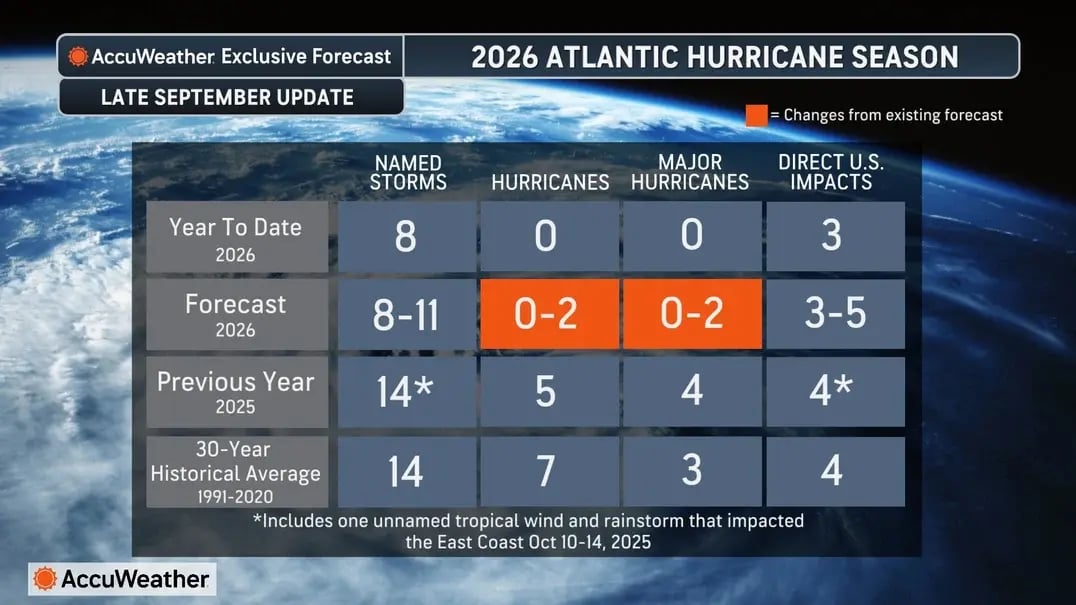
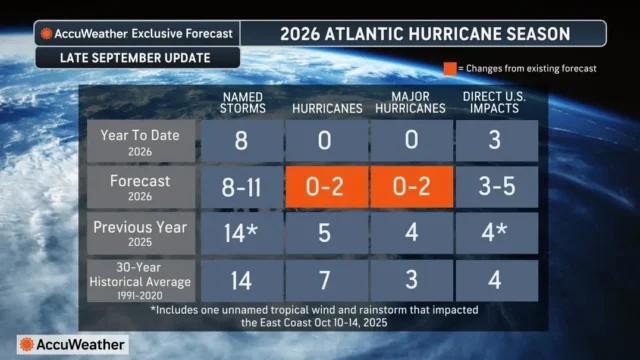
The latest update from AccuWeather experts is lowering the forecast further, now expecting 0-2 hurricanes to form in the Atlantic this season, along with lowering the number of major hurricanes to 0-2, as well. AccuWeather is the first known source to predict the potential for zero hurricanes in the Atlantic for the 2026 season.

9_29 Atlantic Hurricane Forecast

AccuWeather hurricane experts are still forecasting there to be 3-5 direct U.S. impacts. This year there have already been three such impacts occur: tropical storms Arthur, Bertha and Edouard.

El Niño Plays Significant Role in Quiet Atlantic Season

El Niño increases wind shear across the Atlantic, preventing tropical storms from becoming organized and ultimately strengthening into hurricanes. This year, persistent wind shear across the main development region combined with areas of dry air has disrupted tropical systems before they could intensify.

“Another contributing factor is the stability of the Main Development Region, which has been very stable,” continued DaSilva. “A more stable environment has prevented many tropical waves so far this year from developing after they emerge from Africa. This less conducive environment is expected to remain in place for the rest of the hurricane season.”

“While it is still anticipated to be possible that a hurricane develops through the end of the season, a hurricane-free Atlantic season is now a scenario that must be taken seriously,” DaSilva added.

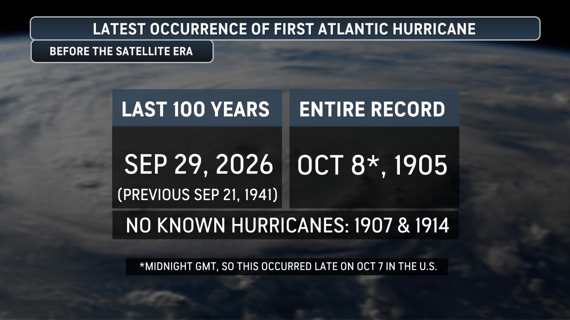
The 2026 season has already hit extraordinary benchmarks for lack of hurricane activity. The Atlantic passed the historical peak of the season without producing a hurricane.

Only once in three previous super El Niño has the Atlantic produced a hurricane after October 1st.

Latest First Atlantic Hurricane
Avg Named Storms

No Atlantic Season During the Modern Era has Finished Without a Hurricane

The lack of hurricanes is even more remarkable when viewed through the lens of modern hurricane observation technology.

Beginning in 1966, routine satellite monitoring dramatically improved scientists’ ability to detect tropical storms and hurricanes in the Atlantic. From 1900-1965, the Atlantic averaged just over 9 tropical storms and hurricanes per year, compared with just more than 13 per year since 1966 when daily tracking became modernized.

“Earlier records require additional context,” DaSilva added. “Before satellites, tropical cyclones over remote stretches of ocean could easily escape detection if they did not encounter ships, populated islands, or land. Nevertheless, historical data points to 1914 as the quietest Atlantic hurricane season on record, with only one documented tropical storm and no hurricanes.”

AccuWeather hurricane experts emphasize that the hurricane season continues through Nov. 30, and tropical development can still occur during October and November. The revised 0-2 hurricane forecast reflects both that continuing risk and the increasingly plausible historic scenario that 2026 could end with no Atlantic hurricanes at all.


Disclaimer

Artificial Intelligence Disclosure & Legal Disclaimer

AI Content Policy.

To provide our readers with timely and comprehensive coverage, South Florida Reporter uses artificial intelligence (AI) to assist in producing certain articles and visual content.

Articles: AI may be used to assist in research, structural drafting, or data analysis. All AI-assisted text is reviewed and edited by our team to ensure accuracy and adherence to our editorial standards.

Images: Any imagery generated or significantly altered by AI is clearly marked with a disclaimer or watermark to distinguish it from traditional photography or editorial illustrations.

General Disclaimer

The information contained in South Florida Reporter is for general information purposes only.

South Florida Reporter assumes no responsibility for errors or omissions in the contents of the Service. In no event shall South Florida Reporter be liable for any special, direct, indirect, consequential, or incidental damages or any damages whatsoever, whether in an action of contract, negligence or other tort, arising out of or in connection with the use of the Service or the contents of the Service.

The Company reserves the right to make additions, deletions, or modifications to the contents of the Service at any time without prior notice. The Company does not warrant that the Service is free of viruses or other harmful components.