KEY HIGHLIGHTS
- Florida ranks eleventh in 2024, with 9.6% of commuters classified as super commuters, meaning over 1 in 10 workers spends 60 or more minutes traveling one way.
- Its average one-way commute reached 27.9 minutes in 2024, up from 27.0 minutes in 2021, the ninth longest average commute in the nation across all four years.
- Florida commuters spend an average of 229.8 hours per year traveling to and from work, based on a four-year average commute of 27.6 minutes and 250 workdays, the 9th highest total in the nation.
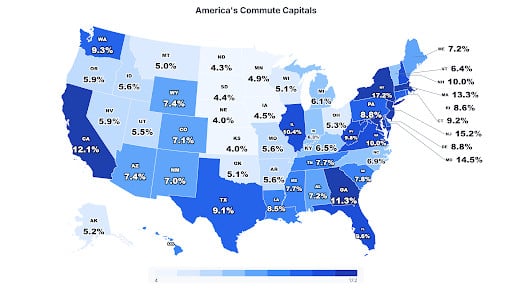
Florida ranks eleventh in the nation for super commuters at 9.6%, placing it just above the national average of 9.3%, with an average one-way commute of 27.9 minutes in 2024 driven by growth across its sprawling Sun Belt metros. The state’s commute has risen each year since 2021 and remained consistently above the national average, reflecting the structural travel pressures that accompany rapid urban expansion in Miami, Tampa, and Orlando.
According to Grigor Law Injury and Car Accident Lawyers, this analysis draws on U.S. Census Bureau American Community Survey 1-year estimates spanning 2021 through 2024. The study ranks all 50 states by their 2024 average one-way commute time and examines how commute patterns have shifted across the four years. The ACS methodology excludes remote workers from all calculations.

States With the Highest Share of Workers Commuting 60 or More Minutes One Way
| State | Super Commuters 60+ min (%) 2024 | Rank |
| New York | 17.2% | 1 |
| New Jersey | 15.2% | 2 |
| Maryland | 14.5% | 3 |
| Massachusetts | 13.3% | 4 |
| California | 12.1% | 5 |
| Georgia | 11.3% | 6 |
| Illinois | 10.4% | 7 |
| Virginia | 10.0% | 8 |
| New Hampshire | 10.0% | 9 |
| West Virginia | 9.8% | 10 |
| Florida | 9.6% | 11 |
| Washington | 9.3% | 12 |
| Connecticut | 9.2% | 13 |
| Texas | 9.1% | 14 |
| Pennsylvania | 8.8% | 15 |
Florida ranks eleventh in the nation for super commuters at 9.6%, just above the 9.3% national average, with more than 1 in 10 commuters traveling 60 or more minutes one way. The ten states ranked above Florida span the Atlantic seaboard and major coastal metros, led by New York (17.2%), New Jersey (15.2%), and Maryland (14.5%). Washington (9.3%), Connecticut (9.2%), Texas (9.1%), and Pennsylvania (8.8%) follow immediately below Florida in the ranking, each sitting at or below the national average. Florida’s 9.6% super commuter rate is more than twice Nebraska’s 4.0%, the nation’s lowest, confirming that even Sun Belt growth states generate significant populations of long-distance commuters.
Looking at the study, Chrissy Grigoropoulos, founder of Grigor Law Injury & Car Accident Lawyers, commented:
“Florida commuters are spending nearly 28 minutes one way getting to their workplace, and over 250 workdays that accumulate to almost 230 hours of annual commute time, the ninth highest in the nation. The rapid population growth across Miami, Tampa, and Orlando has stretched commuting distances in ways that consistently push Florida above the national average for super commuters. Workers navigating the state’s congested freeway systems face a daily fatigue exposure that, while lower than the top-ranked states, still represents a meaningful and quantifiable injury risk that employers and transport planners need to account for.”
Florida Commute Trend Compared to the National Average: 2021 to 2024
| Year | Florida Avg Commute (min) | National Avg Commute (min) | Florida Above National |
| 2021 | 27.0 | 25.6 | +1.4 min (+5.5%) |
| 2022 | 27.5 | 26.4 | +1.1 min (+4.2%) |
| 2023 | 27.9 | 26.8 | +1.1 min (+4.1%) |
| 2024 | 27.9 | 27.2 | +0.7 min (+2.6%) |
Florida’s average one-way commute rose from 27.0 minutes in 2021 to 27.9 minutes in 2024, a 0.9-minute or 3.3% increase, the smallest gain among the top 11 states in this study. The state has held above the national average in every year, though the margin has narrowed from 1.4 minutes in 2021 to just 0.7 minutes in 2024. In 2024, Florida’s 27.9-minute average was 2.6% longer than the national average of 27.2 minutes. The narrowing gap suggests that Florida’s commute burden is growing more slowly than the national rate, even as the state continues to rank above average for super commuters.
States With the Longest Average Commutes and Annual Hours Lost to Commuting
| State | Avg Commute 2021 (min) | Avg Commute 2022 (min) | Avg Commute 2023 (min) | Avg Commute 2024 (min) | Avg Annual Commute 2021-2024 (min) | Annual Hours Commuting (250 days) | Rank |
| New York | 31.5 | 32.5 | 33.2 | 33.5 | 32.7 | 272.3 | 1 |
| Maryland | 31.2 | 31.9 | 32.3 | 33.0 | 32.1 | 267.5 | 2 |
| New Jersey | 30.2 | 31.0 | 31.7 | 32.0 | 31.2 | 260.2 | 3 |
| Massachusetts | 28.0 | 29.0 | 29.6 | 30.0 | 29.2 | 242.9 | 4 |
| California | 27.7 | 28.5 | 29.2 | 29.8 | 28.8 | 240.0 | 5 |
| Illinois | 27.4 | 28.0 | 28.4 | 29.0 | 28.2 | 235.0 | 6 |
| Georgia | 27.3 | 27.9 | 28.4 | 28.7 | 28.1 | 234.0 | 7 |
| Virginia | 27.0 | 27.8 | 28.5 | 28.6 | 28.0 | 233.1 | 8 |
| Florida | 27.0 | 27.5 | 27.9 | 27.9 | 27.6 | 229.8 | 9 |
| Washington | 26.3 | 27.0 | 27.6 | 28.0 | 27.2 | 226.9 | 10 |
| New Hampshire | 26.0 | 26.5 | 26.9 | 27.4 | 26.7 | 222.5 | 11 |
| Pennsylvania | 25.8 | 26.3 | 26.8 | 27.1 | 26.5 | 220.8 | 12 |
| Hawaii | 24.9 | 26.0 | 26.6 | 27.1 | 26.1 | 217.9 | 13 |
| Connecticut | 25.2 | 25.8 | 26.4 | 26.7 | 26.0 | 216.9 | 14 |
| Texas | 25.3 | 25.9 | 26.3 | 26.6 | 26.0 | 216.9 | 15 |
Florida ranks 9th nationally for annual commute time, with workers spending 229.8 hours per year traveling to and from work, based on a four-year average one-way commute of 27.6 minutes and 250 working days. Washington (226.9 hours) follows in 10th place, just below, while Virginia (233.1 hours) ranks directly above in 8th. New Hampshire (222.5 hours) and Pennsylvania (220.8 hours) follow in 11th and 12th, with Connecticut (216.9 hours) and Texas (216.9 hours) rounding out the table in 14th and 15th. New York (272.3 hours), Maryland (267.5 hours), and New Jersey (260.2 hours) lead the national table, more than 30 hours above Florida’s figure.
Methodology
The analysis used U.S. Census Bureau American Community Survey 1-year estimates for its production. Census Bureau American Community Survey 1-year estimates, specifically table codes ACSST1Y2021.S0801, ACSST1Y2022.S0801, ACSST1Y2023.S0801, and ACSST1Y2024.S0801.Each state’s four-year average one-way commute time (2021 through 2024) is used to calculate annual commute hours by multiplying it by 2 to get a daily round-trip figure, then multiplying by 250 workdays and dividing by 60 minutes to convert to hours. The 250-workday benchmark is the standard used by both the U.S. Census Bureau and the Bureau of Labor Statistics in commute research, derived from 52 weeks multiplied by 5 weekdays, minus 10 federal holidays. This analysis excludes remote workers from all commute calculations, following the ACS survey design.
Data Sources
- 2024 ACS Commute Data: https://data.census.gov/table/ACSST1Y2024.S0801
- 2023 ACS Commute Data: https://data.census.gov/table/ACSST1Y2023.S0801
- 2022 ACS Commute Data: https://data.census.gov/table/ACSST1Y2022.S0801
- 2021 ACS Commute Data: https://data.census.gov/table/ACSST1Y2021.S0801
- Research Dataset: https://docs.google.com/spreadsheets/d/1mDps83dp4hveNMI8Sqd_zjPFPMhaqs4uMHJMAByTcZg/edit?gid=0#gid=0
- Research by: https://grigorlaw.com/
About Grigor Law Injury & Car Accident Lawyers
Grigor Law Injury & Car Accident Lawyers is a premier New York “all injury” law firm representing clients in personal injury, car accidents, workers’ compensation, and no-fault claims.
Disclaimer
Artificial Intelligence Disclosure & Legal Disclaimer
AI Content Policy.
To provide our readers with timely and comprehensive coverage, South Florida Reporter uses artificial intelligence (AI) to assist in producing certain articles and visual content.
Articles: AI may be used to assist in research, structural drafting, or data analysis. All AI-assisted text is reviewed and edited by our team to ensure accuracy and adherence to our editorial standards.
Images: Any imagery generated or significantly altered by AI is clearly marked with a disclaimer or watermark to distinguish it from traditional photography or editorial illustrations.
General Disclaimer
The information contained in South Florida Reporter is for general information purposes only.
South Florida Reporter assumes no responsibility for errors or omissions in the contents of the Service. In no event shall South Florida Reporter be liable for any special, direct, indirect, consequential, or incidental damages or any damages whatsoever, whether in an action of contract, negligence or other tort, arising out of or in connection with the use of the Service or the contents of the Service.
The Company reserves the right to make additions, deletions, or modifications to the contents of the Service at any time without prior notice. The Company does not warrant that the Service is free of viruses or other harmful components.