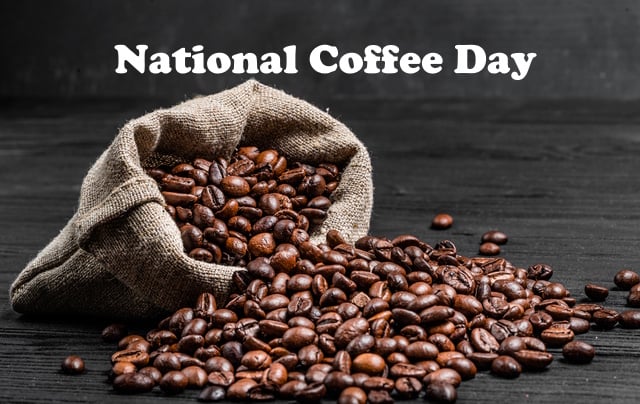
Whether getting one to go or lingering over a second cup, on September 29th be sure to observe National Coffee Day!
- 9th Century – The story goes that a goat herder in Ethiopia noticed his goats were highly energetic after eating berries from a certain tree.
- 1400s – Coffee becomes a commodity used for trade and commerce in Arabia’s Yemeni district
- 15th Century – The earliest credible evidence of either coffee drinking or knowledge of the coffee tree appears in the mid-15th century in Sufi monasteries around Mokha in Yemen.
- 1500s – Along with tea, thirsty people start drinking coffee throughout the Middle East in countries like Persia (modern-day Iran,) Turkey, Egypt, and Syria.
- 16th Century – It wasn’t always called ‘coffee ’. People surmise the word “coffee” entered the English language in the 16th century. It was borrowed from the Italian word “caffe,” which comes from the Dutch word “koffie,” taken from the Ottoman Turkish “kahve,” which stemmed from the Arabic “qahwah.”
- 16th century – In Constantinople, not providing your wife with enough coffee was grounds for divorce.
- 17th Century – Drinking coffee was once punishable by death! During the Ottoman Empire, people believed coffee had mind-altering effects. The ruler of this period believed it to be a type of narcotic and banned it from public consumption.
- 1600s – When European traders and merchants discovered coffee in the Middle East, the brew’s popularity spread across the continent.
- Mid-1600s – The British brought coffee to New Amsterdam, modern-day New York City, and a morning craving was born!
- 1723 – Coffee in the Americas and the Caribbean comes from a single seedling a French naval officer transported to Martinique.
- 1907 – Teddy Roosevelt reportedly coined Maxwell House’s slogan. On a 1907 visit to Andrew Jackson’s former estate, the commander-in-chief supposedly dubbed a cup of Maxwell House joe “good to the last drop,” a catchphrase still used today.
- 1909 – An American inventor, George Washington, invented instant coffee.
- 1930 – For people who are tired of waiting for coffee to brew, Nestle and the Brazilian Coffee Institute introduce instant coffee, which becomes important during WWII.
- 1932 – Brazil couldn’t afford to send its athletes to Los Angeles for the 1932 Olympics, so the government loaded them in a ship full of coffee, which was sold on the way to finance their trip.
- 1938 – Nestlé produced a more stable, free-flowing instant coffee powder under the Nescafé brand
- 1963 – The first freeze-dried instant coffee was launched by General Foods under the brand Maxwell House
- 2012 – Jerry Seinfeld combines classic cars, cute coffee shops, and the world’s top comedians to create improvised TV vignettes.
- 75% – Caffeine consumed by Americans that comes as coffee
- 66% of women drink coffee every day
- 62% of men drink coffee every day
- 100 – The age a coffee plant can live up to
- 5.7 billion Pounds of coffee Brazil exports every year
- 3.1 – The number of coffees the average American drinks each day
- 400 million coffees are consumed throughout America every day
- 146 billion – coffees are consumed in America each year
- Brazil produces more coffee in the world than any other country, Colombia closely follows.
- It’s the world’s 2nd largest traded commodity. Crude oil is first.
- In ancient Arab culture, a woman could only divorce her husband if he didn’t like her coffee.
- Coffee is a fruit. Coffee beans grow on a bush. They are actually the pit of a berry, which makes them a fruit.
- “Kopi Luwak” is the most expensive coffee in the world. It comes from Indonesia and is made from beans digested from the Asian Palm Civet. In other words, it comes from cat poop. It sells for $370 and up per 2 pounds!
- Hawaii is the only American state that grows coffee
- The “Big Four” coffee roasting companies – Kraft, P&G, Sara Lee and Nestle – buy about 50% of the coffee produced worldwide.
- Coffee tastes different from its scent because saliva dilutes the flavor.
- People in New York drink seven times more coffee than people in other U.S. cities.
- Starbucks first began by only selling roasted whole coffee beans.
- Starbucks Coffee contains more caffeine than energy drinks.
- The first webcam was created to watch a coffee pot and avoid unnecessary trips to check if it was empty.
- Yelling for exactly 8 years, 7 months, and 6 days will allow you to generate enough heat to make one cup of coffee.
- Coffee consumed between the hours of 9:30 to 11:30 a.m. is believed to be the most effective
- More than half of the population in the United States drinks coffee every single day.
- The Netherlands is the world’s largest per capita coffee consumer.
- Research links moderate consumption (about three to four cups per day) with a longer life span, plus a reduced risk of cardiovascular disease, type 2 diabetes and Parkinson’s, according to Harvard Health Publishing.
- Decaf does not mean caffeine-free. An eight-ounce brewed cup of decaf coffee actually contains two to 12 milligrams of caffeine, the Mayo Clinic states. In comparison, a regular cup of coffee supplies between 95 to 200 milligrams, while one can of cola has about 23 to 35 milligrams of caffeine.
- You can order coffee 25,000 different ways at Dunkin’. It sells 2 billion cups globally per year, enough for customers to pick each option 80,000 times.
- New York City has the most coffee shops in the U.S. per capita.
- The word espresso comes from Italian and means “expressed” or “forced out”. Espresso is made by forcing very hot water under high pressure through finely ground, compacted coffee.
- According to the International Coffee Association, Europe imports more coffee than the USA. Also, Brazil is the lead exporting country in coffee.
- Finland consumes the most coffee in the world.
- Before coffee became popular in the United States, cider or beer was the breakfast drink of choice, even for children.
- Regularly drinking coffee may have health benefits such as reduced risk of illnesses like cancer, heart disease and Alzheimer’s.
- In England, early coffee houses, increasingly known as “Schools for the Wise,” became gathering places for intellectual pursuits, entertainment and table games, like chess.
- Hakone Kowakien Yunessun hot springs spa gives you the option to soak in a coffee bath, along with 26 other choices including red wine, sake or green tea.
- Recent studies have also shown that drinking coffee may help prevent certain conditions. This may include:
- Parkinson’s Disease. Coffee has been shown to decrease the risk of neurodegenerative diseases, particularly in men.
- Stroke. One study has shown that people who drink 2-3 cups of coffee each day may lower their risk of stroke by almost 1/3.
- Alzheimer’s Disease. Coffee seems to help retain the sharpness in the brain and reduce the risk of this degenerative disease.
- Type 2 Diabetes. In this case, some studies show that drinking either caffeinated or decaffeinated coffee can help reduce blood sugar levels and minimize the risk of diabetes in adults.
Sources:

Disclaimer
Artificial Intelligence Disclosure & Legal Disclaimer
AI Content Policy.
To provide our readers with timely and comprehensive coverage, South Florida Reporter uses artificial intelligence (AI) to assist in producing certain articles and visual content.
Articles: AI may be used to assist in research, structural drafting, or data analysis. All AI-assisted text is reviewed and edited by our team to ensure accuracy and adherence to our editorial standards.
Images: Any imagery generated or significantly altered by AI is clearly marked with a disclaimer or watermark to distinguish it from traditional photography or editorial illustrations.
General Disclaimer
The information contained in South Florida Reporter is for general information purposes only.
South Florida Reporter assumes no responsibility for errors or omissions in the contents of the Service. In no event shall South Florida Reporter be liable for any special, direct, indirect, consequential, or incidental damages or any damages whatsoever, whether in an action of contract, negligence or other tort, arising out of or in connection with the use of the Service or the contents of the Service.
The Company reserves the right to make additions, deletions, or modifications to the contents of the Service at any time without prior notice. The Company does not warrant that the Service is free of viruses or other harmful components.