By Marina Miron, King’s College London and Rod Thornton, King’s College London
The air war between Russia and Ukraine has evolved constantly since the start of the conflict. The latest example is Russia’s deployment of a new type of long-range, jet-powered drone, which is having a significant effect on Ukraine’s ability to defend its cities against aerial attack.
In an interview on September 14, Ukrainian Air Force spokesperson Colonel Yuriy Ihnat told the Financial Times that Ukraine was intercepting only about 60% of attacks by the new Geran-5 drone. This compares with the 95% interception rate Ukraine’s air defences achieve against other drone variants.
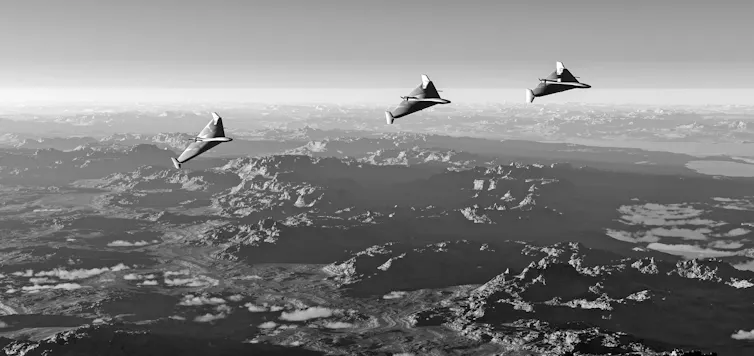
The Geran-5’s cylindrical fuselage and straight wings make its profile closer to that of a cruise missile than a conventional long-range drone. Russian sources indicate it has a range of up to 1,000km and a maximum operating altitude of around 6,000 metres, which is higher than earlier drones.

Geran-5 drones also travel faster than previous models, with an estimated top speed of approximately 600 kilometres per hour. And unlike earlier variants, these drones are fitted with anti-jamming capabilities. Together, this makes them particularly difficult for Ukraine’s ground-based air defences to intercept.
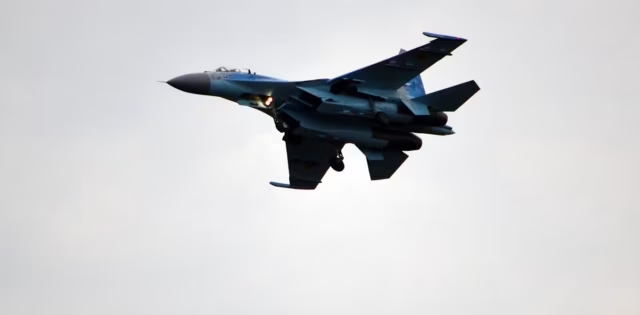
Inhat said Ukraine has been forced into the “very intensive use” of its fighter jets since Russia began using the Geran-5 in August, with pilots shooting down these drones directly.
But the effectiveness of the Geran-5 extends beyond its speed and range. According to Yuri Knutov, a Russian military expert, these drones incorporate machine vision linked to a digital terrain map, which enables them to identify and select targets autonomously.
Ukraine air war
Immediately after Russia’s full-scale invasion in 2022, the air war over Ukraine followed expected lines, with both sides relying heavily on combat aircraft. These aircraft had two specific roles: to engage opposing aircraft directly, and to strike targets in support of forces on the ground.
However, the situation soon changed. With air defence systems taking such a toll on aircraft from both sides, the air war over Ukraine became more stand-off in nature. More long-range tactics were employed instead.
From 2023, the Russians in particular came to make full use of the glide bomb. These bombs, fitted with stabilising wings and navigation aids, could be launched around 70km away from their target, beyond the reach of most anti-aircraft defences. They represented a less risky means of delivering ordnance to the battlefield.
However, drones swiftly became the dominant tool of air power. They have no crews to risk and, given their relative simplicity, can be produced at low cost in large numbers. Smaller drone variants have been used by both sides close to the frontlines, while larger, long-range drones have struck targets deeper inside Ukraine and Russia.
The issue with the earlier long-range drone variants was that they were relatively easy to shoot down. This is because, being propeller-driven, they are slow. For several years, the principal Russian long-range drones have been the propeller-driven Geran-1 and Geran-2 – upgraded Russian copies of the Iranian Shahed-136 drone.
Naeblys / Shutterstock
The first jet-powered drone, the Geran-3, was deployed in 2025. It was significantly faster than the Geran-2, travelling at 330km/h compared with the Geran 2’s 185km/h. While it had a considerably shorter range of just 600km, against the Geran-2’s possible 2,500km, it could fly higher, reducing its vulnerability to air defences.
Later that year, the jet-powered Geran-4 appeared in the skies above Ukraine with an increased top speed of 500km/h and range of 850km. And in August 2026, the Geran-5, with its faster speed and even longer range, was first used operationally by Russian forces.
Ukraine’s military intelligence service has published details of the components identified in the Geran-5 drone, highlighting the extent to which its supply chain draws on foreign technologies. These include a Chinese-supplied jet engine, digital processors made in the US, and transistors manufactured in Germany.
The component list suggests Russia has established resilient supply chains that enable it to circumvent western sanctions and procure commercially available technologies from multiple countries, before manufacturing the final system domestically.
Russia is also able to mass-produce these new jet-powered drones. Ukrainian military intelligence reports that Russia is prioritising Geran-4 and Geran-5 production in order to build up stocks ahead of an autumn and winter campaign against Ukraine.
This may prove devastating, as Ukraine is running low on its stock of western-supplied Patriot ground-to-air and air-to-air missiles. These missiles are the only truly effective means of shooting down the Geran-5 drone.
Ukraine’s deputy head of military intelligence, Major General Vadym Skibitskyi, relayed these fears in August. He announced that Ukraine now needed new interceptor missiles “with the appropriate speed” to intercept the latest jet-powered Gerans.
Marina Miron, Postdoctoral Researcher, War Studies Department, King’s College London and Rod Thornton, Senior Lecturer in International Studies, Defence and Security., King’s College London
This article is republished from The Conversation under a Creative Commons license. Read the original article.
Disclaimer
Artificial Intelligence Disclosure & Legal Disclaimer
AI Content Policy.
To provide our readers with timely and comprehensive coverage, South Florida Reporter uses artificial intelligence (AI) to assist in producing certain articles and visual content.
Articles: AI may be used to assist in research, structural drafting, or data analysis. All AI-assisted text is reviewed and edited by our team to ensure accuracy and adherence to our editorial standards.
Images: Any imagery generated or significantly altered by AI is clearly marked with a disclaimer or watermark to distinguish it from traditional photography or editorial illustrations.
General Disclaimer
The information contained in South Florida Reporter is for general information purposes only.
South Florida Reporter assumes no responsibility for errors or omissions in the contents of the Service. In no event shall South Florida Reporter be liable for any special, direct, indirect, consequential, or incidental damages or any damages whatsoever, whether in an action of contract, negligence or other tort, arising out of or in connection with the use of the Service or the contents of the Service.
The Company reserves the right to make additions, deletions, or modifications to the contents of the Service at any time without prior notice. The Company does not warrant that the Service is free of viruses or other harmful components.