Florida gardeners share their yards with more company than most. In the western suburbs that border the Everglades and farm country, a white-tailed deer can strip a bed of hibiscus in a single night. Closer to the coast, the green iguana basking on your seawall is sizing up which of your plants it’ll eat next. Add armadillos tearing up the lawn, marsh rabbits clipping seedlings, and raccoons raiding the fruit trees, and it can feel like you’re gardening for everyone except yourself.
Most wildlife damage follows predictable patterns, though. Once you know which animal is responsible and how it’s getting in, you can match the defense to the problem and stop spending money on sprays and gadgets that quit working after a week. Here’s how to do that.
Figure Out Who’s Doing the Damage
Before you buy anything, read the evidence. Each of Florida’s common garden raiders leaves a distinct calling card, and the fix for one animal is often useless against another.
White-tailed deer
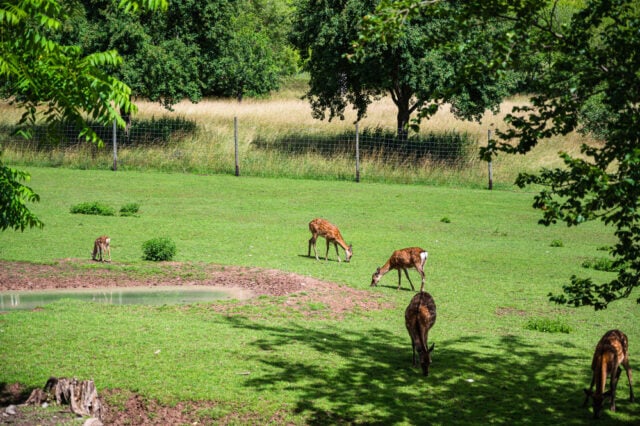
Deer have no upper front teeth, so they tear plants rather than clip them. Look for ragged, shredded leaf edges, stripped branch tips at shoulder height and below, and heart-shaped hoofprints in soft soil. Florida’s deer are smaller than their northern relatives; UF/IFAS Extension Sarasota County reports the average doe weighs about 90 pounds and the average buck about 125. Their appetite isn’t small, though. UF/IFAS Extension agents in Santa Rosa County note that adult deer need more than 6 pounds of forage per 100 pounds of body weight every day, and a well-watered vegetable bed is an easy place to find it.

Green iguanas
Adult iguanas are plant eaters, and they’re picky ones. They go straight for flowers, tender new growth, and soft fruit, and they leave droppings wherever they bask. UF/IFAS Extension names greens, squash, melons, hibiscus, roses, and pink pentas among the plants iguanas find most attractive, which reads like a shopping list for a typical South Florida yard. Iguanas also dig burrows under sidewalks, foundations, and seawalls, and over time, those tunnels accelerate erosion and can undermine the structures above.
The diggers and nibblers
Armadillos leave small, cone-shaped holes as they root for grubs, usually overnight, in freshly watered turf or mulch. Rabbits clip stems cleanly at an angle close to the ground, and they love young beans, lettuce, and just-planted annuals. Raccoons go for ripe fruit, corn, and anything in a compost pile, and they’ll flip back sod or mulch looking for insects. If the damage is low, neat, and concentrated on seedlings, you’re almost certainly dealing with a small mammal rather than a deer.
Plant Smarter Before You Fence
The cheapest defense is a garden that’s less appealing to begin with. South Florida Reporter has pointed out that native plants adapted to local soil tend to need less maintenance and hold up better against pests, and that resilience extends to browsing animals. A yard anchored by tough natives recovers from a bite or two instead of collapsing.
You can also plant around specific animals. UF/IFAS Extension recommends tough, thick-leaved species for iguana country and lists milkweed, citrus, and oleander as plants iguanas tend to avoid. For deer, the Sarasota County Extension office names angelonia, black-eyed Susan, coreopsis, dusty miller, marigold, vinca, salvia, and verbena as annuals deer rarely eat. Just keep in mind that deer-resistant plants still get eaten when food is scarce, so treat them as a first layer of defense rather than the whole plan.
Placement matters as much as selection. Keep vegetables, hibiscus, and other favorites close to the house, where people, pets, and noise make animals nervous. The farther a deer has to venture into your yard, the less likely it is to linger.
Build Barriers Matched to the Animal
Repellents and scare tactics buy time. Physical barriers solve the problem. UF/IFAS Extension agents in Calhoun County describe exclusion as the only guaranteed fix for deer browsing and recommend a fence at least 6 feet tall around the garden. They add a useful detail: deer can clear 6 feet, but they often won’t bother if easier food is available elsewhere. For young trees and shrubs, the same agents cage each plant in 4- to 5-foot wire until it grows above deer reach.
Fencing out deer
Florida is hard on fencing. Intense sun breaks down cheap plastics, humidity and salt air rust untreated metal, and hurricane season tests anything with a solid face. That’s why many Florida gardeners choose polypropylene mesh. It won’t rust, it’s light enough to install without heavy equipment, and its open weave lets wind pass through instead of turning the fence into a sail.
Strength and sun protection are the specs worth checking. A product like UV-stabilized, heavy-duty deer fence is rated at a 650-pound breaking strength and has a reinforced bottom edge designed to accept ground stakes, which matters because deer and smaller animals will test the base of a fence and try to push underneath. The manufacturer says it’s virtually invisible from about 20 feet away, a real advantage if you’d rather look at your garden than at a barrier around it.
Height depends on your layout. In open ground where a deer can get a running start, go with 7.5 or 8 feet. For a small, enclosed vegetable bed, 6 feet often works, since deer are reluctant to jump into tight spaces where they can’t see a clear landing. Stake the bottom edge firmly, run a tension wire along the top to keep the mesh from sagging, and tie strips of flagging to the fence for the first few weeks so deer notice it and don’t blunder through. Check your HOA and city fence rules before you start, because height limits vary from one municipality to the next.
Deer mesh has openings of roughly 2 inches, so it won’t stop rabbits or young iguanas on its own. UF/IFAS Extension suggests installing simple garden fencing at least 2 feet tall to keep rabbits, opossums, and skunks out, and you can attach a band of hardware cloth or chicken wire along the bottom of your deer fence to address all three threats with one line.
Stopping climbers and burrowers
Iguanas climb, so a fence alone won’t keep them out of trees. UF/IFAS Extension recommends wrapping trunks and dock pilings with smooth sheet metal bands they can’t grip. For burrowers, including both iguanas and armadillos, bend the bottom of your wire outward along the ground in an L shape. An animal that digs down at the fence line hits wire and usually gives up. Fill empty burrows with sand or concrete during the day, when the occupant is out, and protect prized vegetable beds or specimen plants with screened cages or hoop covers.
Take Away the Invitations
Barriers work best when your yard isn’t offering free meals on the other side. Never feed iguanas; it only attracts more of them and supports a nuisance population. Bring pet food inside at night, pick up fallen fruit, keep birdseed off the ground, and secure compost bins. Clear brush piles and thick ground cover near water, where iguanas like to bask and hide.
Be skeptical of quick fixes. Blasting an iguana with a hose or installing motion-activated sprinklers works for a while, but animals get used to them. Store-bought iguana repellent granules and sprays have a poor track record, and some chemical treatments can harm pets, kids,s or the plants you’re trying to protect.
Know the rules before you act, too. Green iguanas are nonnative and unprotected, so you can remove them from private property without a permit. However, Florida’s anti-cruelty laws still apply, and live traps and snares are the only legal traps; a licensed pest management company is the safest route. White-tailed deer are a regulated game species managed by the Florida Fish and Wildlife Conservation Commission, and in the Lower Keys the endangered Key deer are federally protected. Exclusion keeps you clear of all of it, since the whole point is keeping animals out without harming them.
Why Right Now Is the Time to Act
Timing is the part most gardeners miss. The Santa Rosa County Extension office notes that deer damage runs lowest from mid-spring to mid-summer and climbs from late summer through late fall. That’s exactly when South Florida’s best growing season begins, with tomatoes, peppers, beans, and greens going into the ground from October onward.
Animals learn fast. A deer that finds your beans once will be back the next night, and an iguana that discovers your hibiscus will treat it as a reliable food source for months. Put your barriers in before the transplants go in, and the only lesson the local wildlife learns is that your garden isn’t worth the trouble.
Disclaimer
Artificial Intelligence Disclosure & Legal Disclaimer
AI Content Policy.
To provide our readers with timely and comprehensive coverage, South Florida Reporter uses artificial intelligence (AI) to assist in producing certain articles and visual content.
Articles: AI may be used to assist in research, structural drafting, or data analysis. All AI-assisted text is reviewed and edited by our team to ensure accuracy and adherence to our editorial standards.
Images: Any imagery generated or significantly altered by AI is clearly marked with a disclaimer or watermark to distinguish it from traditional photography or editorial illustrations.
General Disclaimer
The information contained in South Florida Reporter is for general information purposes only.
South Florida Reporter assumes no responsibility for errors or omissions in the contents of the Service. In no event shall South Florida Reporter be liable for any special, direct, indirect, consequential, or incidental damages or any damages whatsoever, whether in an action of contract, negligence or other tort, arising out of or in connection with the use of the Service or the contents of the Service.
The Company reserves the right to make additions, deletions, or modifications to the contents of the Service at any time without prior notice. The Company does not warrant that the Service is free of viruses or other harmful components.