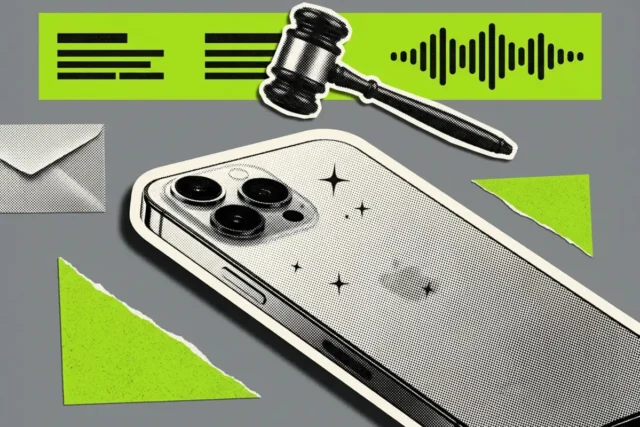
The claims window has opened for iPhone owners entitled to monetary compensation in a landmark false advertising class-action lawsuit alleging that consumers had been misled by Apple’s marketing about forthcoming AI features.
Beginning Monday, owners of affected iPhones can file claims to receive up to $95 per device. Ryan Clarkson, founder and managing partner of Clarkson Law Firm, characterized the $250 million settlement as “the largest false advertising settlement in history.”
Apple, which settled in May, admitted no wrongdoing. A judge granted preliminary approval for the proposed settlement in July.
What was the iPhone AI lawsuit about?
Apple had begun promoting Apple Intelligence, an integrated suite of AI features for the iPhone, in June 2024. The complaint charged that Apple “touted these AI capabilities as the cornerstone of the new iPhone’s appeal, promising consumers a product that would redefine smartphone use in the new AI economy.”

In reality, those promises fell short. According to the legal filing, “[The features] did not exist.”
Handsets shipped in Sept. 2024 lacked the technology, and when Apple eventually rolled out the software, users reported glitches and errors. Apple repeatedly pushed back the planned March 2025 release of an AI-enhanced version of its digital assistant, Siri. TechCrunch and other outlets reported that Apple began rolling out Siri AI just this month, following a beta launch in July.
Aggrieved iPhone users filed lawsuits, which were consolidated into a single class-action case last year. “Apple charged consumers for [p]roducts they would not have purchased, or at least not at its premium price, had the advertising been honest,” the complaint said.
Although Apple holds roughly 60% of mobile phone market share in the U.S., according to market research from StatCounter, the trillion-dollar behemoth has been slower than its competitors to embrace AI. Unlike other tech heavyweights such as Google parent Alphabet and Microsoft, Apple hasn’t built its own large language model (LLM). Earlier this year, it announced a partnership with Google to use that company’s Gemini AI to underpin its AI offerings.
This case unfolded amid a broader AI arms race in Silicon Valley and beyond, as companies spend hundreds of billions of dollars developing LLMs and the vast data center infrastructure to power them.
Which iPhones are included in the settlement?
Eligible devices include all iPhone 16 models and certain iPhone 15 models purchased in the U.S. between June 10, 2024, and March 29, 2025 (not including purchases for resale), an estimated total of around 37 million devices.
The full list of eligible handsets includes:
- iPhone 16
- iPhone 16e
- iPhone 16 Plus
- iPhone 16 Pro
- iPhone 16 Pro Max
- iPhone 15 Pro
- iPhone 15 Pro Max
When and how will claimants get paid?
Owners of affected devices can file their claims at SmartphoneAISettlement.com. In a news release, Clarkson Law Firm said claimants will receive a “presumptive payment of $25 for each eligible device, which may decrease or increase up to $95 per device depending on claim volume and other factors.”
The court approved Clarkson’s motion to move up the final approval hearing, rescheduling it from Sept. 29, 2027, to Feb. 24, 2027. This will likely allow affected customers to receive their payments sooner, although appeals could delay this timeline.
People have until Dec. 21 to file claims. Payments will be offered via paper checks, digital checks, Venmo and PayPal.
Note that this is a different case than the $95 million lawsuit Apple faced over allegations that Siri “listened in” on conversations even when users hadn’t activated the voice assistant. That settlement paid out in January.
Disclaimer
Artificial Intelligence Disclosure & Legal Disclaimer
AI Content Policy.
To provide our readers with timely and comprehensive coverage, South Florida Reporter uses artificial intelligence (AI) to assist in producing certain articles and visual content.
Articles: AI may be used to assist in research, structural drafting, or data analysis. All AI-assisted text is reviewed and edited by our team to ensure accuracy and adherence to our editorial standards.
Images: Any imagery generated or significantly altered by AI is clearly marked with a disclaimer or watermark to distinguish it from traditional photography or editorial illustrations.
General Disclaimer
The information contained in South Florida Reporter is for general information purposes only.
South Florida Reporter assumes no responsibility for errors or omissions in the contents of the Service. In no event shall South Florida Reporter be liable for any special, direct, indirect, consequential, or incidental damages or any damages whatsoever, whether in an action of contract, negligence or other tort, arising out of or in connection with the use of the Service or the contents of the Service.
The Company reserves the right to make additions, deletions, or modifications to the contents of the Service at any time without prior notice. The Company does not warrant that the Service is free of viruses or other harmful components.