The ongoing feud between Donald Trump and the press corps has reached a boiling point. The White House briefing room feels less like a workspace and more like an active arena. Trump has long branded critical news outlets as dishonest adversaries. Journalists counter that holding power accountable is their fundamental constitutional duty.
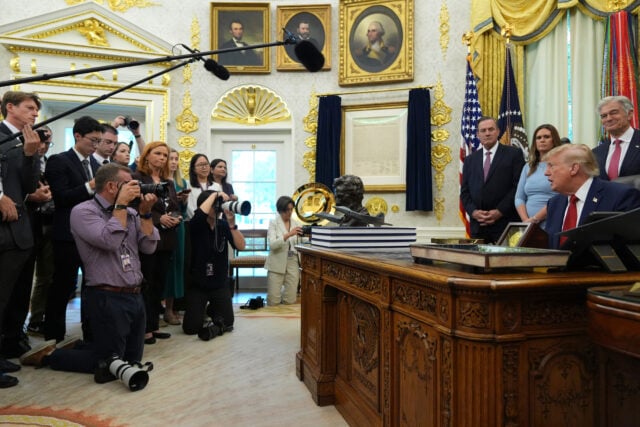
A central point of contention involves the White House press pool. The press pool is a small, rotating group of designated journalists. Space at presidential events, in the Oval Office, and on Air Force One is extremely limited. Because every reporter cannot fit, pool members share their dispatches, audio, and visual footage with everyone else. This system ensures the public receives continuous updates on presidential activity.
Tensions recently boiled over when the administration barred specific reporters and outlets from access. Instead of accepting the exclusions, other media organizations took immediate collective action. Competing television networks refused to provide substitute coverage for excluded colleagues. Even fierce rival newsrooms stood together in open solidarity.
Still photographers also joined the protest with striking visual resistance. Visual journalists understand that pictures shape public memory and historical records. To protest access restrictions, photographers lowered their lenses or refused to distribute official photo releases. They declined staged photo opportunities meant to produce flattering presidential imagery. By withholding pool photographs, they delivered a powerful message about press independence.

This battle over access is deeply anchored in long-standing legal battles. Decades of judicial precedent establish that the government cannot arbitrarily restrict press access. In the 1977 federal appellate ruling Sherrill v. Knight, the court addressed White House press passes. The court ruled that press credentials cannot be denied or revoked without clear standards and due process.
The Supreme Court has consistently protected journalists under the First Amendment. In Near v. Minnesota in 1931, the Court struck down prior restraints on the press. Forty years later, the landmark 1971 New York Times Co. v. United States decision affirmed robust reporting. In that case, known as the Pentagon Papers, the Court rejected government censorship. Justices affirmed that a free press serves the governed, not the governors.
Furthermore, Richmond Newspapers, Inc. v. Virginia in 1980 recognized the public’s right to attend trials. The Supreme Court underscored that listening and observing are vital aspects of press freedom. Courts have applied that same principle to governmental retaliations against specific critical reporters.
Federal judges reaffirmed this during Trump’s previous terms when officials stripped reporter credentials. In 2018, CNN successfully challenged the revocation of Jim Acosta’s hard pass. A federal judge ordered the press pass restored based on fundamental Fifth Amendment due process.
The friction between the presidency and the Fourth Estate is not entirely new. George Washington complained privately about harsh newspaper critics in his era. Richard Nixon maintained an enemies list targeting outspoken investigative journalists.
Yet today’s digital climate and direct attacks have created an unprecedented escalation. Reporters and photographers are showing that solidarity is their strongest defense. Both sides understand that this struggle is about much more than seating charts. It defines how accountable a president remains to the American public.
Sources Used:
- The Guardian — ‘It’s difficult to imagine a more blatant violation of the First Amendment’: criticism mounts over Trump’s media ban
- The New Republic — Trump Crashes Out Over Media Lawsuit as Press Pool Protest Grows
- American Civil Liberties Union (ACLU) — Trump’s Attacks on Press Freedom Escalate
- Justia U.S. Supreme Court Center — New York Times Co. v. United States, 403 U.S. 713 (1971)
- Justia U.S. Supreme Court Center — Richmond Newspapers, Inc. v. Virginia, 448 U.S. 555 (1980)
- Justia U.S. Court of Appeals for the D.C. Circuit Center — Sherrill v. Knight, 569 F.2d 124 (D.C. Cir. 1977)
Disclaimer
Artificial Intelligence Disclosure & Legal Disclaimer
AI Content Policy.
To provide our readers with timely and comprehensive coverage, South Florida Reporter uses artificial intelligence (AI) to assist in producing certain articles and visual content.
Articles: AI may be used to assist in research, structural drafting, or data analysis. All AI-assisted text is reviewed and edited by our team to ensure accuracy and adherence to our editorial standards.
Images: Any imagery generated or significantly altered by AI is clearly marked with a disclaimer or watermark to distinguish it from traditional photography or editorial illustrations.
General Disclaimer
The information contained in South Florida Reporter is for general information purposes only.
South Florida Reporter assumes no responsibility for errors or omissions in the contents of the Service. In no event shall South Florida Reporter be liable for any special, direct, indirect, consequential, or incidental damages or any damages whatsoever, whether in an action of contract, negligence or other tort, arising out of or in connection with the use of the Service or the contents of the Service.
The Company reserves the right to make additions, deletions, or modifications to the contents of the Service at any time without prior notice. The Company does not warrant that the Service is free of viruses or other harmful components.