Sleep is the most important part of your day, and most adults need seven to nine hours of sleep per day, yet more than one in three Americans get insufficient sleep on average (35.5%), with 14.5% of people having trouble falling asleep and 17.8% having trouble staying asleep most days or every day.
A bad night’s sleep can be caused by anything from noise and health to your surroundings and even light pollution. But does where you live determine how well you sleep?
Eager to find out, Alpine Hearing Protection, the experts in earmuffs and hearing protection for babies and children’s hearing in noisy environments, have revealed the US states where it’s hardest and easiest to get a good night’s sleep.
Study Highlights

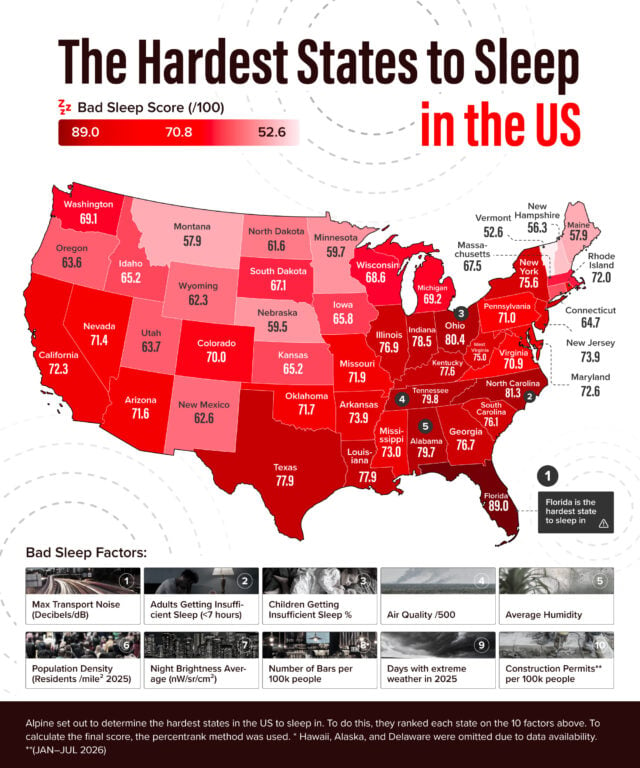
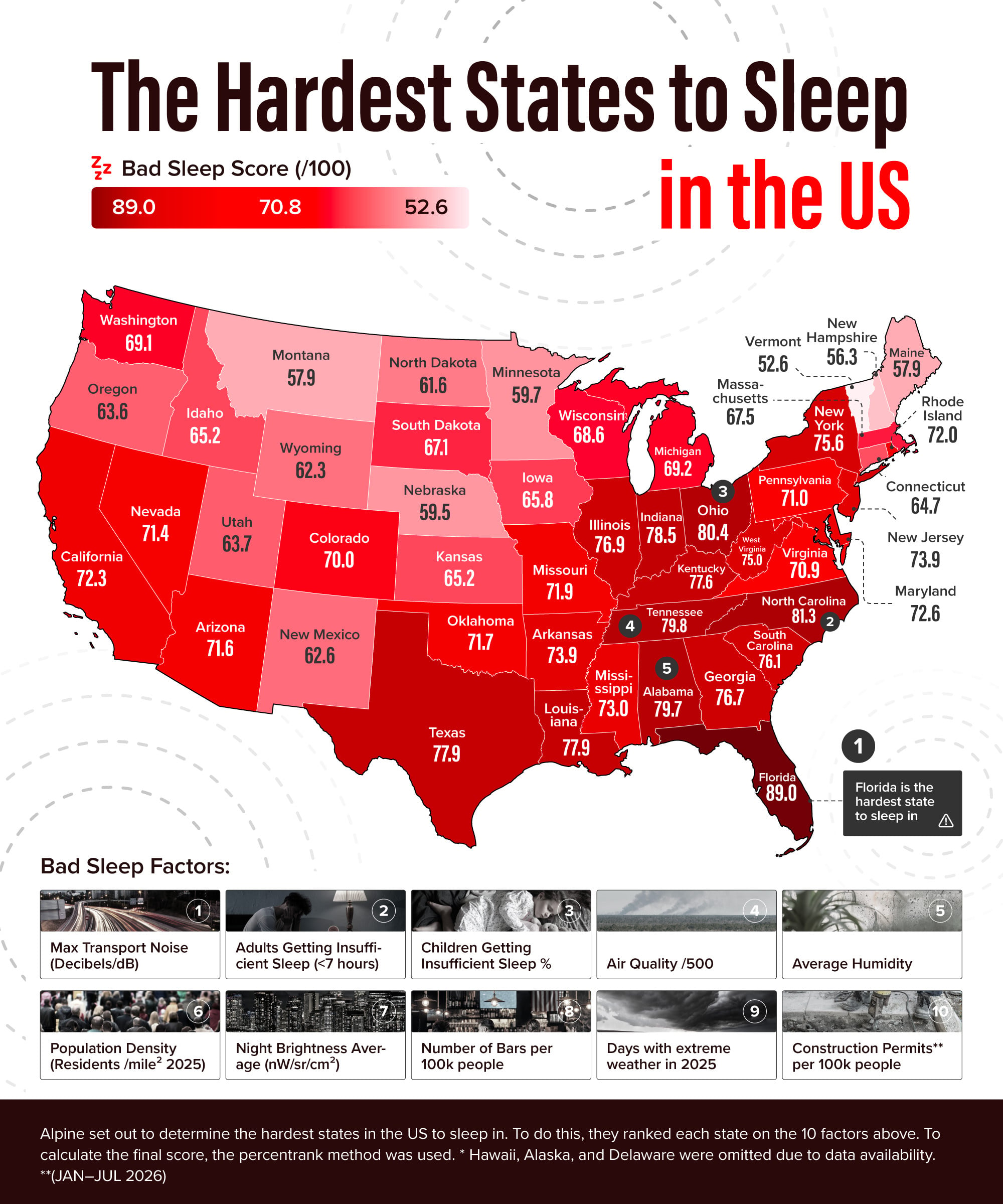
- Florida is the worst state for sleep, scoring 89 out of 100 for bad sleep
- Vermont is the best state for sleep, with a 52.6/100 bad sleep score
- Adults in West Virginia are the most sleep-deprived, with 41.3% getting insufficient sleep
- New Jersey has the worst light pollution at night at 6.599 nW/sr/cm²
- Colorado experienced 292 days with extreme weather in 2025
America’s Hardest States to Sleep In
Full dataset available here
Florida is the worst state for sleep
Alpine Hearing Protection can reveal that Florida is the hardest state to sleep in, scoring 89 out of 100 for bad sleep. 37.4% of adults in the state get insufficient sleep, as well as 35.9% of children. The Sunshine State boasts beautiful weather, but when the lights go out, the hot and humid nights can make it hard to fall and stay asleep. If the temperature is too high, the body struggles to lower its core temperature, making it difficult to fall asleep, increasing the number of nighttime awakenings, and reducing the amount of deep sleep you can get. Research has shown that temperatures above 70°F are likely to cause sleep disruptions, and humidity over 60% can increase nighttime awakenings too, but Florida’s average humidity is 74.5%, the second highest in the US.
Florida also gets very loud, with a max volume level of 68.3 decibels (dB). Orlando is the loudest city in the state with 63.1 dB, followed by Miami and Fort Lauderdale with 62.6 dB and then Jacksonville with 60.6. Florida is also home to 438 residents per one square mile; raising the volume, the nighttime brightness levels are at 2.994 (nW/sr/cm²) – the sixth highest in the US. In 2025, Florida experienced 176 days with extreme weather too, with the state particularly exposed to hurricanes, tropical storms, flooding, and extreme heat, all contributing to a bad night’s sleep, from physical barriers to anxiety from severe weather.
North Carolina’s growing population is fuelling construction noise
North Carolina lands in second place with a score of 81.3/100. 34.1% of adults in the state get insufficient sleep, as well as 37.4% of children. North Carolina scores particularly high for the number of construction permits per 100k people, with 509 – the third most in the US. The state is growing rapidly, with a staggering 7.2% increase in population from 2020 to 2025. This growth has fueled substantial development and construction across the state, increasing construction-related noise pollution and keeping residents awake.
Poor air quality in Ohio disturbs sleep
In third place, Ohio scores 80.4 out of 100 for bad sleep. 38.5% of adults and 35.9% of children get insufficient sleep in the state, with many factors obstructing sleep. Ohio ranks as the second-worst state for air quality with 48.2/500, where the higher the score, the worse the air quality. Air pollution can have significant health impacts, and breathing in pollutants can lead to inflammation and immunosuppression, as well as respiratory conditions, all of which heavily impact sleep quality.
The state also scores high for humidity with 71.5%, population density with 291 residents per square mile, and 41 bars per 100k people. Ohio is the seventh brightest state at night with an average of 2.497 nW/sr/cm².
Rounding out the top five is Tennessee in fourth with 79.8/100, followed by Alabama, with 79.7/100.
Vermont is the best state for a good night’s sleep
On the flip side, the best state for sleep is Vermont, scoring just a 52.6 out of 100 bad sleep score. Adults in Vermont are the least sleep-deprived, with just 29.6% of adults getting insufficient sleep. This could be a result of its great air quality at 38.5/500 – the second best in the US – alongside Vermont also having the second-quietest transport at just 55 dB. Night brightness is also low in the state, at just 0.169 nW/sr/cm², and only 68 days of extreme weather in 2025 kept Vermonters awake.
Harm de Groot, Lead Product Marketing in Sleep at Alpine Hearing Protection, rounds off the study: “Your sleep environment is probably the most important role to a good sleep, so if you live in a state that has external factors that make it difficult, making a few simple changes like keeping your bedroom dark, cool and quiet, with something such as SleepDeep earplugs, can help create better conditions for your sleep. If noise regularly disturbs you, earplugs can be a simple way to reduce unwanted sound.
When you’re struggling to sleep, the best approach is often to experiment with different ways of helping your body and mind wind down. Whether that means slowing your breathing, relaxing your muscles, occupying your mind with random images or reducing distractions around you, the key is to find an approach that feels calming rather than stressful.”
Miranda Belcher, registered nurse at healthcare staffing platform Nursa, comments on the impact of poor sleep on your health:
“Sleep is incredibly important for overall health, including the immune system. Studies show that people who don’t get quality or enough quality sleep are more likely to get sick; even one day of sleep deprivation can alter your immune system and increase inflammation in the body.
Surveys show that people who get seven and eight hours of sleep a night are more likely to experience better moods. Healthy adults need, on average, between seven and nine hours of sleep a night.”
Methodology:
- Alpine set out to determine the hardest states in the US to sleep in.
- To do this, they ranked each state on 10 factors:
- The US National Transportation Noise Map was collected for Continental U.S. road, rail, and aviation noise in 2022/2023. This was then spatially joined to a number of different TIGER/Line Shapefiles to get an average noise level of postal areas, most populated urban areas, counties, and states.
- The percentage of adults who reported sleeping, on average, less than seven hours in a 24-hour period was sourced from America’s Health Rankings.
- Insufficient sleep among children ages 4 months to 14 years was sourced from the CDC.
- Population, Air quality, and average humidity % were sourced from World Population Review.
- Population density was sourced from Statista (2025).
- Nighttime light pollution was sourced from Light Pollution Map (2020).
- The number of bars per 100k people was sourced from PoiData.io.
- Days of extreme weather, excluding drought was sourced from the National Centers for Environmental Information (2025).
- The Number of building permits issued per 100k people from January-July 2026 was sourced from the US Census Bureau.
- To calculate the final score, we used the percent rank method.
- All data is correct as of 9/2/2026
- The full dataset is available here.
- * Hawaii, Alaska, and Delaware were omitted due to data availability.
About Alpine Hearing Protection
Founded in the Netherlands in 1994, Alpine Hearing Protection is a global leader in innovative hearing protection for every age and occasion. A pioneer of reusable, filtered earplugs for the general public, Alpine has spent over 30 years on a mission to make healthy hearing accessible to all—guided by the belief that protecting your ears should be as simple as brushing your teeth.
Alpine’s award-winning product range spans earplugs and earmuffs for musicians, festival-goers, travelers, workers, children, and babies, combining Dutch design heritage with cutting-edge acoustic technology. The company has won eight Red Dot Design Awards and currently protects over 1.3 million pairs of ears worldwide. In 2024, Alpine achieved B Corp certification, reflecting its commitment to social and environmental responsibility. Most recently, Alpine was named FD Gazelle International 2026, recognizing it as one of the fastest-growing Dutch companies with an international footprint.
Headquartered in the Netherlands, Alpine products are available across the US, Europe, the UK, and globally through retail partners and at www.alpinehearingprotection.co.uk.
Own The Volume.
Disclaimer
Artificial Intelligence Disclosure & Legal Disclaimer
AI Content Policy.
To provide our readers with timely and comprehensive coverage, South Florida Reporter uses artificial intelligence (AI) to assist in producing certain articles and visual content.
Articles: AI may be used to assist in research, structural drafting, or data analysis. All AI-assisted text is reviewed and edited by our team to ensure accuracy and adherence to our editorial standards.
Images: Any imagery generated or significantly altered by AI is clearly marked with a disclaimer or watermark to distinguish it from traditional photography or editorial illustrations.
General Disclaimer
The information contained in South Florida Reporter is for general information purposes only.
South Florida Reporter assumes no responsibility for errors or omissions in the contents of the Service. In no event shall South Florida Reporter be liable for any special, direct, indirect, consequential, or incidental damages or any damages whatsoever, whether in an action of contract, negligence or other tort, arising out of or in connection with the use of the Service or the contents of the Service.
The Company reserves the right to make additions, deletions, or modifications to the contents of the Service at any time without prior notice. The Company does not warrant that the Service is free of viruses or other harmful components.