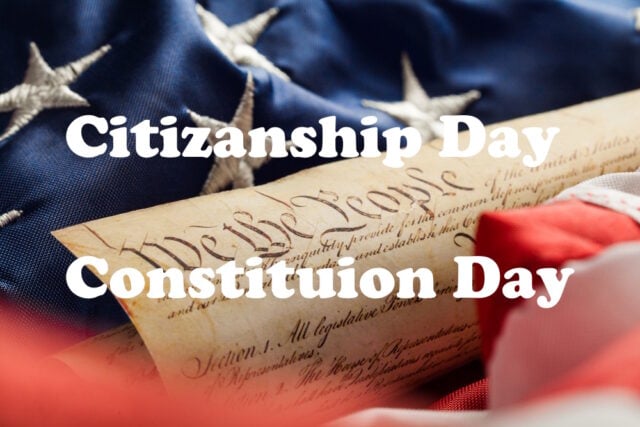
Constitution Day and Citizenship Day is an American federal observance (not a holiday) that commemorates the adoption of the Constitution of the United States and those who have become United States citizens. This day is observed each year on September 17.
- 1787 – Members of the U.S. Constitutional Convention signed the Constitution in 1787. The convention lasted from May 25 to September 17, 1787. 55 delegates debated the duties of the government, checks and balances, and the rights and freedoms of the people.
- 1787 – On December 7, 1787, Delaware became the first state to ratify the Constitution.
- 1788 – The U.S. Constitution took effect when New Hampshire became the ninth state to ratify it.
- 1789 – On November 26, 1789, President George Washington created the first national Thanksgiving Day to thank God for the Constitution.
- 1789 – Inspired by the American Revolution, the French took up arms against the monarchy, eventually toppling King Louis XVI.
- 1790 – Rhode Island didn’t send any delegates to the Constitutional Convention. As a result, they were the last state to ratify the Constitution on May 29, 1790.
- 1791 – The original Constitution did not describe individual rights. The first ten Amendments were added in 1791 and became known as the Bill of Rights.
- 1841 – When Vice President John Tyler assumed the presidency after William Harrison’s death, the Constitution provided no mechanism for the vice president to become president. Despite lacking Constitutional authority, Tyler assumed the presidency as has every succeeding vice president in the same position.
- 1868 – Under the 14th Amendment of the U.S. Constitution, citizenship is defined as “All persons born or naturalized in the United States, and subject to the jurisdiction thereof, are citizens of the United States and of the State wherein they reside.” Secretary of State William Seward proclaimed the amendment ratified on July 28, 1868.
- 1911 – when schools in Iowa first recognized Constitution Day.
- 1917 – The Sons of the American Revolution formed a committee to promote Constitution Day. Members included Calvin Coolidge, John D. Rockefeller, and General John Pershing.
- 1924 – The 15th and 19th Amendments define the rights of Black men and women to vote. However, it wasn’t until 1924 that all Native Americans were granted citizenship. Through the Indian Citizenship Act, many Native Americans could vote for the first time. Still, this legislation did not stop some states from preventing some from voting.
- 1939 – William Hearst began advocating for a holiday to celebrate citizenship. William Hearst owned a chain of newspapers and used these to build awareness for his idea.
- 1940 – President Franklin D. Roosevelt declared “I am an American Day,” and Congress designated the third Sunday in May to celebrate it.
- 1949 – The governors of all 48 states issued Constitution Day proclamations. On February 29, 1952, Congress changed the name from “I am an American Day” to “Citizenship Day” and moved its observance to September 17.
- 1954 – The original copy of the Constitution was placed in the Department of State in 1789 and was transferred to the Library of Congress in 1921. In 1954, it began its exhibit in the National Archives in Washington, DC.
- 1967 – It was only in 1967 that the 25th Amendment stated that the vice president technically becomes the president in cases of removal of the president from office, death, resignation or inability to discharge the powers of office.
- 2004 – The day was renamed Constitution Day and Citizenship Day.
- They divided the government into three branches: the legislative branch to make the laws; the executive to execute the laws, and the judicial to interpret the laws.
- Benjamin Franklin, Alexander Hamilton, James Madison, and George Washington all signed the Constitution.
- Three delegates—Elbridge Gerry, George Mason, and Edmund Randolph—declined to sign because they worried about the document’s lack of a Bill of Rights and other issues.
- Among the world’s major governments, the United States Constitution is both the shortest and the oldest constitution, with only 4,543 words.
- A Pennsylvania General Assembly Clerk named Jacob Shallus was paid $30 to pen the Constitution, which is about $1000 today.
- Not once in the Constitution does the word ‘democracy’ appear.
- The phrase “All men are created equal” is not in the Constitution. It is from the Declaration of Independence.
- Among the most glaring misspellings in the original Constitution was “Pensylvania”
- The famous Liberty’s Voice, Patrick Henry, did not sign the Constitution because he “smelt a rat.”
- Some very important Founding Fathers never actually signed the Constitution. Thomas Jefferson, for example, was away in Paris serving as an ambassador to France.
- Of 11,600 proposed amendments, only 27 have been ratified, making the chance of passing an amendment 0.23% — or, rounded down, 0.
- The Constitution faced significant opposition during ratification, with debates between Federalists and Anti-Federalists, leading to the addition of the Bill of Rights.
Here is a Citizenship test, how many can you get right?
Sources:

Disclaimer
Artificial Intelligence Disclosure & Legal Disclaimer
AI Content Policy.
To provide our readers with timely and comprehensive coverage, South Florida Reporter uses artificial intelligence (AI) to assist in producing certain articles and visual content.
Articles: AI may be used to assist in research, structural drafting, or data analysis. All AI-assisted text is reviewed and edited by our team to ensure accuracy and adherence to our editorial standards.
Images: Any imagery generated or significantly altered by AI is clearly marked with a disclaimer or watermark to distinguish it from traditional photography or editorial illustrations.
General Disclaimer
The information contained in South Florida Reporter is for general information purposes only.
South Florida Reporter assumes no responsibility for errors or omissions in the contents of the Service. In no event shall South Florida Reporter be liable for any special, direct, indirect, consequential, or incidental damages or any damages whatsoever, whether in an action of contract, negligence or other tort, arising out of or in connection with the use of the Service or the contents of the Service.
The Company reserves the right to make additions, deletions, or modifications to the contents of the Service at any time without prior notice. The Company does not warrant that the Service is free of viruses or other harmful components.