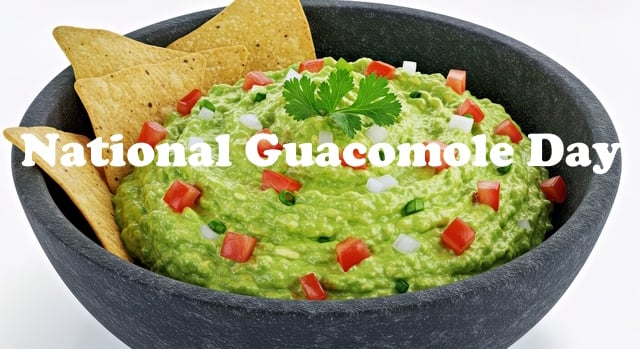
National Guacamole Day on September 16 brings fresh flavors together for the perfect celebration.
- 1920s – Salat avocado is a rural Israeli avocado salad, with lemon juice and chopped scallions (spring onions) with salt and black pepper added, was introduced by farmers who planted avocado trees on the coastal plain in the 1920s. Avocados have since become a winter delicacy and are cut into salads, as well as being spread on bread today, also with pita and flatbread.
- 1926 – The Hass avocado is the most popular varietal of avocado and is named after postal worker Rudolph Hass, who purchased the seedling in 1926 from a California farmer and patented it in 1935
- 1969 – The Apollo 11 astronauts brought guacamole to space! However, they did not eat it, since, according to Command Module Pilot Michael Collins, “that pig Buzz Aldrin ate all the chips before we even left Earth.”
- 2015 – Musician Jack White’s recipe for guacamole, included as part of his contract to perform at the University of Oklahoma in 2015, was obtained through a Freedom of Information Act request to the university.
- 2020 – The demand for avocados in the United States has continued to grow, with the country consuming over 1.9 million tons of the fruit in 2020 alone.
- 2024 – There are over 13.4 million avocado hashtags on Instagram.
- 2026 – Guinness World Record for the largest serving of guacamole is 27,879 pounds, set in Jalisco, Mexico, on June 18, 2026.
- Originating with the Aztecs in Mexico, guacamole is an avocado-based sauce that has become popular in American cuisine as a dip, condiment, and salad ingredient.
- Guacamole is Aztec for “Avocado Sauce”, the original recipe calls for crushed avocado, tomatoes and salt.
- Avocados are native to Central and South America.
- People have cultivated them for over 10,000 years.
- Another name for the avocado is the “alligator pear.”
- The Aztec word for avocado was ahuacatl, which means “testicle tree”.
- Spanish explorers could not pronounce ahuacatl, so they called the avocado “aguacate.” This is where the word guacamole comes from.
- In many South American countries, children rise on Easter to search for avocados hidden by Senor Bernardo, the happy winged cat
- Over 53 million pounds of Avocado will be consumed on Super Bowl Sunday.
- Avocado competes with buffalo wings and pizza as the Super Bowl food, thanks to a successful marketing campaign by avocado growers over the past 2 decades.
- Avocados are a unique fruit. They have a high-fat content, but this is “good” fat – monounsaturated fat.
- A whole avocado contains 200-300 calories and is a good source of vitamins A, C, E, and B vitamins, as well as fiber and potassium.
- Mantequilla de pobre (Spanish for “poor man’s butter”) is a mixture of avocado, tomato, oil, and citrus juice.
- In response to the New York Times publishing a guacamole recipe that includes peas, President Barack Obama tweeted, “Respect the NYT, but not buying peas in guac. onions, garlic, hot peppers, classic.”
- California is known as the ‘King of Avocado’ in the United States and accounts for over 90% of avocado production in the country
- About 100 million pounds of guacamole were eaten on Super Bowl Sunday, 2024, which is enough to cover a football field more than 20 feet thick.
- The avocado is a fruit, not a vegetable.
Sources:
Foodimentary

Days of the Year
Disclaimer
Artificial Intelligence Disclosure & Legal Disclaimer
AI Content Policy.
To provide our readers with timely and comprehensive coverage, South Florida Reporter uses artificial intelligence (AI) to assist in producing certain articles and visual content.
Articles: AI may be used to assist in research, structural drafting, or data analysis. All AI-assisted text is reviewed and edited by our team to ensure accuracy and adherence to our editorial standards.
Images: Any imagery generated or significantly altered by AI is clearly marked with a disclaimer or watermark to distinguish it from traditional photography or editorial illustrations.
General Disclaimer
The information contained in South Florida Reporter is for general information purposes only.
South Florida Reporter assumes no responsibility for errors or omissions in the contents of the Service. In no event shall South Florida Reporter be liable for any special, direct, indirect, consequential, or incidental damages or any damages whatsoever, whether in an action of contract, negligence or other tort, arising out of or in connection with the use of the Service or the contents of the Service.
The Company reserves the right to make additions, deletions, or modifications to the contents of the Service at any time without prior notice. The Company does not warrant that the Service is free of viruses or other harmful components.